Download Mendeley
p100/I kappa B delta sequesters and inhibits NF-kappa B through kappaBsome formation.
Tao, Z., Fusco, A., Huang, D.B., Gupta, K., Young Kim, D., Ware, C.F., Van Duyne, G.D., Ghosh, G.(2014) Proc Natl Acad Sci U S A 111: 15946-15951
- PubMed: 25349408 Search on PubMedSearch on PubMed Central
- DOI: https://doi.org/10.1073/pnas.1408552111
- Primary Citation Related Structures:
4OT9 - PubMed Abstract:
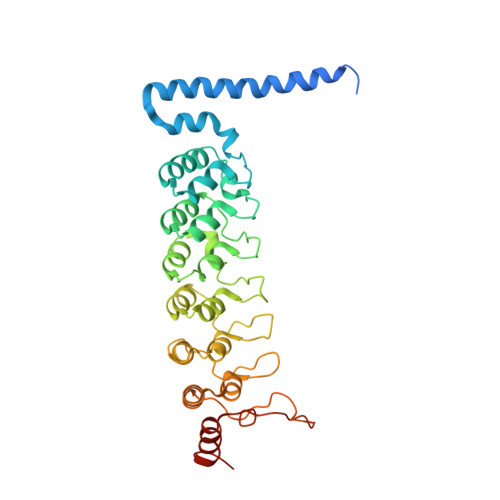
Degradation of I kappaB (κB) inhibitors is critical to activation of dimeric transcription factors of the NF-κB family. There are two types of IκB inhibitors: the prototypical IκBs (IκBα, IκBβ, and IκBε), which form low-molecular-weight (MW) IκB:NF-κB complexes that are highly stable, and the precursor IκBs (p105/IκBγ and p100/IκBδ), which form high-MW assemblies, thereby suppressing the activity of nearly half the cellular NF-κB [Savinova OV, Hoffmann A, Ghosh G (2009) Mol Cell 34(5):591-602]. The identity of these larger assemblies and their distinct roles in NF-κB inhibition are unknown. Using the X-ray crystal structure of the C-terminal domain of p100/IκBδ and functional analysis of structure-guided mutants, we show that p100/IκBδ forms high-MW (IκBδ)4:(NF-κB)4 complexes, referred to as kappaBsomes. These IκBδ-centric "kappaBsomes" are distinct from the 2:2 complexes formed by IκBγ. The stability of the IκBδ tetramer is enhanced upon association with NF-κB, and hence the high-MW assembly is essential for NF-κB inhibition. Furthermore, weakening of the IκBδ tetramer impairs both its association with NF-κB subunits and stimulus-dependent processing into p52. The unique ability of p100/IκBδ to stably interact with all NF-κB subunits by forming kappaBsomes demonstrates its importance in sequestering NF-κB subunits and releasing them as dictated by specific stimuli for developmental programs.
- Department of Chemistry and Biochemistry, University of California, San Diego, La Jolla, CA 92093;
Organizational Affiliation: