4OBQ | pdb_00004obq

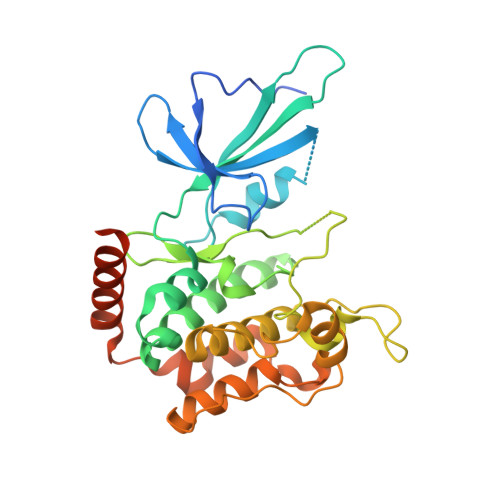
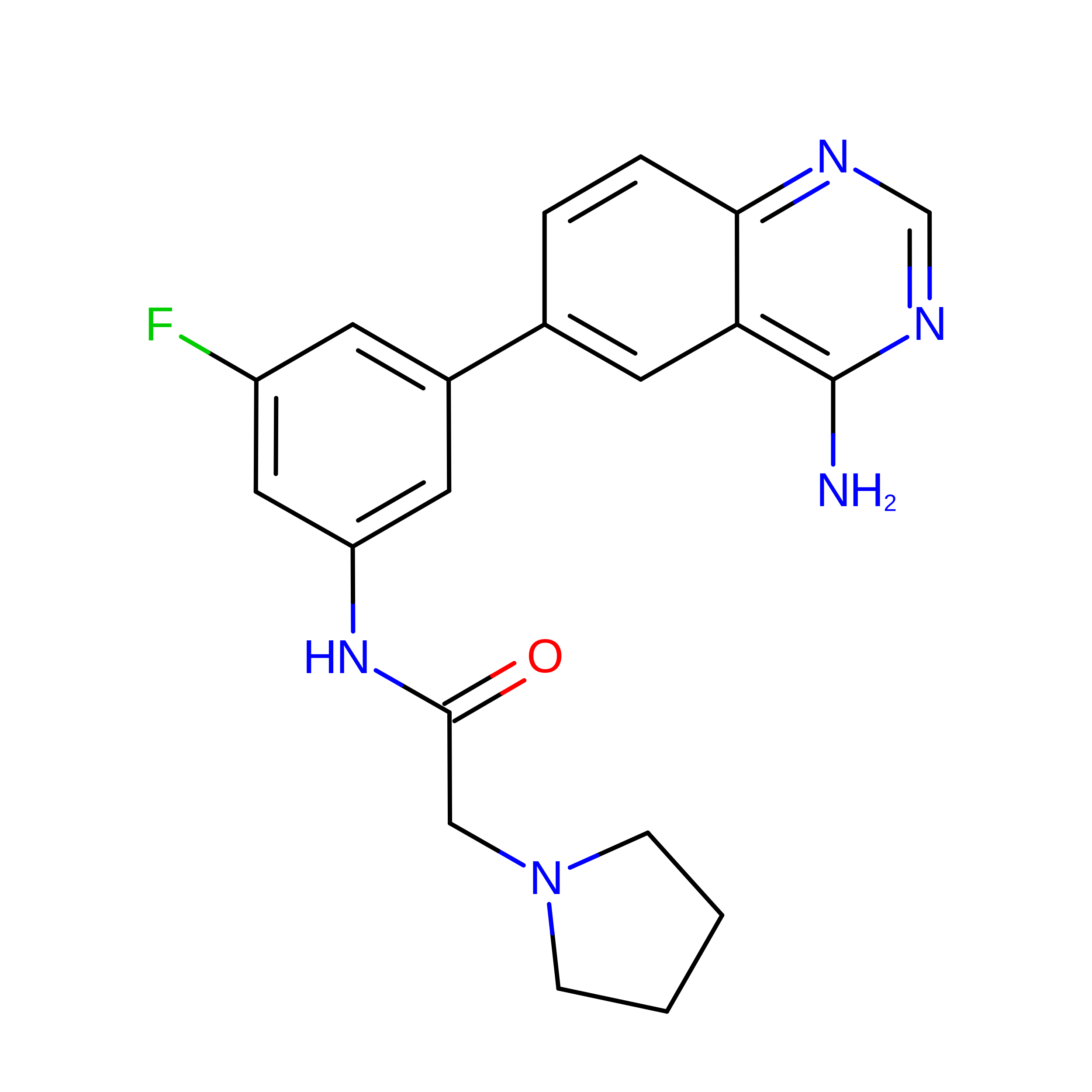
MAP4K4 in complex with inhibitor (compound 31), N-[3-(4-AMINOQUINAZOLIN-6-YL)-5-FLUOROPHENYL]-2-(PYRROLIDIN-1-YL)ACETAMIDE


Experimental Data Snapshot

  • Method: X-RAY DIFFRACTION
  • Resolution: 2.19 Å
  • R-Value Free: 
    0.240 (Depositor), 0.256 (DCC) 
  • R-Value Work: 
    0.205 (Depositor), 0.212 (DCC) 
  • R-Value Observed: 
    0.207 (Depositor) 

wwPDB Validation 3D Report Full Report

Validation slider image for 4OBQ

Ligand Structure Quality Assessment 


This is version 1.2 of the entry. See complete history

Literature

Discovery of Selective 4-Amino-pyridopyrimidine Inhibitors of MAP4K4 Using Fragment-Based Lead Identification and Optimization.

Crawford, T.D.Ndubaku, C.O.Chen, H.Boggs, J.W.Bravo, B.J.Delatorre, K.Giannetti, A.M.Gould, S.E.Harris, S.F.Magnuson, S.R.McNamara, E.Murray, L.J.Nonomiya, J.Sambrone, A.Schmidt, S.Smyczek, T.Stanley, M.Vitorino, P.Wang, L.West, K.Wu, P.Ye, W.

(2014) J Med Chem 57: 3484-3493

  • DOI: https://doi.org/10.1021/jm500155b
  • Primary Citation Related Structures: 
    4OBO, 4OBP, 4OBQ

  • PubMed Abstract: 

    Mitogen-activated protein kinase kinase kinase kinase 4 (MAP4K4) is a serine/threonine kinase implicated in the regulation of many biological processes. A fragment-based lead discovery approach was used to generate potent and selective MAP4K4 inhibitors. The fragment hit pursued in this article had excellent ligand efficiency (LE), an important attribute for subsequent successful optimization into drug-like lead compounds. The optimization efforts eventually led us to focus on the pyridopyrimidine series, from which 6-(2-fluoropyridin-4-yl)pyrido[3,2-d]pyrimidin-4-amine (29) was identified. This compound had low nanomolar potency, excellent kinase selectivity, and good in vivo exposure, and demonstrated in vivo pharmacodynamic effects in a human tumor xenograft model.


  • Organizational Affiliation
    • Genentech Inc., 1 DNA Way, South San Francisco, California 94080, United States.

Macromolecule Content 

  • Total Structure Weight: 76.33 kDa 
  • Atom Count: 4,868 
  • Modeled Residue Count: 568 
  • Deposited Residue Count: 664 
  • Unique protein chains: 1

Macromolecules

Find similar proteins by:|  3D Structure
Entity ID: 1
MoleculeChains  Sequence LengthOrganismDetailsImage
Mitogen-activated protein kinase kinase kinase kinase 4
A, B
332Homo sapiensMutation(s): 0 
Gene Names: HGKKIAA0687MAP4K4NIK
EC: 2.7.11.1
UniProt & NIH Common Fund Data Resources
Find proteins for O95819 (Homo sapiens)
Explore O95819 
Go to UniProtKB:  O95819
PHAROS:  O95819
GTEx:  ENSG00000071054 
Entity Groups
Sequence Clusters30% Identity50% Identity70% Identity90% Identity95% Identity100% Identity
UniProt GroupO95819
Sequence Annotations
Expand
Reference Sequence

Small Molecules

Ligands 3 Unique
IDChains Name / Formula / InChI Key2D Diagram3D Interactions
2QT

Query on 2QT


Download:Ideal Coordinates CCD File
E [auth A]N-[3-(4-aminoquinazolin-6-yl)-5-fluorophenyl]-2-(pyrrolidin-1-yl)acetamide
C20 H20 F N5 O
GDCGMGVDMXRLGC-UHFFFAOYSA-N
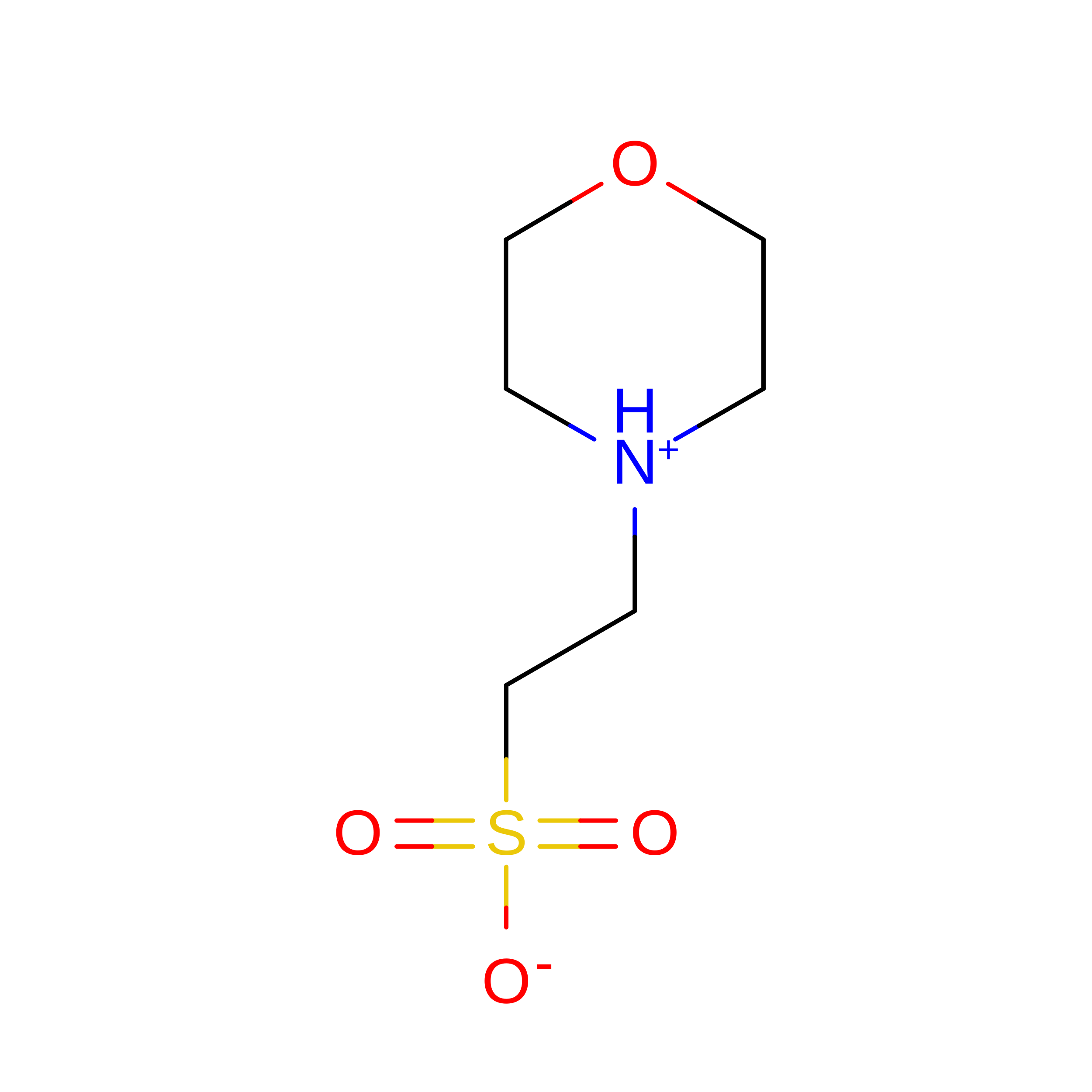
MES

Query on MES


Download:Ideal Coordinates CCD File
C [auth A]2-(N-MORPHOLINO)-ETHANESULFONIC ACID
C6 H13 N O4 S
SXGZJKUKBWWHRA-UHFFFAOYSA-N
MG

Query on MG


Download:Ideal Coordinates CCD File
D [auth A]MAGNESIUM ION
Mg
JLVVSXFLKOJNIY-UHFFFAOYSA-N

Experimental Data & Validation

Experimental Data

  • Method: X-RAY DIFFRACTION
  • Resolution: 2.19 Å
  • R-Value Free:  0.240 (Depositor), 0.256 (DCC) 
  • R-Value Work:  0.205 (Depositor), 0.212 (DCC) 
  • R-Value Observed: 0.207 (Depositor) 
Space Group: P 21 21 21
Unit Cell:
Length ( Å )Angle ( ˚ )
a = 80.228α = 90
b = 86.911β = 90
c = 91.499γ = 90
Software Package:
Software NamePurpose
SCALAdata scaling
PHASERphasing
BUSTER-TNTrefinement
PDB_EXTRACTdata extraction
BUSTERrefinement

Structure Validation

View Full Validation Report


Ligand Structure Quality Assessment 


Entry History 

Deposition Data

Revision History  (Full details and data files)

  • Version 1.0: 2014-04-23
    Type: Initial release
  • Version 1.1: 2014-05-07
    Changes: Database references
  • Version 1.2: 2024-02-28
    Changes: Data collection, Database references, Derived calculations