4O5L | pdb_00004o5l

Crystal structure of broadly neutralizing antibody F045-092


Experimental Data Snapshot

  • Method: X-RAY DIFFRACTION
  • Resolution: 1.50 Å
  • R-Value Free: 
    0.207 (Depositor), 0.210 (DCC) 
  • R-Value Work: 
    0.174 (Depositor), 0.178 (DCC) 
  • R-Value Observed: 
    0.176 (Depositor) 

Starting Model: experimental
View more details

wwPDB Validation 3D Report Full Report

Validation slider image for 4O5L

This is version 1.4 of the entry. See complete history

Literature

Receptor mimicry by antibody F045-092 facilitates universal binding to the H3 subtype of influenza virus.

Lee, P.S.Ohshima, N.Stanfield, R.L.Yu, W.Iba, Y.Okuno, Y.Kurosawa, Y.Wilson, I.A.

(2014) Nat Commun 5: 3614-3614

  • DOI: https://doi.org/10.1038/ncomms4614
  • Primary Citation Related Structures: 
    4O58, 4O5I, 4O5L, 4O5N

  • PubMed Abstract: 

    Influenza viruses present a significant health challenge each year, as in the H3N2 epidemic of 2012-2013. Here we describe an antibody, F045-092, that possesses broadly neutralizing activity against the entire H3 subtype and accommodates the natural variation and additional glycosylation in all strains tested from 1963 to 2011. Crystal structures of F045-092 in complex with HAs from 1975 and 2011 H3N2 viruses reveal the structural basis for its neutralization breadth through insertion of its 23-residue HCDR3 into the receptor-binding site that involves striking receptor mimicry. F045-092 extends its recognition to divergent subtypes, including H1, H2 and H13, using the enhanced avidity of its IgG to overcome lower-affinity Fab binding, as observed with other antibodies that target the receptor-binding site. This unprecedented level of antibody cross-reactivity against the H3 subtype can potentially inform on development of a pan-H3 vaccine or small-molecule therapeutics.


  • Organizational Affiliation
    • 1] Department of Integrative Structural and Computational Biology, The Scripps Research Institute, La Jolla, California 92037, USA [2] The Skaggs Institute of Chemical Biology, The Scripps Research Institute, La Jolla, California 92037, USA.

Macromolecule Content 

  • Total Structure Weight: 49.9 kDa 
  • Atom Count: 3,898 
  • Modeled Residue Count: 449 
  • Deposited Residue Count: 470 
  • Unique protein chains: 2

Macromolecules

Find similar proteins by:|  3D Structure
Entity ID: 1
MoleculeChains  Sequence LengthOrganismDetailsImage
Fab F045-092 light chainA [auth L]230Homo sapiensMutation(s): 0 
UniProt & NIH Common Fund Data Resources
Find proteins for P0DOY3 (Homo sapiens)
Explore P0DOY3 
Go to UniProtKB:  P0DOY3
GTEx:  ENSG00000211679 
Entity Groups
Sequence Clusters30% Identity50% Identity70% Identity90% Identity95% Identity100% Identity
UniProt GroupP0DOY3
Sequence Annotations
Expand
Reference Sequence
Find similar proteins by:|  3D Structure
Entity ID: 2
MoleculeChains  Sequence LengthOrganismDetailsImage
Fab F045-092 heavy chainB [auth H]240Homo sapiensMutation(s): 0 
UniProt
Find proteins for A8K008 (Homo sapiens)
Explore A8K008 
Go to UniProtKB:  A8K008
Entity Groups
Sequence Clusters30% Identity50% Identity70% Identity90% Identity95% Identity100% Identity
UniProt GroupA8K008
Sequence Annotations
Expand
Reference Sequence

Small Molecules

Ligands 1 Unique
IDChains Name / Formula / InChI Key2D Diagram3D Interactions
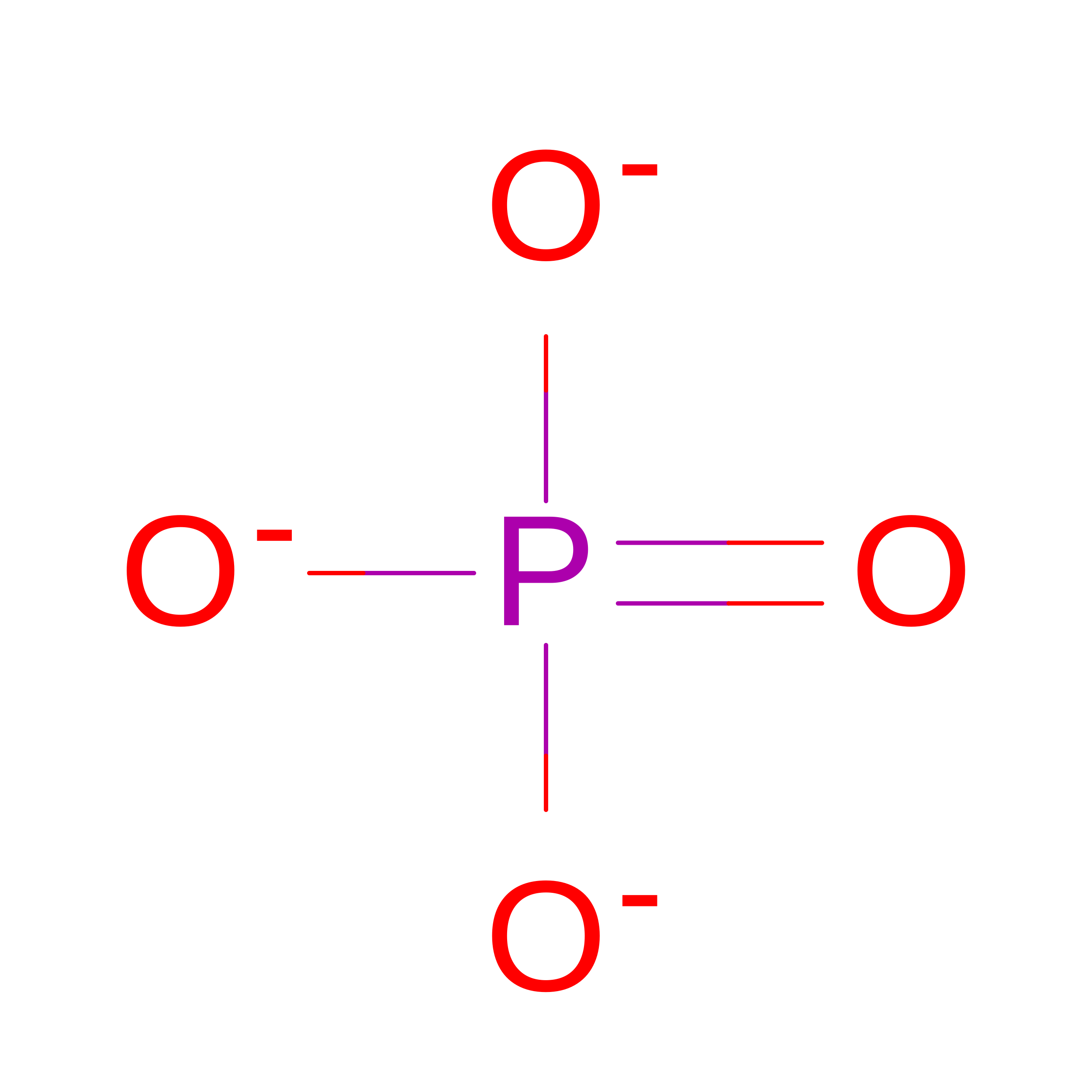
PO4

Query on PO4


Download:Ideal Coordinates CCD File
C [auth L]PHOSPHATE ION
O4 P
NBIIXXVUZAFLBC-UHFFFAOYSA-K

Experimental Data & Validation

Experimental Data

  • Method: X-RAY DIFFRACTION
  • Resolution: 1.50 Å
  • R-Value Free:  0.207 (Depositor), 0.210 (DCC) 
  • R-Value Work:  0.174 (Depositor), 0.178 (DCC) 
  • R-Value Observed: 0.176 (Depositor) 
Space Group: P 21 21 21
Unit Cell:
Length ( Å )Angle ( ˚ )
a = 69.515α = 90
b = 77.278β = 90
c = 81.451γ = 90
Software Package:
Software NamePurpose
Blu-Icedata collection
PHASERphasing
PHENIXrefinement
XDSdata reduction
XDSdata scaling

Structure Validation

View Full Validation Report


Entry History 

Deposition Data

Revision History  (Full details and data files)

  • Version 1.0: 2014-04-16
    Type: Initial release
  • Version 1.1: 2014-05-14
    Changes: Database references
  • Version 1.2: 2017-06-21
    Changes: Database references, Source and taxonomy, Structure summary
  • Version 1.3: 2023-09-20
    Changes: Data collection, Database references, Derived calculations, Refinement description
  • Version 1.4: 2024-11-06
    Changes: Structure summary