4O4Y | pdb_00004o4y

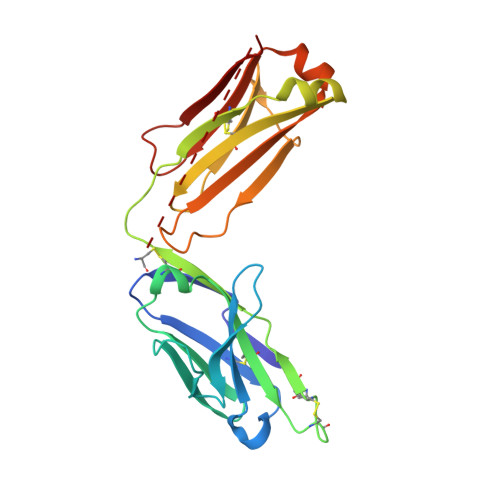
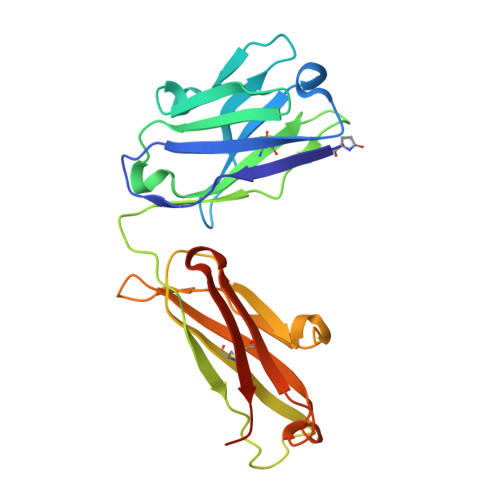
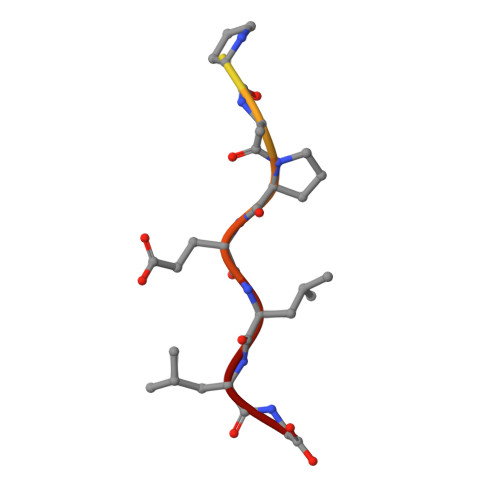
Crystal structure of the anti-hinge rabbit antibody 2095-2 in complex with IDES hinge peptide


Experimental Data Snapshot

  • Method: X-RAY DIFFRACTION
  • Resolution: 1.85 Å
  • R-Value Free: 
    0.237 (Depositor), 0.251 (DCC) 
  • R-Value Work: 
    0.192 (Depositor), 0.206 (DCC) 
  • R-Value Observed: 
    0.194 (Depositor) 

Starting Model: experimental
View more details

wwPDB Validation 3D Report Full Report

Validation slider image for 4O4Y

This is version 2.2 of the entry. See complete history

Literature

Structure and specificity of an antibody targeting a proteolytically cleaved IgG hinge.

Malia, T.J.Teplyakov, A.Brezski, R.J.Luo, J.Kinder, M.Sweet, R.W.Almagro, J.C.Jordan, R.E.Gilliland, G.L.

(2014) Proteins 82: 1656-1667

  • DOI: https://doi.org/10.1002/prot.24545
  • Primary Citation Related Structures: 
    4MA3, 4O4Y, 4O51

  • PubMed Abstract: 

    The functional role of human antihinge (HAH) autoantibodies in normal health and disease remains elusive, but recent evidence supports their role in the host response to IgG cleavage by proteases that are prevalent in certain disorders. Characterization and potential exploitation of these HAH antibodies has been hindered by the absence of monoclonal reagents. 2095-2 is a rabbit monoclonal antibody targeting the IdeS-cleaved hinge of human IgG1. We have determined the crystal structure of the Fab of 2095-2 and its complex with a hinge analog peptide. The antibody is selective for the C-terminally cleaved hinge ending in G236 and this interaction involves an uncommon disulfide in VL CDR3. We probed the importance of the disulfide in VL CDR3 through engineering variants. We identified one variant, QAA, which does not require the disulfide for biological activity or peptide binding. The structure of this variant offers a starting point for further engineering of 2095-2 with the same specificity, but lacking the potential manufacturing liability of an additional disulfide. Proteins 2014; 82:1656-1667. © 2014 Wiley Periodicals, Inc.


  • Organizational Affiliation
    • Biologics Research, Janssen Research and Development, LLC, Spring House, Pennsylvania.

Macromolecule Content 

  • Total Structure Weight: 49.15 kDa 
  • Atom Count: 3,931 
  • Modeled Residue Count: 441 
  • Deposited Residue Count: 457 
  • Unique protein chains: 3

Macromolecules

Find similar proteins by:|  3D Structure
Entity ID: 1
MoleculeChains  Sequence LengthOrganismDetailsImage
2095-2 light chainA [auth L]220Oryctolagus cuniculusHomo sapiens
This entity is chimeric
Mutation(s): 0 
Find similar proteins by:|  3D Structure
Entity ID: 2
MoleculeChains  Sequence LengthOrganismDetailsImage
2095-2 heavy chainB [auth H]223Oryctolagus cuniculusHomo sapiens
This entity is chimeric
Mutation(s): 0 
Find similar proteins by:  Sequence   |   3D Structure  
Entity ID: 3
MoleculeChains  Sequence LengthOrganismDetailsImage
IDES hinge peptideC [auth A]14Homo sapiensMutation(s): 0 
UniProt & NIH Common Fund Data Resources
Find proteins for P01857 (Homo sapiens)
Explore P01857 
Go to UniProtKB:  P01857
PHAROS:  P01857
GTEx:  ENSG00000211896 
Entity Groups
Sequence Clusters30% Identity50% Identity70% Identity90% Identity95% Identity100% Identity
UniProt GroupP01857
Sequence Annotations
Expand
Reference Sequence

Experimental Data & Validation

Experimental Data

  • Method: X-RAY DIFFRACTION
  • Resolution: 1.85 Å
  • R-Value Free:  0.237 (Depositor), 0.251 (DCC) 
  • R-Value Work:  0.192 (Depositor), 0.206 (DCC) 
  • R-Value Observed: 0.194 (Depositor) 
Space Group: P 21 21 2
Unit Cell:
Length ( Å )Angle ( ˚ )
a = 64.41α = 90
b = 89.37β = 90
c = 83.39γ = 90
Software Package:
Software NamePurpose
CrystalCleardata collection
PHASERphasing
REFMACrefinement
d*TREKdata reduction
d*TREKdata scaling

Structure Validation

View Full Validation Report


Entry History 

Deposition Data

Revision History  (Full details and data files)

  • Version 1.0: 2014-03-26
    Type: Initial release
  • Version 1.1: 2014-04-02
    Changes: Database references
  • Version 1.2: 2014-08-06
    Changes: Database references
  • Version 2.0: 2019-12-25
    Changes: Derived calculations, Polymer sequence
  • Version 2.1: 2023-09-20
    Changes: Data collection, Database references, Derived calculations, Refinement description
  • Version 2.2: 2024-10-30
    Changes: Structure summary