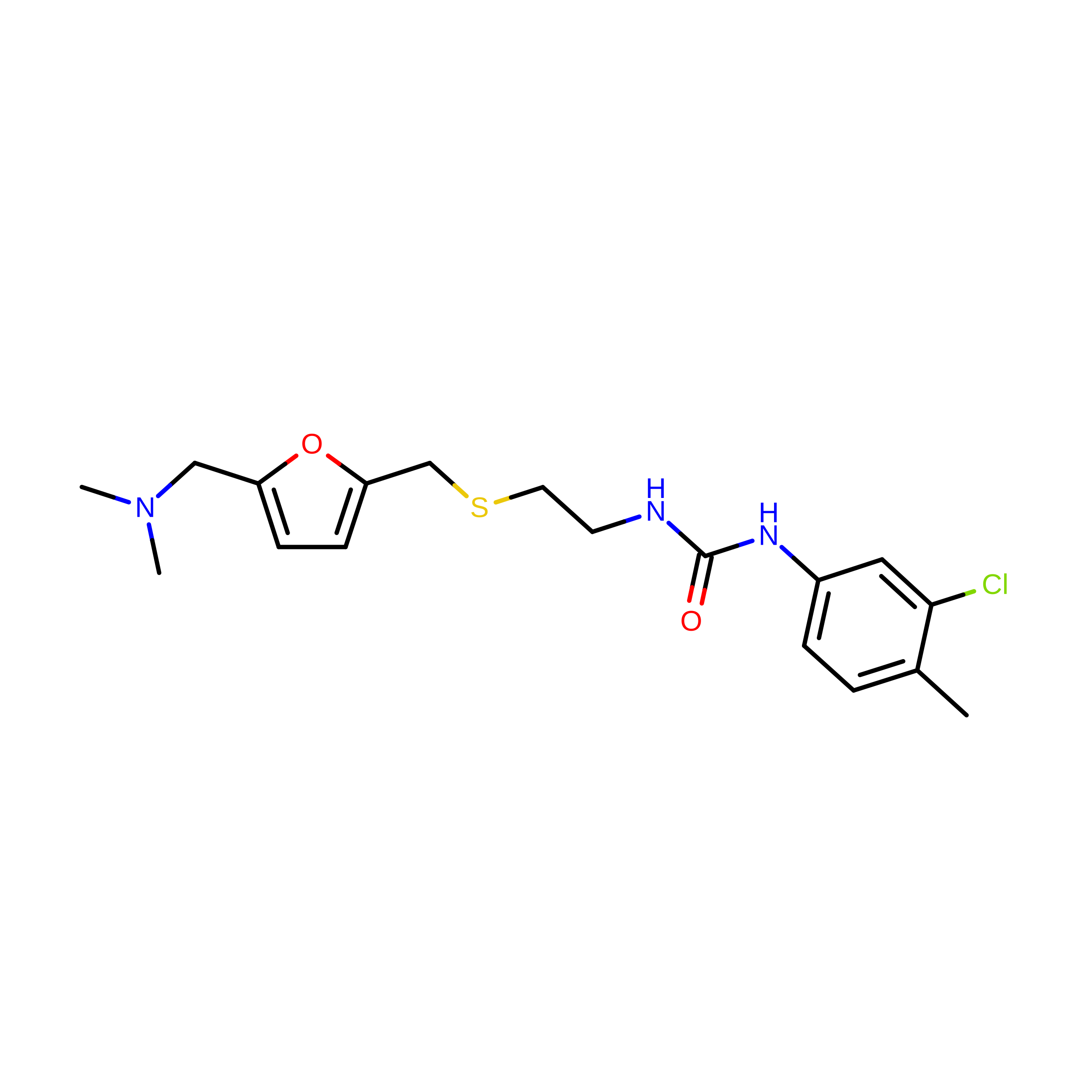
4NX4 | pdb_00004nx4

Re-refinement of CAP-1 HIV-CA complex


Experimental Data Snapshot

  • Method: X-RAY DIFFRACTION
  • Resolution: 1.50 Å
  • R-Value Free: 
    0.191 (Depositor), 0.190 (DCC) 
  • R-Value Work: 
    0.145 (Depositor), 0.148 (DCC) 
  • R-Value Observed: 
    0.147 (Depositor) 

wwPDB Validation 3D Report Full Report

Validation slider image for 4NX4

Ligand Structure Quality Assessment 


This is version 1.1 of the entry. See complete history

Re-refinement Note

This entry reflects an alternative modeling of the original data in: 2PXR

Literature

Protein structural ensembles are revealed by redefining X-ray electron density noise.

Lang, P.T.Holton, J.M.Fraser, J.S.Alber, T.

(2014) Proc Natl Acad Sci U S A 111: 237-242

  • DOI: https://doi.org/10.1073/pnas.1302823110
  • Primary Citation Related Structures: 
    4NX4

  • PubMed Abstract: 

    To increase the power of X-ray crystallography to determine not only the structures but also the motions of biomolecules, we developed methods to address two classic crystallographic problems: putting electron density maps on the absolute scale of e(-)/Å(3) and calculating the noise at every point in the map. We find that noise varies with position and is often six to eight times lower than thresholds currently used in model building. Analyzing the rescaled electron density maps from 485 representative proteins revealed unmodeled conformations above the estimated noise for 45% of side chains and a previously hidden, low-occupancy inhibitor of HIV capsid protein. Comparing the electron density maps in the free and nucleotide-bound structures of three human protein kinases suggested that substrate binding perturbs distinct intrinsic allosteric networks that link the active site to surfaces that recognize regulatory proteins. These results illustrate general approaches to identify and analyze alternative conformations, low-occupancy small molecules, solvent distributions, communication pathways, and protein motions.


  • Organizational Affiliation
    • Department of Molecular and Cell Biology, University of California, Berkeley, CA 94720.

Macromolecule Content 

  • Total Structure Weight: 16.75 kDa 
  • Atom Count: 1,442 
  • Modeled Residue Count: 145 
  • Deposited Residue Count: 146 
  • Unique protein chains: 1

Macromolecules

Find similar proteins by:|  3D Structure
Entity ID: 1
MoleculeChains  Sequence LengthOrganismDetailsImage
Gag-Pol polyproteinA [auth C]146Human immunodeficiency virus type 1 (NEW YORK-5 ISOLATE)Mutation(s): 0 
UniProt
Find proteins for P12497 (Human immunodeficiency virus type 1 group M subtype B (isolate NY5))
Explore P12497 
Go to UniProtKB:  P12497
Entity Groups
Sequence Clusters30% Identity50% Identity70% Identity90% Identity95% Identity100% Identity
UniProt GroupP12497
Sequence Annotations
Expand
Reference Sequence

Small Molecules

Binding Affinity Annotations 
IDSourceBinding Affinity
JPR BindingDB:  4NX4 Kd: 8.00e+5 (nM) from 1 assay(s)
IC50: 6.00e+4 (nM) from 1 assay(s)

Experimental Data & Validation

Experimental Data

  • Method: X-RAY DIFFRACTION
  • Resolution: 1.50 Å
  • R-Value Free:  0.191 (Depositor), 0.190 (DCC) 
  • R-Value Work:  0.145 (Depositor), 0.148 (DCC) 
  • R-Value Observed: 0.147 (Depositor) 
Space Group: C 2 2 21
Unit Cell:
Length ( Å )Angle ( ˚ )
a = 42.187α = 90
b = 62.777β = 90
c = 106.286γ = 90
Software Package:
Software NamePurpose
PHENIXrefinement

Structure Validation

View Full Validation Report


Ligand Structure Quality Assessment 


Entry History 

Deposition Data

Revision History  (Full details and data files)

  • Version 1.0: 2014-02-26
    Type: Initial release
  • Version 1.1: 2024-02-28
    Changes: Data collection, Database references, Derived calculations