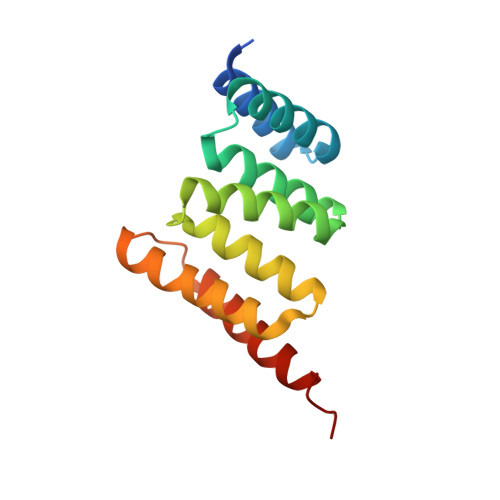
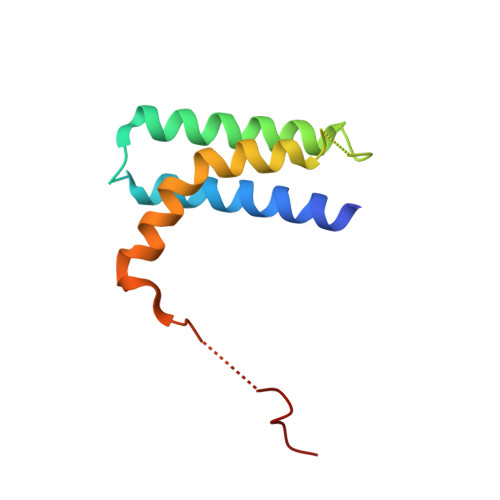
4KBQ | pdb_00004kbq

Structure of the CHIP-TPR domain in complex with the Hsc70 Lid-Tail domains


Experimental Data Snapshot

  • Method: X-RAY DIFFRACTION
  • Resolution: 2.91 Å
  • R-Value Free: 
    0.263 (Depositor), 0.266 (DCC) 
  • R-Value Work: 
    0.224 (Depositor), 0.229 (DCC) 
  • R-Value Observed: 
    0.227 (Depositor) 

Starting Models: experimental
View more details

wwPDB Validation 3D Report Full Report

Validation slider image for 4KBQ

This is version 1.3 of the entry. See complete history

Literature

A Bipartite Interaction between Hsp70 and CHIP Regulates Ubiquitination of Chaperoned Client Proteins.

Zhang, H.Amick, J.Chakravarti, R.Santarriaga, S.Schlanger, S.McGlone, C.Dare, M.Nix, J.C.Scaglione, K.M.Stuehr, D.J.Misra, S.Page, R.C.

(2015) Structure 23: 472-482

  • DOI: https://doi.org/10.1016/j.str.2015.01.003
  • Primary Citation Related Structures: 
    4KBQ

  • PubMed Abstract: 

    The ubiquitin ligase CHIP plays an important role in cytosolic protein quality control by ubiquitinating proteins chaperoned by Hsp70/Hsc70 and Hsp90, thereby targeting such substrate proteins for degradation. We present a 2.91 Å resolution structure of the tetratricopeptide repeat (TPR) domain of CHIP in complex with the α-helical lid subdomain and unstructured tail of Hsc70. Surprisingly, the CHIP-TPR interacts with determinants within both the Hsc70-lid subdomain and the C-terminal PTIEEVD motif of the tail, exhibiting an atypical mode of interaction between chaperones and TPR domains. We demonstrate that the interaction between CHIP and the Hsc70-lid subdomain is required for proper ubiquitination of Hsp70/Hsc70 or Hsp70/Hsc70-bound substrate proteins. Posttranslational modifications of the Hsc70 lid and tail disrupt key contacts with the CHIP-TPR and may regulate CHIP-mediated ubiquitination. Our study shows how CHIP docks onto Hsp70/Hsc70 and defines a bipartite mode of interaction between TPR domains and their binding partners.


  • Organizational Affiliation
    • Department of Chemistry and Biochemistry, Miami University, Oxford, OH 45056, USA.

Macromolecule Content 

  • Total Structure Weight: 54.62 kDa 
  • Atom Count: 3,559 
  • Modeled Residue Count: 434 
  • Deposited Residue Count: 480 
  • Unique protein chains: 2

Macromolecules

Find similar proteins by:|  3D Structure
Entity ID: 1
MoleculeChains  Sequence LengthOrganismDetailsImage
E3 ubiquitin-protein ligase CHIP
A, B
139Homo sapiensMutation(s): 0 
Gene Names: CHIPPP1131STUB1
EC: 6.3.2 (PDB Primary Data), 2.3.2.27 (UniProt)
UniProt & NIH Common Fund Data Resources
Find proteins for Q9UNE7 (Homo sapiens)
Explore Q9UNE7 
Go to UniProtKB:  Q9UNE7
PHAROS:  Q9UNE7
GTEx:  ENSG00000103266 
Entity Groups
Sequence Clusters30% Identity50% Identity70% Identity90% Identity95% Identity100% Identity
UniProt GroupQ9UNE7
Sequence Annotations
Expand
Reference Sequence
Find similar proteins by:|  3D Structure
Entity ID: 2
MoleculeChains  Sequence LengthOrganismDetailsImage
Heat shock cognate 71 kDa proteinC [auth D],
D [auth C]
101Homo sapiensMutation(s): 0 
Gene Names: HSC70HSP73HSPA10HSPA8
EC: 3.6.4.10
UniProt & NIH Common Fund Data Resources
Find proteins for P11142 (Homo sapiens)
Explore P11142 
Go to UniProtKB:  P11142
PHAROS:  P11142
GTEx:  ENSG00000109971 
Entity Groups
Sequence Clusters30% Identity50% Identity70% Identity90% Identity95% Identity100% Identity
UniProt GroupP11142
Sequence Annotations
Expand
Reference Sequence

Experimental Data & Validation

Experimental Data

  • Method: X-RAY DIFFRACTION
  • Resolution: 2.91 Å
  • R-Value Free:  0.263 (Depositor), 0.266 (DCC) 
  • R-Value Work:  0.224 (Depositor), 0.229 (DCC) 
  • R-Value Observed: 0.227 (Depositor) 
Space Group: P 61 2 2
Unit Cell:
Length ( Å )Angle ( ˚ )
a = 78.5α = 90
b = 78.5β = 90
c = 424.7γ = 120
Software Package:
Software NamePurpose
ADSCdata collection
PHENIXmodel building
PHENIXrefinement
HKL-3000data reduction
SCALAdata scaling
PHENIXphasing

Structure Validation

View Full Validation Report


Entry History 

Deposition Data

Revision History  (Full details and data files)

  • Version 1.0: 2015-01-14
    Type: Initial release
  • Version 1.1: 2015-03-04
    Changes: Database references
  • Version 1.2: 2015-03-18
    Changes: Database references
  • Version 1.3: 2023-09-20
    Changes: Data collection, Database references, Refinement description