Download Mendeley
Increase in activation rate of Pro-Tk-subtilisin by a single nonpolar-to-polar amino acid substitution at the hydrophobic core of the propeptide domain
Yuzaki, K., Sanda, Y., You, D.J., Uehara, R., Koga, Y., Kanaya, S.(2013) Protein Sci 22: 1711-1721
- PubMed: 24115021 Search on PubMedSearch on PubMed Central
- DOI: https://doi.org/10.1002/pro.2371
- Primary Citation Related Structures:
4JP8 - PubMed Abstract:
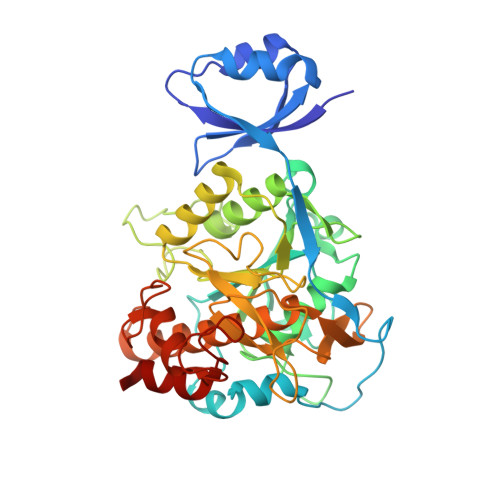
Tk-subtilisin (Gly70-Gly398) is a subtilisin homolog from Thermococcus kodakarensis. Active Tk-subtilisin is produced from its inactive precursor, Pro-Tk-subtilisin (Gly1-Gly398), by autoprocessing and degradation of the propeptide (Tk-propeptide, Gly1-Leu69). This activation process is extremely slow at moderate temperatures owing to high stability of Tk-propeptide. Tk-propeptide is stabilized by the hydrophobic core. To examine whether a single nonpolar-to-polar amino acid substitution at this core affects the activation rate of Pro-Tk-subtilisin, the Pro-Tk-subtilisin derivative with the Phe17 → His mutation (Pro-F17H), Tk-propeptide derivative with the same mutation (F17H-propeptide), and two active-site mutants of Pro-F17H (Pro-F17H/S324A and Pro-F17H/S324C) were constructed. The crystal structure of Pro-F17H/S324A was nearly identical to that of Pro-S324A, indicating that the mutation does not affect the structure of Pro-Tk-subtilisin. The refolding rate of Pro-F17H/S324A and autoprocessing rate of Pro-F17H/S324C were also nearly identical to those of their parent proteins (Pro-S324A and Pro-S324C). However, the activation rate of Pro-F17H greatly increased when compared with that of Pro-Tk-subtilisin, such that Pro-F17H is efficiently activated even at 40°C. The far-UV circular dichroism spectrum of F17H-propeptide did not exhibit a broad trough at 205-230 nm, which is observed in the spectrum of Tk-propeptide. F17H-propeptide is more susceptible to chymotryptic degradation than Tk-propeptide. These results suggest that F17H-propeptide is unfolded in an isolated form and is therefore rapidly degraded by Tk-subtilisin. Thus, destabilization of the hydrophobic core of Tk-propeptide by a nonpolar-to-polar amino acid substitution is an effective way to increase the activation rate of Pro-Tk-subtilisin.
- Department of Material and Life Science, Graduate School of Engineering, Osaka University, Suita, Osaka, 565-0871, Japan.
Organizational Affiliation: