4JIP | pdb_00004jip

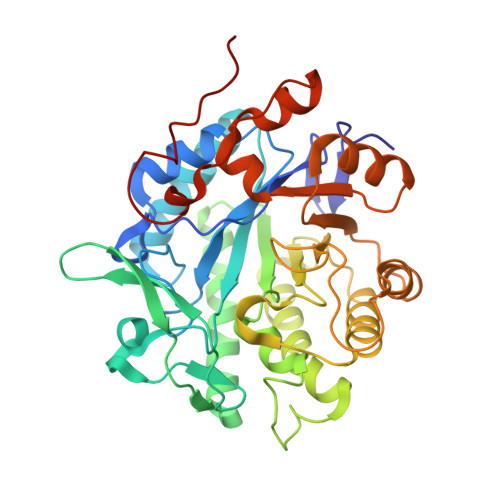
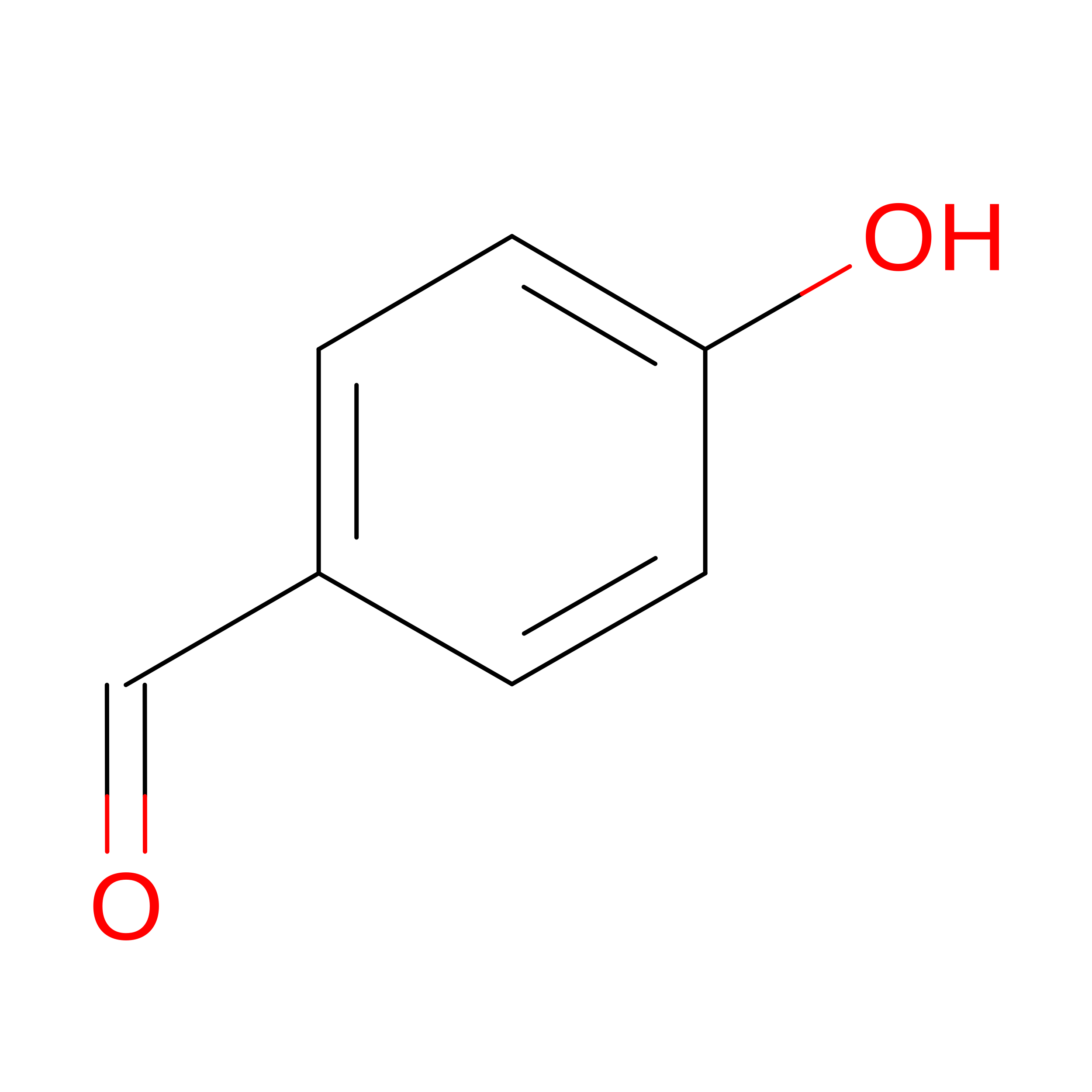
Crystal structure of glycerol trinitrate reductase NerA from Agrobacterium radiobacter in complex with 4-hydroxybenzaldehyde


Experimental Data Snapshot

  • Method: X-RAY DIFFRACTION
  • Resolution: 2.29 Å
  • R-Value Free: 
    0.239 (Depositor), 0.218 (DCC) 
  • R-Value Work: 
    0.194 (Depositor), 0.181 (DCC) 
  • R-Value Observed: 
    0.197 (Depositor) 

Starting Model: experimental
View more details

wwPDB Validation 3D Report Full Report

Validation slider image for 4JIP

Ligand Structure Quality Assessment 


This is version 1.2 of the entry. See complete history

Literature

The Structure of Glycerol Trinitrate Reductase NerA from Agrobacterium radiobacter Reveals the Molecular Reason for Nitro- and Ene-Reductase Activity in OYE Homologues.

Oberdorfer, G.Binter, A.Wallner, S.Durchschein, K.Hall, M.Faber, K.Macheroux, P.Gruber, K.

(2013) Chembiochem 14: 836-845

  • DOI: https://doi.org/10.1002/cbic.201300136
  • Primary Citation Related Structures: 
    4JIC, 4JIP, 4JIQ

  • PubMed Abstract: 

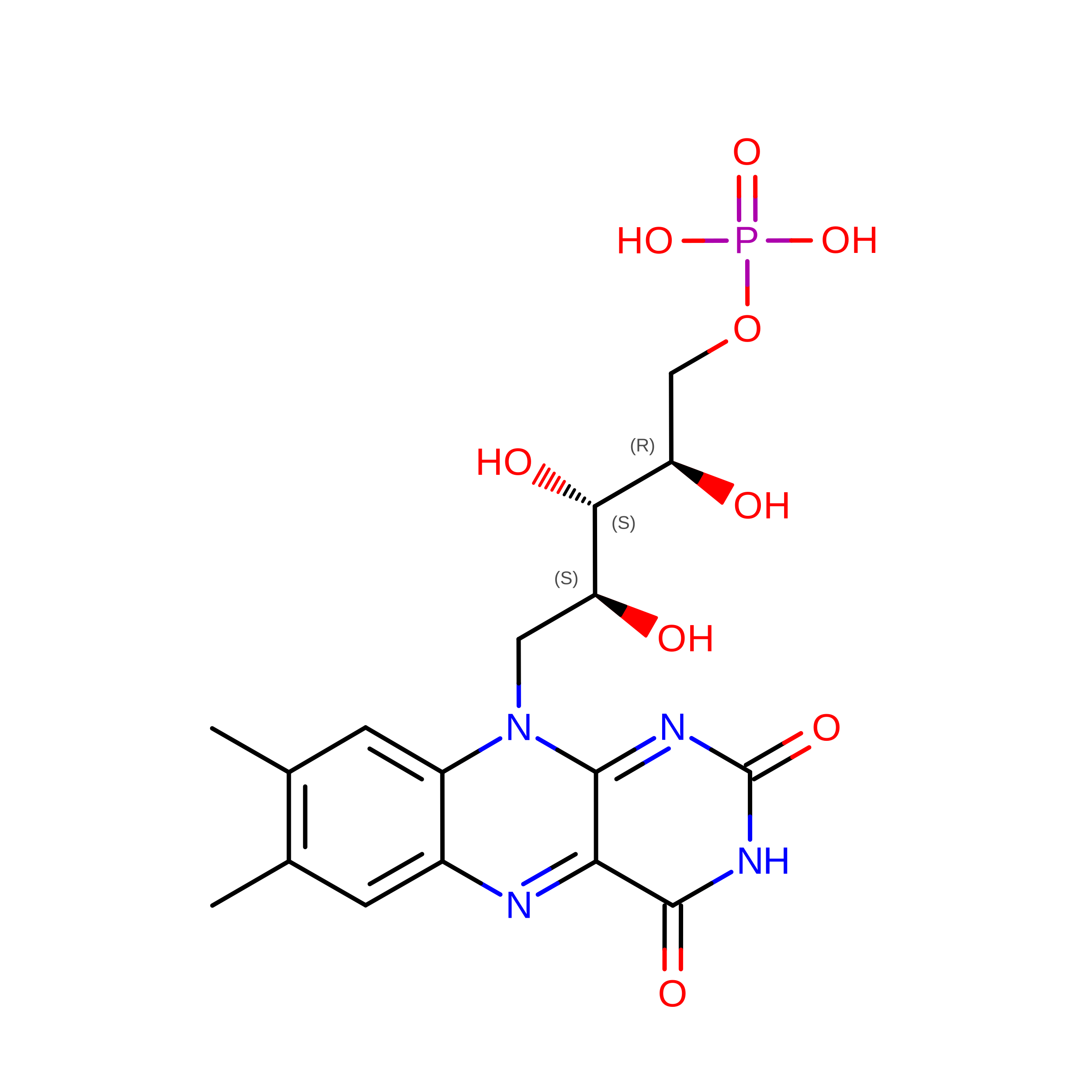
    In recent years, Old Yellow Enzymes (OYEs) and their homologues have found broad application in the efficient asymmetric hydrogenation of activated C=C bonds with high selectivities and yields. Members of this class of enzymes have been found in many different organisms and are rather diverse on the sequence level, with pairwise identities as low as 20 %, but they exhibit significant structural similarities with the adoption of a conserved (αβ)(8)-barrel fold. Some OYEs have been shown not only to reduce C=C double bonds, but also to be capable of reducing nitro groups in both saturated and unsaturated substrates. In order to understand this dual activity we determined and analyzed X-ray crystal structures of NerA from Agrobacterium radiobacter, both in its apo form and in complex with 4-hydroxybenzaldehyde and with 1-nitro-2-phenylpropene. These structures, together with spectroscopic studies of substrate binding to several OYEs, indicate that nitro-containing substrates can bind to OYEs in different binding modes, one of which leads to C=C double bond reduction and the other to nitro group reduction.


  • Organizational Affiliation
    • ACIB--Austrian Centre of Industrial Biotechnology, Petergasse 14, 8010 Graz, Austria.

Macromolecule Content 

  • Total Structure Weight: 41.15 kDa 
  • Atom Count: 3,079 
  • Modeled Residue Count: 370 
  • Deposited Residue Count: 377 
  • Unique protein chains: 1

Macromolecules

Find similar proteins by:|  3D Structure
Entity ID: 1
MoleculeChains  Sequence LengthOrganismDetailsImage
GTN Reductase377Agrobacterium tumefaciensMutation(s): 0 
Gene Names: nerA
UniProt
Find proteins for O31246 (Agrobacterium tumefaciens)
Explore O31246 
Go to UniProtKB:  O31246
Entity Groups
Sequence Clusters30% Identity50% Identity70% Identity90% Identity95% Identity100% Identity
UniProt GroupO31246
Sequence Annotations
Expand
Reference Sequence

Small Molecules

Experimental Data & Validation

Experimental Data

  • Method: X-RAY DIFFRACTION
  • Resolution: 2.29 Å
  • R-Value Free:  0.239 (Depositor), 0.218 (DCC) 
  • R-Value Work:  0.194 (Depositor), 0.181 (DCC) 
  • R-Value Observed: 0.197 (Depositor) 
Space Group: P 21 21 21
Unit Cell:
Length ( Å )Angle ( ˚ )
a = 58.91α = 90
b = 68.28β = 90
c = 90.06γ = 90
Software Package:
Software NamePurpose
MAR345dtbdata collection
PHASERphasing
PHENIXrefinement
MOSFLMdata reduction
SCALAdata scaling

Structure Validation

View Full Validation Report


Ligand Structure Quality Assessment 


Entry History 

Deposition Data

Revision History  (Full details and data files)

  • Version 1.0: 2013-05-08
    Type: Initial release
  • Version 1.1: 2013-05-15
    Changes: Database references
  • Version 1.2: 2023-09-20
    Changes: Data collection, Database references, Derived calculations, Refinement description