4JDA | pdb_00004jda

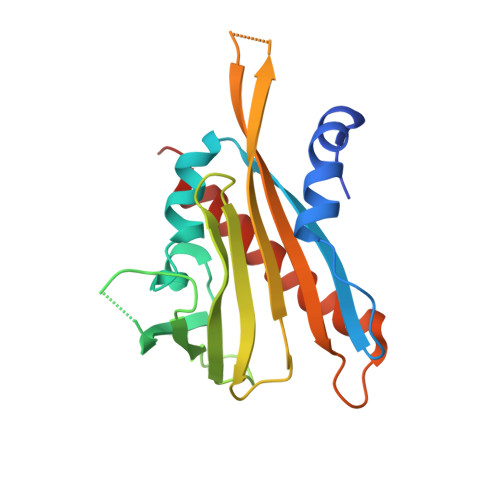
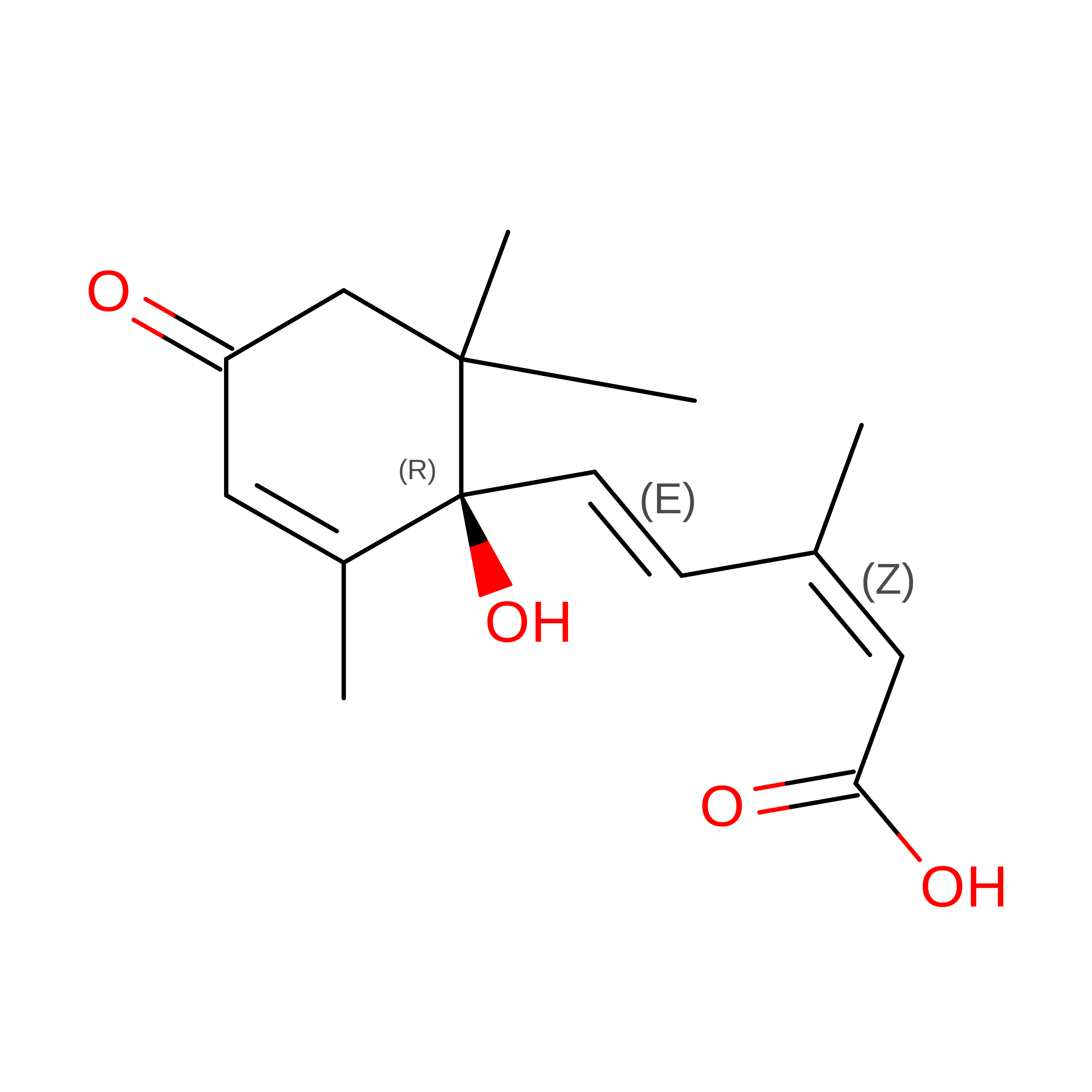
Complex structure of abscisic acid receptor PYL3 with (-)-ABA


Experimental Data Snapshot

  • Method: X-RAY DIFFRACTION
  • Resolution: 2.65 Å
  • R-Value Free: 
    0.267 (Depositor), 0.235 (DCC) 
  • R-Value Work: 
    0.243 (Depositor), 0.237 (DCC) 
  • R-Value Observed: 
    0.245 (Depositor) 

Starting Model: experimental
View more details

wwPDB Validation 3D Report Full Report

Validation slider image for 4JDA

Ligand Structure Quality Assessment 


This is version 1.1 of the entry. See complete history

Literature

Structural Insights into the Abscisic Acid Stereospecificity by the ABA Receptors PYR/PYL/RCAR

Zhang, X.Jiang, L.Wang, G.Yu, L.Zhang, Q.Xin, Q.Wu, W.Gong, Z.Chen, Z.

(2013) PLoS One 8: e67477-e67477

  • DOI: https://doi.org/10.1371/journal.pone.0067477
  • Primary Citation Related Structures: 
    3OQU, 4JDA, 4JDL

  • PubMed Abstract: 

    The phytohormone abscisic acid ((+)-ABA) plays a key role in many processes. The biological and biochemical activities of unnatural (-)-ABA have been extensively investigated since 1960s. However, the recognition mechanism by which only a few members among PYR/PYL/RCAR (PYLs) family can bind (-)-ABA remains largely unknown. Here we systematically characterized the affinity of PYLs binding to the (-)-ABA and reported the crystal structures of apo-PYL5, PYL3-(-)-ABA and PYL9-(+)-ABA. PYL5 showed the strongest binding affinity with (-)-ABA among all the PYLs. PYL9 is a stringently exclusive (+)-ABA receptor with interchangeable disulfide bonds shared by a subclass of PYLs. PYL3 is a dual receptor to both ABA enantiomers. The binding orientation and pocket of (-)-ABA in PYLs are obviously different from those of (+)-ABA. Steric hindrance and hydrophobic interaction are the two key factors in determining the stereospecificity of PYLs binding to (-)-ABA, which is further confirmed by gain-of-function and loss-of-function mutagenesis. Our results provide novel insights of the bioactivity of ABA enantiomers onto PYLs, and shed light on designing the selective ABA receptors agonists.


  • Organizational Affiliation
    • State Key Laboratory of Agrobiotechnology, China Agricultural University, Beijing, China.

Macromolecule Content 

  • Total Structure Weight: 87.64 kDa 
  • Atom Count: 5,396 
  • Modeled Residue Count: 695 
  • Deposited Residue Count: 768 
  • Unique protein chains: 1

Macromolecules

Find similar proteins by:|  3D Structure
Entity ID: 1
MoleculeChains  Sequence LengthOrganismDetailsImage
Abscisic acid receptor PYL3
A, B, C, D
192Arabidopsis thalianaMutation(s): 0 
Gene Names: PYL3
UniProt
Find proteins for Q9SSM7 (Arabidopsis thaliana)
Explore Q9SSM7 
Go to UniProtKB:  Q9SSM7
Entity Groups
Sequence Clusters30% Identity50% Identity70% Identity90% Identity95% Identity100% Identity
UniProt GroupQ9SSM7
Sequence Annotations
Expand
Reference Sequence

Experimental Data & Validation

Experimental Data

  • Method: X-RAY DIFFRACTION
  • Resolution: 2.65 Å
  • R-Value Free:  0.267 (Depositor), 0.235 (DCC) 
  • R-Value Work:  0.243 (Depositor), 0.237 (DCC) 
  • R-Value Observed: 0.245 (Depositor) 
Space Group: P 65
Unit Cell:
Length ( Å )Angle ( ˚ )
a = 142.738α = 90
b = 142.738β = 90
c = 99.802γ = 120
Software Package:
Software NamePurpose
MAR345dtbdata collection
PHASERphasing
REFMACrefinement
HKL-2000data reduction
HKL-2000data scaling

Structure Validation

View Full Validation Report


Ligand Structure Quality Assessment 


Entry History 

Deposition Data

Revision History  (Full details and data files)

  • Version 1.0: 2013-07-24
    Type: Initial release
  • Version 1.1: 2023-11-08
    Changes: Data collection, Database references, Derived calculations, Refinement description