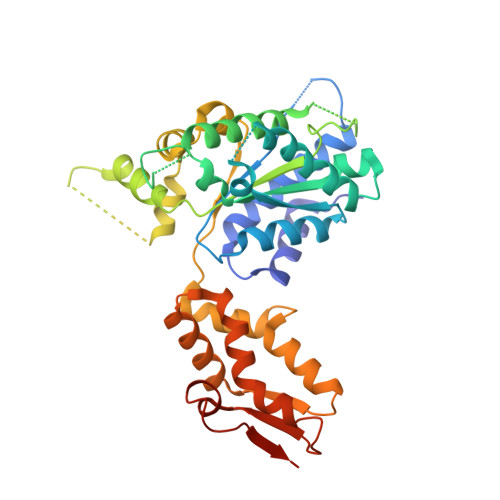
4I63 | pdb_00004i63

Crystal Structure of E-R ClpX Hexamer


Experimental Data Snapshot

  • Method: X-RAY DIFFRACTION
  • Resolution: 5.71 Å
  • R-Value Free: 
    0.315 (Depositor), 0.307 (DCC) 
  • R-Value Work: 
    0.307 (Depositor), 0.294 (DCC) 
  • R-Value Observed: 
    0.307 (Depositor) 

Starting Model: experimental
View more details

wwPDB Validation 3D Report Full Report

Validation slider image for 4I63

This is version 1.2 of the entry. See complete history

Literature

Nucleotide Binding and Conformational Switching in the Hexameric Ring of a AAA+ Machine.

Stinson, B.M.Nager, A.R.Glynn, S.E.Schmitz, K.R.Baker, T.A.Sauer, R.T.

(2013) Cell 153: 628-639

  • DOI: https://doi.org/10.1016/j.cell.2013.03.029
  • Primary Citation Related Structures: 
    4I34, 4I4L, 4I5O, 4I63, 4I81, 4I9K

  • PubMed Abstract: 

    ClpX, a AAA+ ring homohexamer, uses the energy of ATP binding and hydrolysis to power conformational changes that unfold and translocate target proteins into the ClpP peptidase for degradation. In multiple crystal structures, some ClpX subunits adopt nucleotide-loadable conformations, others adopt unloadable conformations, and each conformational class exhibits substantial variability. Using mutagenesis of individual subunits in covalently tethered hexamers together with fluorescence methods to assay the conformations and nucleotide-binding properties of these subunits, we demonstrate that dynamic interconversion between loadable and unloadable conformations is required to couple ATP hydrolysis by ClpX to mechanical work. ATP binding to different classes of subunits initially drives staged allosteric changes, which set the conformation of the ring to allow hydrolysis and linked mechanical steps. Subunit switching between loadable and unloadable conformations subsequently isomerizes or resets the configuration of the nucleotide-loaded ring and is required for mechanical function.


  • Organizational Affiliation
    • Department of Biology, Massachusetts Institute of Technology, Cambridge, MA 02139, USA.

Macromolecule Content 

  • Total Structure Weight: 237.19 kDa 
  • Atom Count: 13,933 
  • Modeled Residue Count: 1,846 
  • Deposited Residue Count: 2,178 
  • Unique protein chains: 1

Macromolecules

Find similar proteins by:|  3D Structure
Entity ID: 1
MoleculeChains  Sequence LengthOrganismDetailsImage
ATP-dependent Clp protease ATP-binding subunit ClpX
A, B, C, D, E
A, B, C, D, E, F
363Escherichia coli K-12Mutation(s): 0 
Gene Names: b0438clpXJW0428lopC
UniProt
Find proteins for P0A6H1 (Escherichia coli (strain K12))
Explore P0A6H1 
Go to UniProtKB:  P0A6H1
Entity Groups
Sequence Clusters30% Identity50% Identity70% Identity90% Identity95% Identity100% Identity
UniProt GroupP0A6H1
Sequence Annotations
Expand
Reference Sequence

Experimental Data & Validation

Experimental Data

  • Method: X-RAY DIFFRACTION
  • Resolution: 5.71 Å
  • R-Value Free:  0.315 (Depositor), 0.307 (DCC) 
  • R-Value Work:  0.307 (Depositor), 0.294 (DCC) 
  • R-Value Observed: 0.307 (Depositor) 
Space Group: P 21 21 21
Unit Cell:
Length ( Å )Angle ( ˚ )
a = 55.219α = 90
b = 201.168β = 90
c = 222.62γ = 90
Software Package:
Software NamePurpose
SCALEPACKdata scaling
PHENIXrefinement
PDB_EXTRACTdata extraction
ADSCdata collection
HKL-2000data reduction
HKL-2000data scaling
PHASERphasing

Structure Validation

View Full Validation Report


Entry History 

Deposition Data

Revision History  (Full details and data files)

  • Version 1.0: 2013-05-15
    Type: Initial release
  • Version 1.1: 2013-05-22
    Changes: Refinement description
  • Version 1.2: 2023-09-20
    Changes: Data collection, Database references, Derived calculations, Refinement description