4H3M | pdb_00004h3m

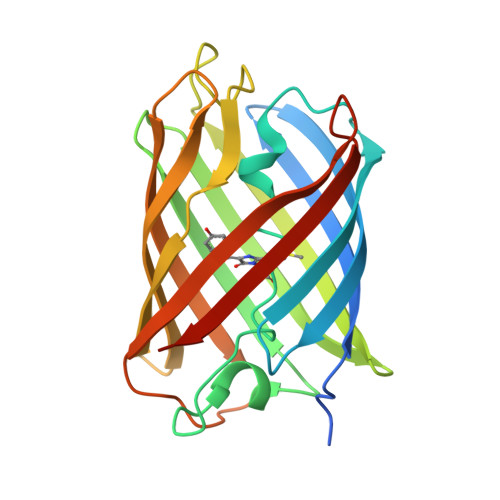
mPlumAYC-E16A


Experimental Data Snapshot

  • Method: X-RAY DIFFRACTION
  • Resolution: 2.00 Å
  • R-Value Free: 
    0.274 (Depositor), 0.271 (DCC) 
  • R-Value Work: 
    0.215 (Depositor), 0.216 (DCC) 
  • R-Value Observed: 
    0.218 (Depositor) 

Starting Model: experimental
View more details

wwPDB Validation 3D Report Full Report

Validation slider image for 4H3M

This is version 1.3 of the entry. See complete history

Literature

Recovery of Red Fluorescent Protein Chromophore Maturation Deficiency through Rational Design.

Moore, M.M.Oteng-Pabi, S.K.Pandelieva, A.T.Mayo, S.L.Chica, R.A.

(2012) PLoS One 7: e52463-e52463

  • DOI: https://doi.org/10.1371/journal.pone.0052463
  • Primary Citation Related Structures: 
    4H3L, 4H3M, 4H3N

  • PubMed Abstract: 

    Red fluorescent proteins (RFPs) derived from organisms in the class Anthozoa have found widespread application as imaging tools in biological research. For most imaging experiments, RFPs that mature quickly to the red chromophore and produce little or no green chromophore are most useful. In this study, we used rational design to convert a yellow fluorescent mPlum mutant to a red-emitting RFP without reverting any of the mutations causing the maturation deficiency and without altering the red chromophore's covalent structure. We also created an optimized mPlum mutant (mPlum-E16P) that matures almost exclusively to the red chromophore. Analysis of the structure/function relationships in these proteins revealed two structural characteristics that are important for efficient red chromophore maturation in DsRed-derived RFPs. The first is the presence of a lysine residue at position 70 that is able to interact directly with the chromophore. The second is an absence of non-bonding interactions limiting the conformational flexibility at the peptide backbone that is oxidized during red chromophore formation. Satisfying or improving these structural features in other maturation-deficient RFPs may result in RFPs with faster and more complete maturation to the red chromophore.


  • Organizational Affiliation
    • Division of Biology, California Institute of Technology, Pasadena, California, USA.

Macromolecule Content 

  • Total Structure Weight: 53.08 kDa 
  • Atom Count: 3,469 
  • Modeled Residue Count: 425 
  • Deposited Residue Count: 464 
  • Unique protein chains: 1

Macromolecules

Find similar proteins by:|  3D Structure
Entity ID: 1
MoleculeChains  Sequence LengthOrganismDetailsImage
Fluorescent protein plum
A, B
232Discosoma sp. LW-2004Mutation(s): 5 
UniProt
Find proteins for Q5S3G7 (Discosoma sp. LW-2004)
Explore Q5S3G7 
Go to UniProtKB:  Q5S3G7
Entity Groups
Sequence Clusters30% Identity50% Identity70% Identity90% Identity95% Identity100% Identity
UniProt GroupQ5S3G7
Sequence Annotations
Expand
Reference Sequence

Small Molecules

Modified Residues  1 Unique
IDChains TypeFormula2D DiagramParent
NRQ
Query on NRQ
A, B
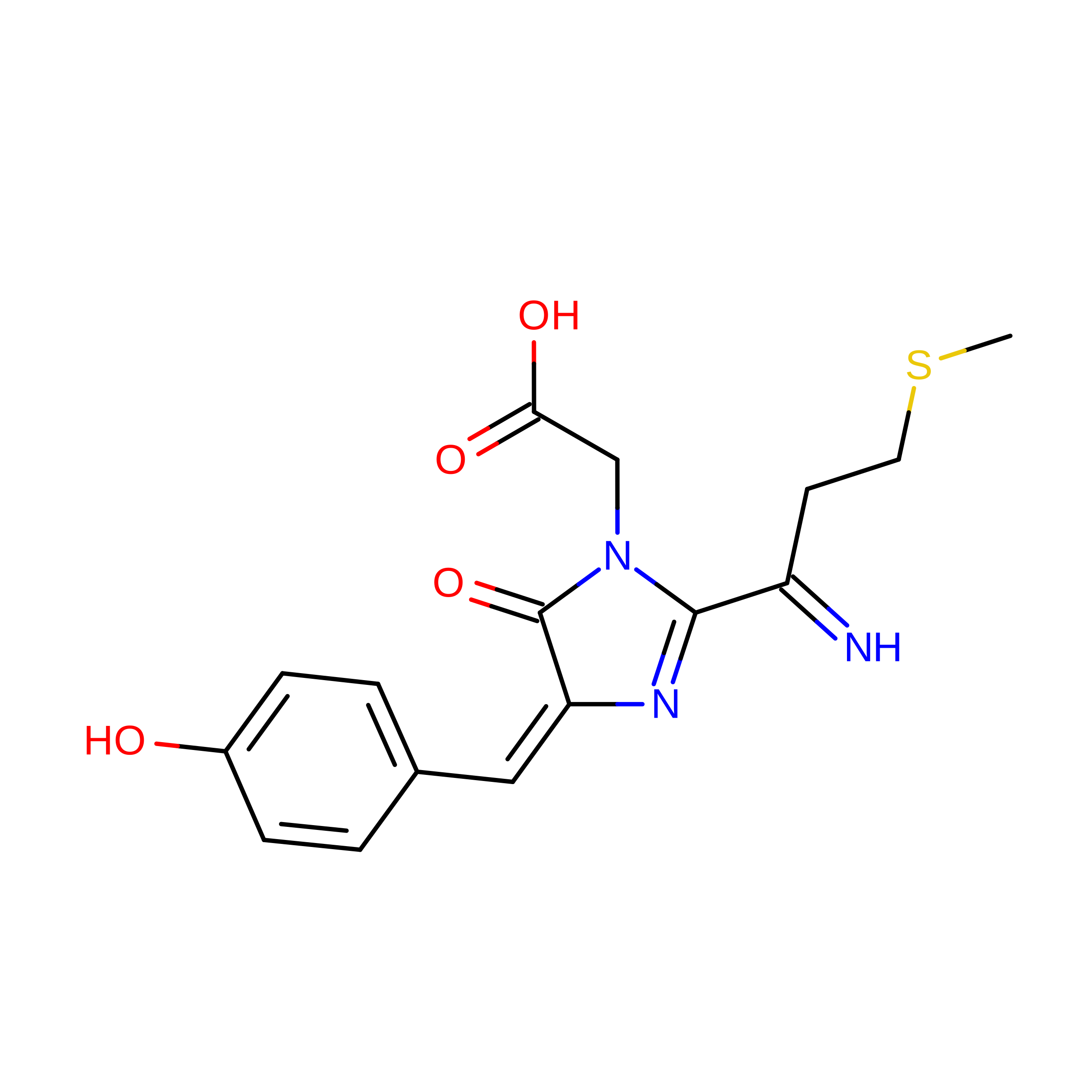
L-PEPTIDE LINKINGC16 H17 N3 O4 SMET, TYR, GLY

Experimental Data & Validation

Experimental Data

  • Method: X-RAY DIFFRACTION
  • Resolution: 2.00 Å
  • R-Value Free:  0.274 (Depositor), 0.271 (DCC) 
  • R-Value Work:  0.215 (Depositor), 0.216 (DCC) 
  • R-Value Observed: 0.218 (Depositor) 
Space Group: P 21 21 21
Unit Cell:
Length ( Å )Angle ( ˚ )
a = 61.24α = 90
b = 64.69β = 90
c = 94.77γ = 90
Software Package:
Software NamePurpose
HKL-3000data collection
PHASESphasing
PHENIXrefinement
MOSFLMdata reduction
SCALAdata scaling

Structure Validation

View Full Validation Report


Entry History 

Deposition Data

Revision History  (Full details and data files)

  • Version 1.0: 2012-10-24
    Type: Initial release
  • Version 1.1: 2013-01-16
    Changes: Database references
  • Version 1.2: 2023-09-20
    Changes: Data collection, Database references, Derived calculations, Refinement description
  • Version 1.3: 2023-12-06
    Changes: Data collection