4GVZ | pdb_00004gvz

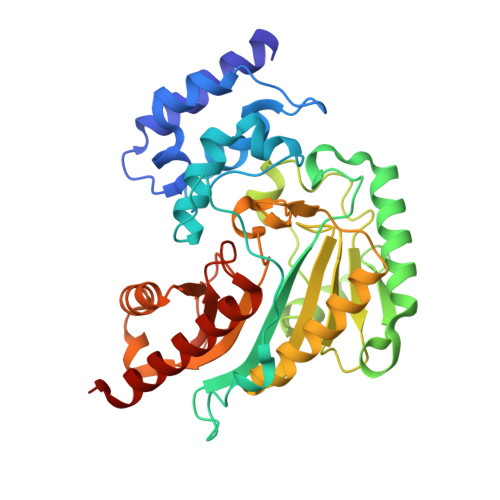
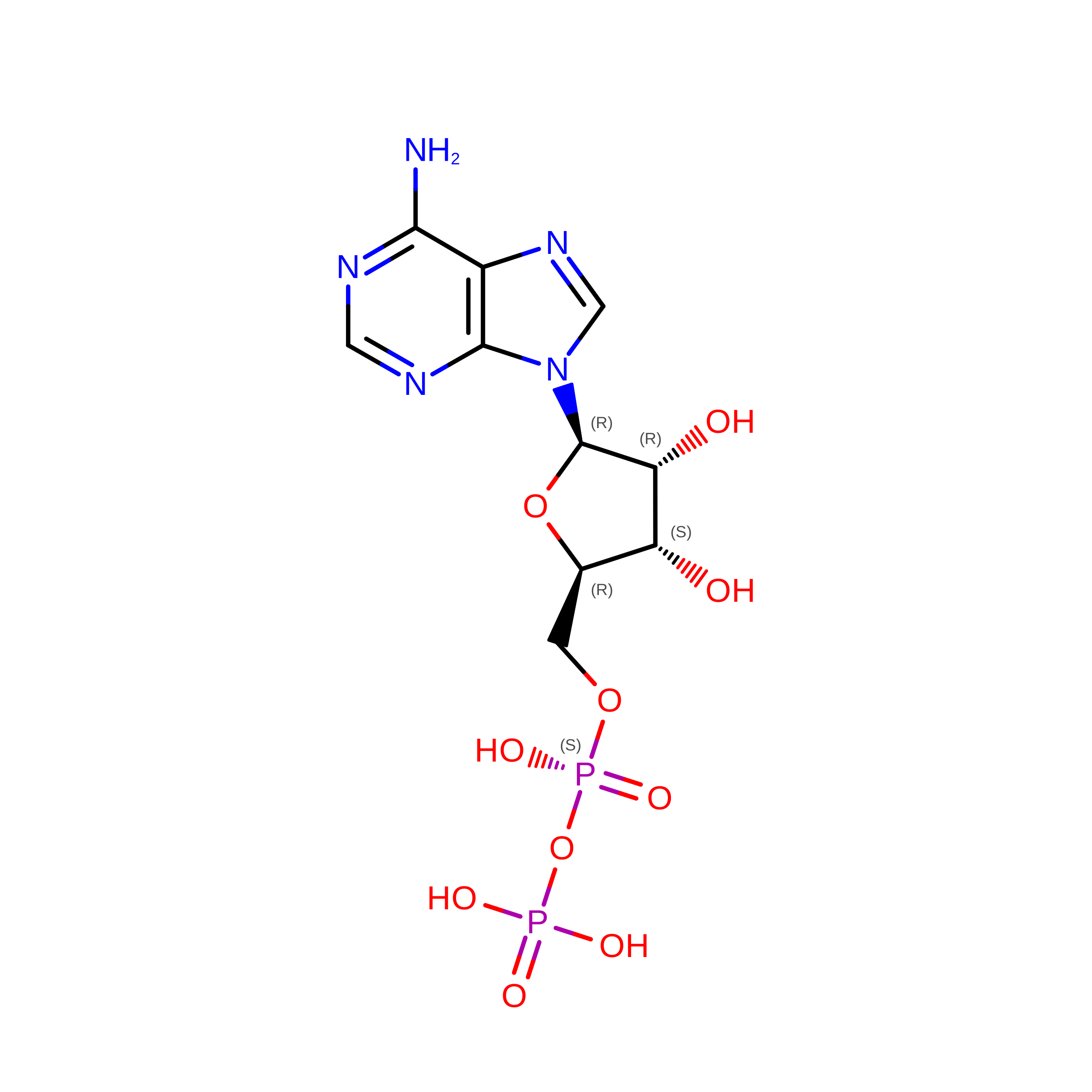
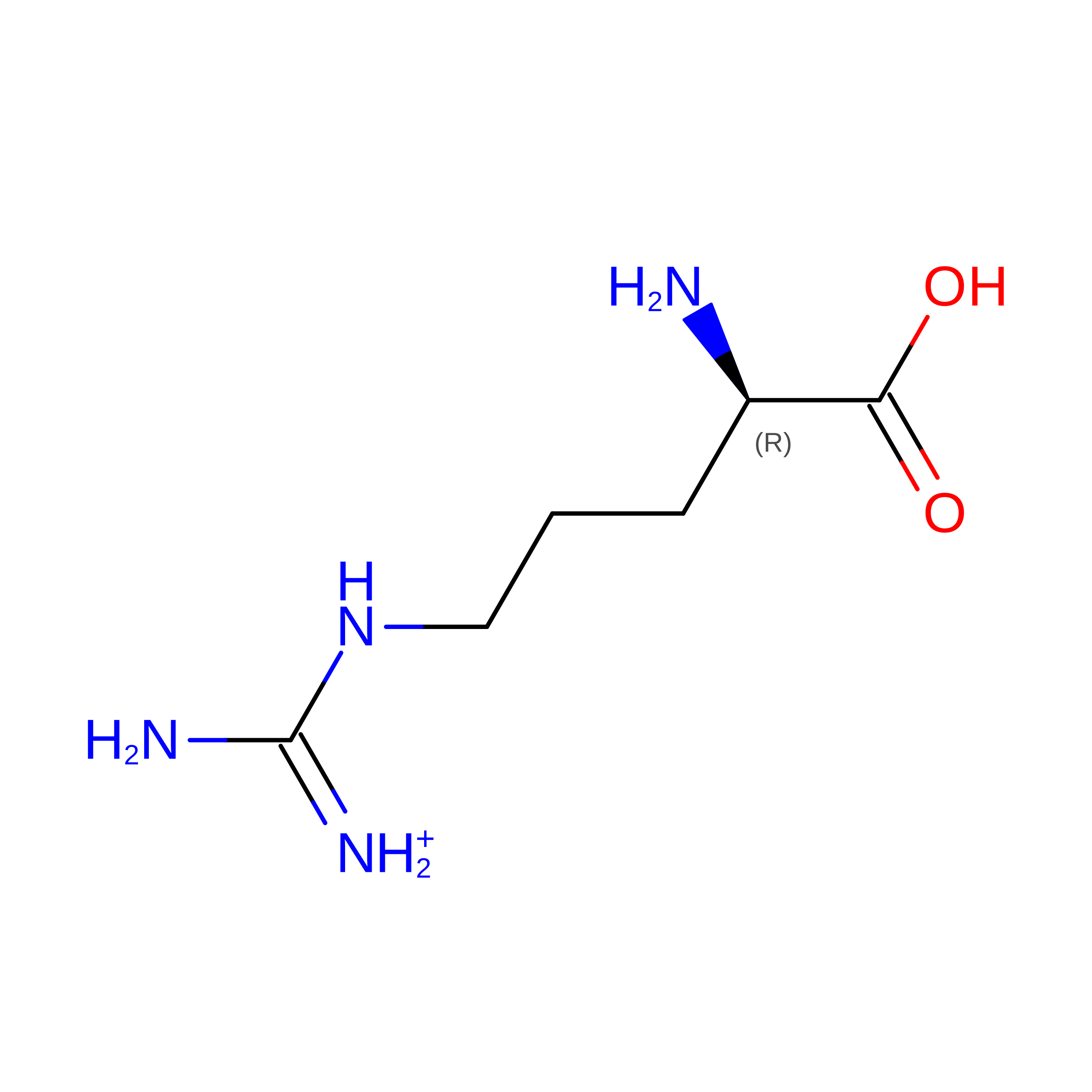
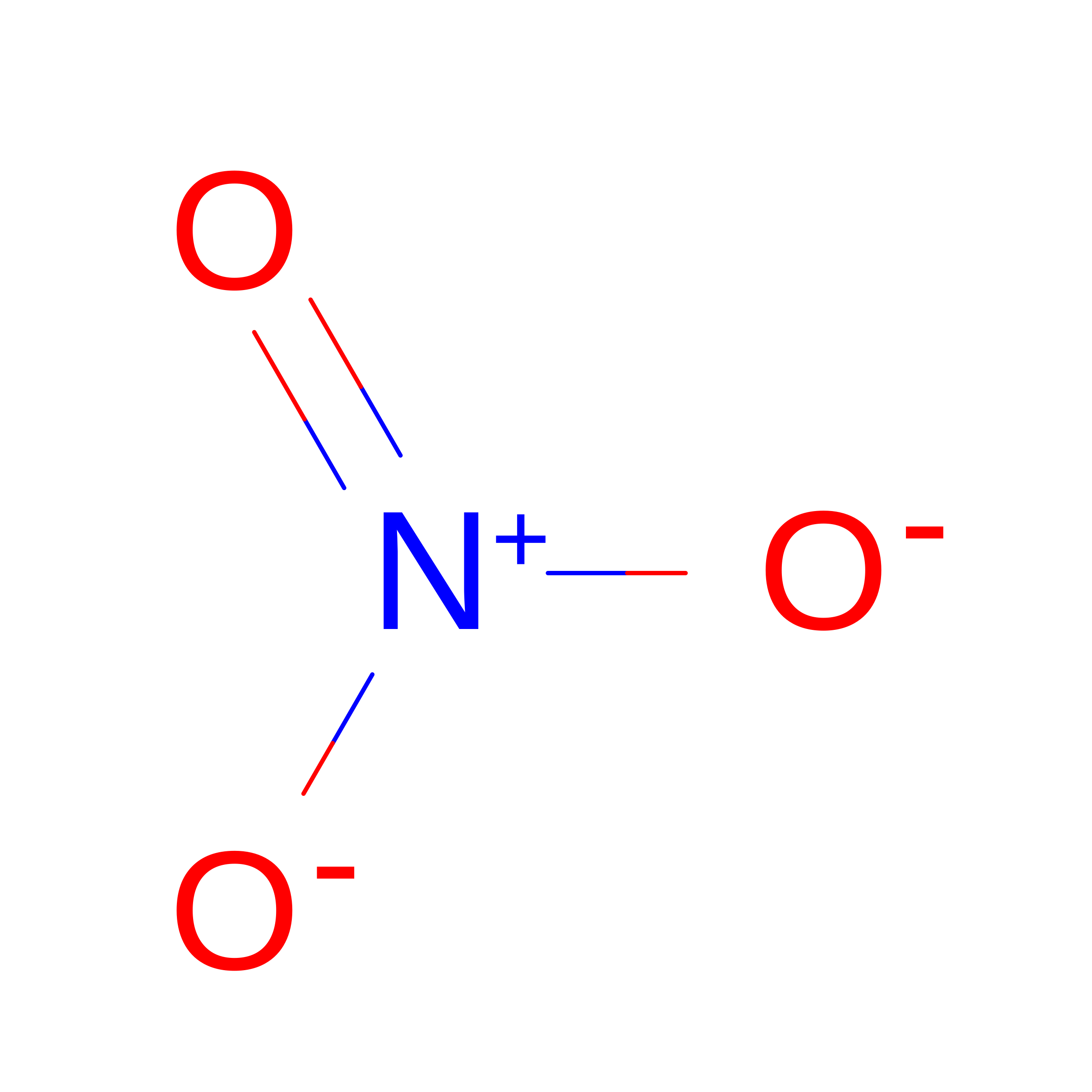
Crystal structure of arginine kinase in complex with D-arginine, MgADP, and nitrate.


Experimental Data Snapshot

  • Method: X-RAY DIFFRACTION
  • Resolution: 2.96 Å
  • R-Value Free: 
    0.229 (Depositor), 0.232 (DCC) 
  • R-Value Work: 
    0.192 (Depositor), 0.196 (DCC) 
  • R-Value Observed: 
    0.194 (Depositor) 

Starting Model: experimental
View more details

wwPDB Validation 3D Report Full Report

Validation slider image for 4GVZ

Ligand Structure Quality Assessment 


This is version 1.2 of the entry. See complete history

Literature

Crystal structures of arginine kinase in complex with ADP, nitrate, and various phosphagen analogs.

Clark, S.A.Davulcu, O.Chapman, M.S.

(2012) Biochem Biophys Res Commun 427: 212-217

  • DOI: https://doi.org/10.1016/j.bbrc.2012.09.053
  • Primary Citation Related Structures: 
    4GVY, 4GVZ, 4GW0, 4GW2

  • PubMed Abstract: 

    Arginine kinase catalyzes the reversible transfer of a phosphoryl group between ATP and l-arginine and is a monomeric homolog of the human enzyme creatine kinase. Arginine and creatine kinases belongs to the phosphagen kinase family of enzymes, which consists of eight known members, each of which is specific for its own phosphagen. Here, the source of phosphagen specificity in arginine kinase is investigated through the use of phosphagen analogs. Crystal structures have been determined for Limulus polyphemus arginine kinase with one of four arginine analogs bound in a transition state analog complex: l-ornithine, l-citrulline, imino-l-ornithine, and d-arginine. In all complexes, the enzyme achieves a closed conformation very similar to that of the cognate transition state analog complex, but differences are observed in the configurations of bound ligands. Arginine kinase exhibits no detectable activity towards ornithine, citrulline, or imino-l-ornithine, and only trace activity towards d-arginine. The crystal structures presented here demonstrate that phosphagen specificity is derived neither from a lock-and-key mechanism nor a modulation of induced-fit conformational changes, but potentially from subtle distortions in bound substrate configurations.


  • Organizational Affiliation
    • Institute of Molecular Biophysics, Department of Chemistry & Biochemistry, Florida State University, Tallahassee, FL 32306-4380, USA.

Macromolecule Content 

  • Total Structure Weight: 40.94 kDa 
  • Atom Count: 2,977 
  • Modeled Residue Count: 356 
  • Deposited Residue Count: 357 
  • Unique protein chains: 1

Macromolecules

Find similar proteins by:|  3D Structure
Entity ID: 1
MoleculeChains  Sequence LengthOrganismDetailsImage
Arginine kinase357Limulus polyphemusMutation(s): 3 
EC: 2.7.3.3
UniProt
Find proteins for P51541 (Limulus polyphemus)
Explore P51541 
Go to UniProtKB:  P51541
Entity Groups
Sequence Clusters30% Identity50% Identity70% Identity90% Identity95% Identity100% Identity
UniProt GroupP51541
Sequence Annotations
Expand
Reference Sequence

Experimental Data & Validation

Experimental Data

  • Method: X-RAY DIFFRACTION
  • Resolution: 2.96 Å
  • R-Value Free:  0.229 (Depositor), 0.232 (DCC) 
  • R-Value Work:  0.192 (Depositor), 0.196 (DCC) 
  • R-Value Observed: 0.194 (Depositor) 
Space Group: P 21 21 21
Unit Cell:
Length ( Å )Angle ( ˚ )
a = 64.109α = 90
b = 65.382β = 90
c = 85.912γ = 90
Software Package:
Software NamePurpose
CrystalCleardata collection
PHENIXmodel building
PHENIXrefinement
DENZOdata reduction
SCALEPACKdata scaling
PHENIXphasing

Structure Validation

View Full Validation Report


Ligand Structure Quality Assessment 


Entry History 

Deposition Data

Revision History  (Full details and data files)

  • Version 1.0: 2012-10-03
    Type: Initial release
  • Version 1.1: 2012-10-31
    Changes: Database references
  • Version 1.2: 2023-09-13
    Changes: Data collection, Database references, Derived calculations, Refinement description