Download Mendeley
Structural Basis for Phosphorylated Autoinducer-2 Modulation of the Oligomerization State of the Global Transcription Regulator LsrR from Escherichia coli
Wu, M., Tao, Y., Liu, X., Zang, J.(2013) J Biol Chem 288: 15878-15887
- PubMed: 23589368 Search on PubMedSearch on PubMed Central
- DOI: https://doi.org/10.1074/jbc.M112.417634
- Primary Citation Related Structures:
4GO1 - PubMed Abstract:
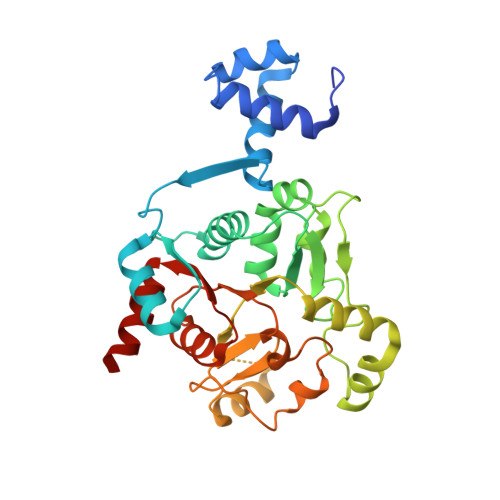
Quorum-sensing systems are widely used by bacteria to control behavior in response to fluctuations in cell density. Several small diffusible molecules called autoinducers act as signaling molecules in quorum-sensing processes through interplay with sensors. Autoinducers modulate vital physiological functions such as nutrient acquisition, gene transcription, and virulence factor production. In Escherichia coli, LsrR serves as a global transcription regulator that responds to autoinducer-2 to regulate the expression of a variety of genes, including the lsr operon and the lsrR gene. Here, we report the crystal structure of full-length LsrR from E. coli, which has an N-terminal DNA-binding domain and a C-terminal ligand-binding domain connected by a β-strand. Although only two molecules are found in one asymmetric unit, two neighboring dimers pack to form a tetramer that is consistent with the oligomerization state of LsrR in solution. Mutagenesis experiments and gel shift assays indicated that Gln-33 and Tyr-26 might be involved in interactions between LsrR and DNA. The LsrR-binding site for phosphorylated autoinducer-2 was predicted by structural comparisons of LsrR with CggR and SorC. Cross-linking, size exclusion chromatography, and gel shift assays determined that phosphorylated autoinducer-2 triggered the disassembly of the LsrR tetramer into dimers and reduced the DNA binding ability of LsrR. Our findings reveal a mechanism for the change in the oligomerization state of LsrR in the presence of phosphorylated autoinducer-2. Based on these observations, we propose that phosphorylated autoinducer-2 triggers the disassembly of the LsrR tetramer to activate the transcription of its target genes.
- Hefei National Laboratory for Physical Sciences at Microscale and School of Life Sciences, University of Science and Technology of China, Hefei, Anhui 230026, China.
Organizational Affiliation: