4FXP | pdb_00004fxp

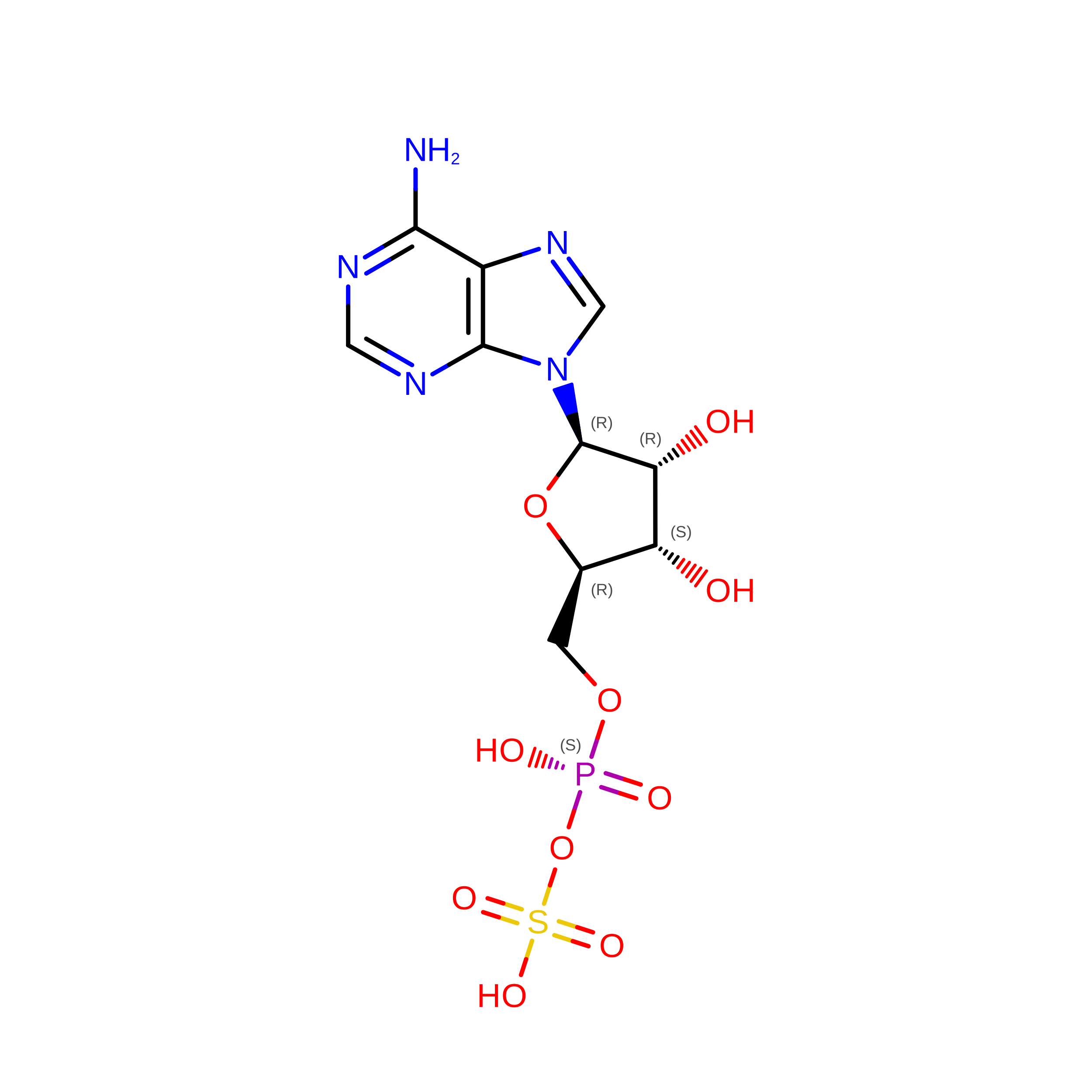
Crystal structure of adenosine 5'-phosphosulfate kinase from Arabidopsis thaliana in Complex with Sulfate and APS


Experimental Data Snapshot

  • Method: X-RAY DIFFRACTION
  • Resolution: 1.95 Å
  • R-Value Free: 
    0.189 (Depositor), 0.191 (DCC) 
  • R-Value Work: 
    0.166 (Depositor), 0.168 (DCC) 
  • R-Value Observed: 
    0.167 (Depositor) 

wwPDB Validation 3D Report Full Report

Validation slider image for 4FXP

Ligand Structure Quality Assessment 


This is version 1.2 of the entry. See complete history

Literature

Nucleotide binding site communication in Arabidopsis thaliana adenosine 5'-phosphosulfate kinase.

Ravilious, G.E.Jez, J.M.

(2012) J Biological Chem 287: 30385-30394

  • DOI: https://doi.org/10.1074/jbc.M112.387001
  • Primary Citation Related Structures: 
    4FXP

  • PubMed Abstract: 

    Adenosine 5'-phosphosulfate kinase (APSK) catalyzes the ATP-dependent synthesis of adenosine 3'-phosphate 5'-phosphosulfate (PAPS), which is an essential metabolite for sulfur assimilation in prokaryotes and eukaryotes. Using APSK from Arabidopsis thaliana, we examine the energetics of nucleotide binary and ternary complex formation and probe active site features that coordinate the order of ligand addition. Calorimetric analysis shows that binding can occur first at either nucleotide site, but that initial interaction at the ATP/ADP site was favored and enhanced affinity for APS in the second site by 50-fold. The thermodynamics of the two possible binding models (i.e. ATP first versus APS first) differs and implies that active site structural changes guide the order of nucleotide addition. The ligand binding analysis also supports an earlier suggestion of intermolecular interactions in the dimeric APSK structure. Crystallographic, site-directed mutagenesis, and energetic analyses of oxyanion recognition by the P-loop in the ATP/ADP binding site and the role of Asp(136), which bridges the ATP/ADP and APS/PAPS binding sites, suggest how the ordered nucleotide binding sequence and structural changes are dynamically coordinated for catalysis.


  • Organizational Affiliation
    • Department of Biology, Washington University, St. Louis, MO 63130, USA.

Macromolecule Content 

  • Total Structure Weight: 67.88 kDa 
  • Atom Count: 5,135 
  • Modeled Residue Count: 583 
  • Deposited Residue Count: 600 
  • Unique protein chains: 1

Macromolecules

Find similar proteins by:|  3D Structure
Entity ID: 1
MoleculeChains  Sequence LengthOrganismDetailsImage
Adenylyl-sulfate kinase 1, chloroplastic
A, B, C
200Arabidopsis thalianaMutation(s): 0 
Gene Names: AKN1At2g14750F26C24.11T6B13.1
EC: 2.7.1.25
UniProt
Find proteins for Q43295 (Arabidopsis thaliana)
Explore Q43295 
Go to UniProtKB:  Q43295
Entity Groups
Sequence Clusters30% Identity50% Identity70% Identity90% Identity95% Identity100% Identity
UniProt GroupQ43295
Sequence Annotations
Expand
Reference Sequence

Experimental Data & Validation

Experimental Data

  • Method: X-RAY DIFFRACTION
  • Resolution: 1.95 Å
  • R-Value Free:  0.189 (Depositor), 0.191 (DCC) 
  • R-Value Work:  0.166 (Depositor), 0.168 (DCC) 
  • R-Value Observed: 0.167 (Depositor) 
Space Group: C 1 2 1
Unit Cell:
Length ( Å )Angle ( ˚ )
a = 120.948α = 90
b = 92.348β = 113.52
c = 73.183γ = 90
Software Package:
Software NamePurpose
HKL-3000data collection
PHASERphasing
PHENIXrefinement
HKL-3000data reduction
HKL-3000data scaling

Structure Validation

View Full Validation Report


Ligand Structure Quality Assessment 


Entry History 

Deposition Data

Revision History  (Full details and data files)

  • Version 1.0: 2012-07-25
    Type: Initial release
  • Version 1.1: 2013-01-09
    Changes: Database references
  • Version 1.2: 2024-10-09
    Changes: Data collection, Database references, Derived calculations, Structure summary