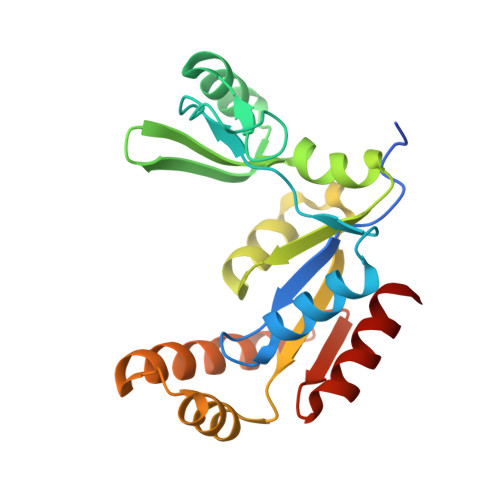
4F4J | pdb_00004f4j

Conversion of the enzyme guanylate kinase into a mitotic spindle orienting protein by a single mutation that inhibits gmp- induced closing


Experimental Data Snapshot

  • Method: X-RAY DIFFRACTION
  • Resolution: 2.45 Å
  • R-Value Free: 
    0.255 (Depositor), 0.245 (DCC) 
  • R-Value Work: 
    0.216 (Depositor), 0.213 (DCC) 
  • R-Value Observed: 
    0.218 (Depositor) 

wwPDB Validation 3D Report Full Report

Validation slider image for 4F4J

This is version 1.1 of the entry. See complete history

Literature

Conversion of the enzyme guanylate kinase into a mitotic-spindle orienting protein by a single mutation that inhibits GMP-induced closing.

Johnston, C.A.Whitney, D.S.Volkman, B.F.Doe, C.Q.Prehoda, K.E.

(2011) Proc Natl Acad Sci U S A 108: E973-E978

  • DOI: https://doi.org/10.1073/pnas.1104365108
  • Primary Citation Related Structures: 
    4F4J

  • PubMed Abstract: 

    New protein functions can require complex sequence changes, but the minimal path is not well understood. The guanylate kinase enzyme (GK(enz)), which catalyzes phosphotransfer from ATP to GMP, evolved into the GK domain (GK(dom)), a protein-binding domain found in membrane associate guanylate kinases that function in mitotic spindle orientation and cell adhesion. Using an induced polarity assay for GK(dom) function, we show that a single serine to proline mutation is sufficient to switch extant GK(enz) into a functional GK(dom). The mutation blocks catalysis (GK(enz) function) but allows protein binding and spindle orientation (GK(dom) function). Furthermore, whereas the GK(enz) undergoes a large closing motion upon GMP binding, fluorescence quenching and NMR demonstrate that the S → P mutation inhibits GMP-induced GK movements. Disrupting GK closing with a mutation at a different position also leads to GK(dom) function, suggesting that blocking the GK(enz) closing motion is sufficient for functional conversion of GK(enz) to GK(dom). Although subtle changes in protein function can require complex sequence paths, our work shows that entirely new functions can arise from single mutations that alter protein dynamics.


  • Organizational Affiliation
    • Institute of Molecular Biology, Department of Chemistry, University of Oregon, Eugene, OR 97403, USA.

Macromolecule Content 

  • Total Structure Weight: 45.32 kDa 
  • Atom Count: 3,032 
  • Modeled Residue Count: 375 
  • Deposited Residue Count: 404 
  • Unique protein chains: 1

Macromolecules

Find similar proteins by:|  3D Structure
Entity ID: 1
MoleculeChains  Sequence LengthOrganismDetailsImage
Guanylate kinase
A, B
202Saccharomyces cerevisiae S288CMutation(s): 1 
Gene Names: GUK1YDR454CD9461.39
EC: 2.7.4.8
UniProt
Find proteins for P15454 (Saccharomyces cerevisiae (strain ATCC 204508 / S288c))
Explore P15454 
Go to UniProtKB:  P15454
Entity Groups
Sequence Clusters30% Identity50% Identity70% Identity90% Identity95% Identity100% Identity
UniProt GroupP15454
Sequence Annotations
Expand
Reference Sequence

Experimental Data & Validation

Experimental Data

  • Method: X-RAY DIFFRACTION
  • Resolution: 2.45 Å
  • R-Value Free:  0.255 (Depositor), 0.245 (DCC) 
  • R-Value Work:  0.216 (Depositor), 0.213 (DCC) 
  • R-Value Observed: 0.218 (Depositor) 
Space Group: P 43 21 2
Unit Cell:
Length ( Å )Angle ( ˚ )
a = 103.682α = 90
b = 103.682β = 90
c = 130.881γ = 90
Software Package:
Software NamePurpose
HKL-2000data collection
PHASERphasing
REFMACrefinement
HKL-2000data reduction
HKL-2000data scaling

Structure Validation

View Full Validation Report


Entry History 

Deposition Data

Revision History  (Full details and data files)

  • Version 1.0: 2012-06-13
    Type: Initial release
  • Version 1.1: 2024-02-28
    Changes: Data collection, Database references, Derived calculations