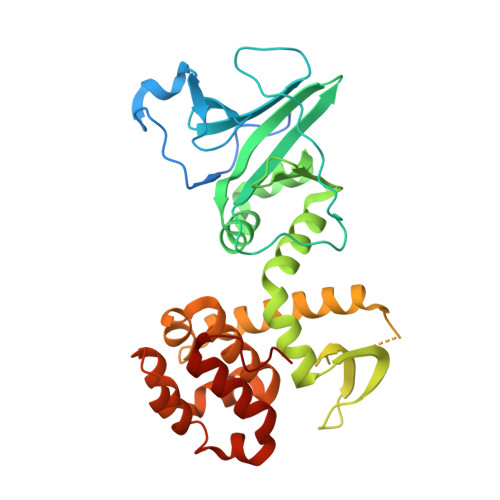
4EXM | pdb_00004exm

The crystal structure of an engineered phage lysin containing the binding domain of pesticin and the killing domain of T4-lysozyme


Experimental Data Snapshot

  • Method: X-RAY DIFFRACTION
  • Resolution: 2.60 Å
  • R-Value Free: 
    0.251 (Depositor), 0.255 (DCC) 
  • R-Value Work: 
    0.199 (Depositor), 0.204 (DCC) 
  • R-Value Observed: 
    0.201 (Depositor) 

Starting Models: experimental
View more details

wwPDB Validation 3D Report Full Report

Validation slider image for 4EXM

This is version 1.3 of the entry. See complete history. 

Literature

Structural engineering of a phage lysin that targets Gram-negative pathogens.

Lukacik, P., Barnard, T.J., Keller, P.W., Chaturvedi, K.S., Seddiki, N., Fairman, J.W., Noinaj, N., Kirby, T.L., Henderson, J.P., Steven, A.C., Hinnebusch, B.J., Buchanan, S.K.

(2012) Proc Natl Acad Sci U S A 109: 9857-9862

  • DOI: https://doi.org/10.1073/pnas.1203472109
  • Primary Citation Related Structures: 
    4EPA, 4EPF, 4EPI, 4EXM

  • PubMed Abstract: 

    Bacterial pathogens are becoming increasingly resistant to antibiotics. As an alternative therapeutic strategy, phage therapy reagents containing purified viral lysins have been developed against gram-positive organisms but not against gram-negative organisms due to the inability of these types of drugs to cross the bacterial outer membrane. We solved the crystal structures of a Yersinia pestis outer membrane transporter called FyuA and a bacterial toxin called pesticin that targets this transporter. FyuA is a β-barrel membrane protein belonging to the family of TonB dependent transporters, whereas pesticin is a soluble protein with two domains, one that binds to FyuA and another that is structurally similar to phage T4 lysozyme. The structure of pesticin allowed us to design a phage therapy reagent comprised of the FyuA binding domain of pesticin fused to the N-terminus of T4 lysozyme. This hybrid toxin kills specific Yersinia and pathogenic E. coli strains and, importantly, can evade the pesticin immunity protein (Pim) giving it a distinct advantage over pesticin. Furthermore, because FyuA is required for virulence and is more common in pathogenic bacteria, the hybrid toxin also has the advantage of targeting primarily disease-causing bacteria rather than indiscriminately eliminating natural gut flora.


  • Organizational Affiliation: 
    • Laboratory of Molecular Biology, National Institute of Diabetes and Digestive and Kidney Diseases, National Institutes of Health, Bethesda, MD 20892, USA.

Macromolecule Content 

  • Total Structure Weight: 158.8 kDa 
  • Atom Count: 9,875 
  • Modeled Residue Count: 1,244 
  • Deposited Residue Count: 1,388 
  • Unique protein chains: 1

Macromolecules

Find similar proteins by:|  3D Structure
Entity ID: 1
MoleculeChains  Sequence LengthOrganismDetailsImage
Pesticin, Lysozyme Chimera
A, B, C, D
347Yersinia pestis, Tequatrovirus T4
This entity is chimeric
Mutation(s): 4 
Gene Names: pst, YP_pPCP06, YPPCP1.05c, E
EC: 3.2.1.17
UniProt
Find proteins for P00720 (Enterobacteria phage T4)
Explore P00720 
Go to UniProtKB:  P00720
Find proteins for Q57159 (Yersinia pestis)
Explore Q57159 
Go to UniProtKB:  Q57159
Entity Groups
Sequence Clusters30% Identity50% Identity70% Identity90% Identity95% Identity100% Identity
UniProt GroupsQ57159P00720
Sequence Annotations
Expand
Reference Sequence

Experimental Data & Validation

Experimental Data

  • Method: X-RAY DIFFRACTION
  • Resolution: 2.60 Å
  • R-Value Free:  0.251 (Depositor), 0.255 (DCC) 
  • R-Value Work:  0.199 (Depositor), 0.204 (DCC) 
  • R-Value Observed: 0.201 (Depositor) 
Space Group: P 32
Unit Cell:
Length ( Å )Angle ( ˚ )
a = 108.427α = 90
b = 108.427β = 90
c = 109.752γ = 120
Software Package:
Software NamePurpose
SERGUIdata collection
PHASERphasing
PHENIXrefinement
HKL-2000data reduction
HKL-2000data scaling

Structure Validation

View Full Validation Report


Entry History 

Deposition Data

Revision History  (Full details and data files)

  • Version 1.0: 2012-06-20
    Type: Initial release
  • Version 1.1: 2012-07-04
    Changes: Database references
  • Version 1.2: 2017-07-26
    Changes: Refinement description, Source and taxonomy
  • Version 1.3: 2023-09-13
    Changes: Data collection, Database references, Refinement description