4EWN | pdb_00004ewn

Structure of HisF-D130V+D176V with bound rCdRP


Experimental Data Snapshot

  • Method: X-RAY DIFFRACTION
  • Resolution: 1.90 Å
  • R-Value Free: 
    0.236 (Depositor), 0.237 (DCC) 
  • R-Value Work: 
    0.204 (Depositor), 0.205 (DCC) 
  • R-Value Observed: 
    0.205 (Depositor) 

wwPDB Validation 3D Report Full Report

Validation slider image for 4EWN

Ligand Structure Quality Assessment 


This is version 1.1 of the entry. See complete history

Literature

A sugar isomerization reaction established on various (beta-alpha)8-barrel scaffolds is based on substrate-assisted catalysis

Reisinger, B.Bocola, M.List, F.Claren, J.Rajendran, C.Sterner, R.

(2012) Protein Eng Des Sel 25: 751-760

  • DOI: https://doi.org/10.1093/protein/gzs080
  • Primary Citation Related Structures: 
    4EWN

  • PubMed Abstract: 

    In the course of tryptophan biosynthesis, the isomerization of phosphoribosylanthranilate (PRA) is catalyzed by the (βα)₈-barrel enzyme TrpF. The reaction occurs via a general acid-base mechanism with an aspartate and a cysteine residue acting as acid and base, respectively. PRA isomerase activity could be established on two (βα)₈-barrel enzymes involved in histidine biosynthesis, namely HisA and HisF, and on a HisAF chimera, by introducing two aspartate-to-valine substitutions. We have analyzed the reaction mechanism underlying this engineered activity by measuring its pH dependence, solving the crystal structure of a HisF variant with bound product analogue, and applying molecular dynamics simulations and mixed quantum and molecular mechanics calculations. The results suggest that PRA is anchored by the C-terminal phosphate-binding sites of HisA, HisF and HisAF. As a consequence, a conserved aspartate residue, which is equivalent to Cys7 from TrpF, is properly positioned to act as catalytic base. However, no obvious catalytic acid corresponding to Asp126 from TrpF could be identified in the three proteins. Instead, this role appears to be carried out by the carboxylate group of the anthranilate moiety of PRA. Thus, the engineered PRA isomerization activity is based on a reaction mechanism including substrate-assisted catalysis and thus differs substantially from the naturally evolved reaction mechanism used by TrpF.


  • Organizational Affiliation
    • Institute of Biophysics and Physical Biochemistry, University of Regensburg, Germany.

Macromolecule Content 

  • Total Structure Weight: 28.07 kDa 
  • Atom Count: 1,961 
  • Modeled Residue Count: 243 
  • Deposited Residue Count: 253 
  • Unique protein chains: 1

Macromolecules

Find similar proteins by:|  3D Structure
Entity ID: 1
MoleculeChains  Sequence LengthOrganismDetailsImage
Imidazole glycerol phosphate synthase subunit HisFA [auth D]253Thermotoga maritimaMutation(s): 2 
Gene Names: hisFTM_1036
EC: 4.1.3 (PDB Primary Data), 4.3.2.10 (UniProt)
UniProt
Find proteins for Q9X0C6 (Thermotoga maritima (strain ATCC 43589 / DSM 3109 / JCM 10099 / NBRC 100826 / MSB8))
Explore Q9X0C6 
Go to UniProtKB:  Q9X0C6
Entity Groups
Sequence Clusters30% Identity50% Identity70% Identity90% Identity95% Identity100% Identity
UniProt GroupQ9X0C6
Sequence Annotations
Expand
Reference Sequence

Small Molecules

Ligands 1 Unique
IDChains Name / Formula / InChI Key2D Diagram3D Interactions
0VR

Query on 0VR


Download:Ideal Coordinates CCD File
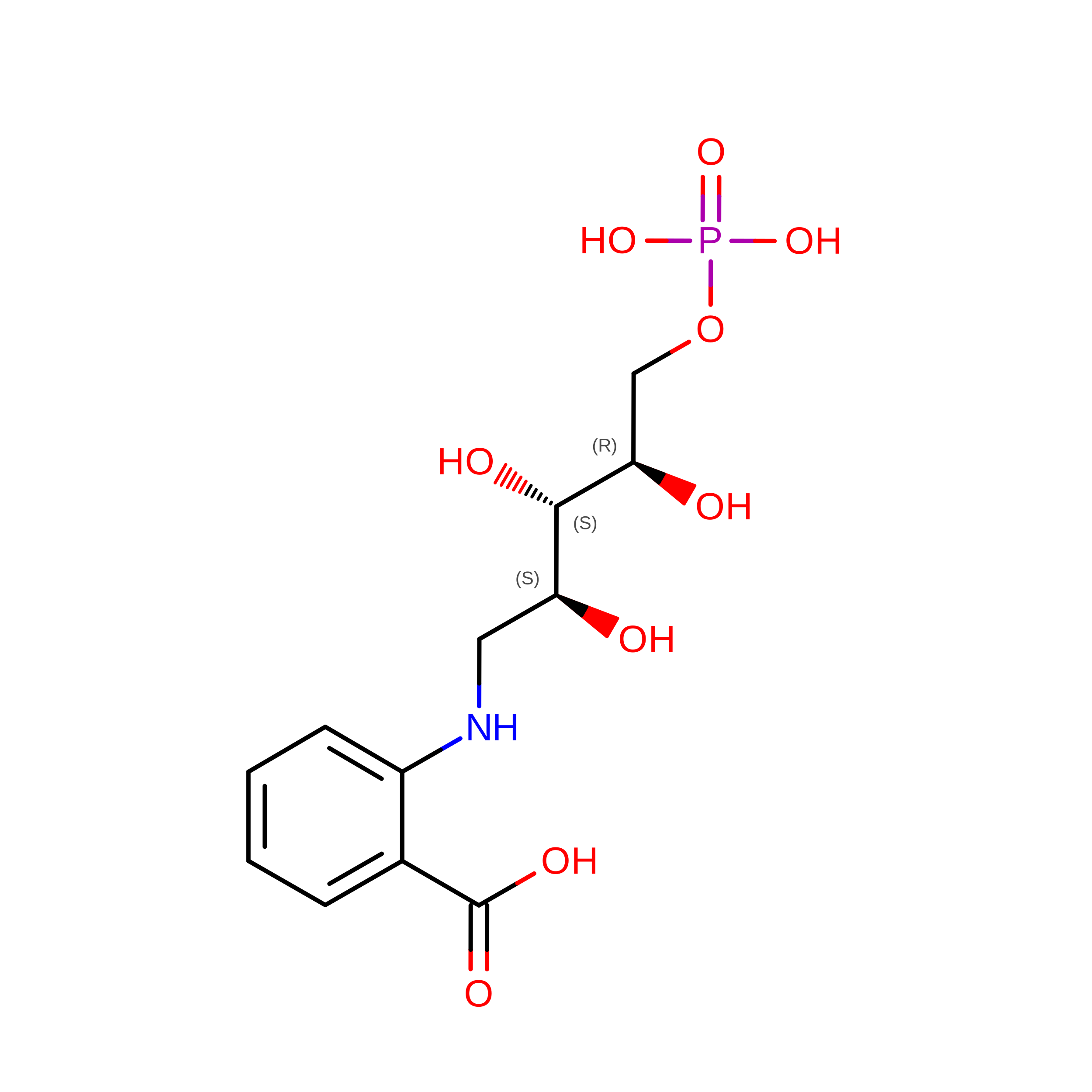
B [auth D]1-(O-carboxy-phenylamino)-1-deoxy-D-ribulose-5-phosphate
C12 H18 N O9 P
AULMJMUNCOBRHC-AXFHLTTASA-N

Experimental Data & Validation

Experimental Data

  • Method: X-RAY DIFFRACTION
  • Resolution: 1.90 Å
  • R-Value Free:  0.236 (Depositor), 0.237 (DCC) 
  • R-Value Work:  0.204 (Depositor), 0.205 (DCC) 
  • R-Value Observed: 0.205 (Depositor) 
Space Group: F 2 2 2
Unit Cell:
Length ( Å )Angle ( ˚ )
a = 57.654α = 90
b = 112.517β = 90
c = 163.402γ = 90
Software Package:
Software NamePurpose
PHENIXrefinement

Structure Validation

View Full Validation Report


Ligand Structure Quality Assessment 


Entry History 

Deposition Data

Revision History  (Full details and data files)

  • Version 1.0: 2012-12-05
    Type: Initial release
  • Version 1.1: 2024-02-28
    Changes: Data collection, Database references, Derived calculations