4E7P | pdb_00004e7p

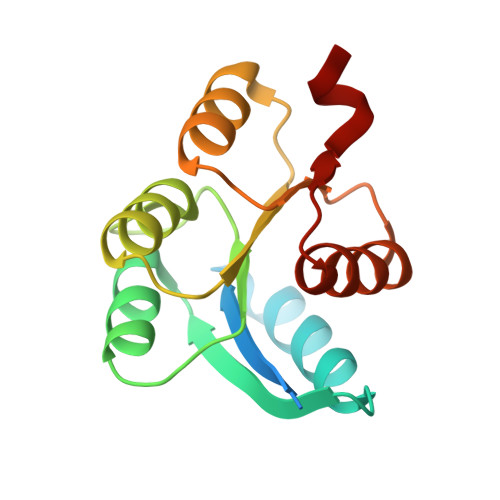
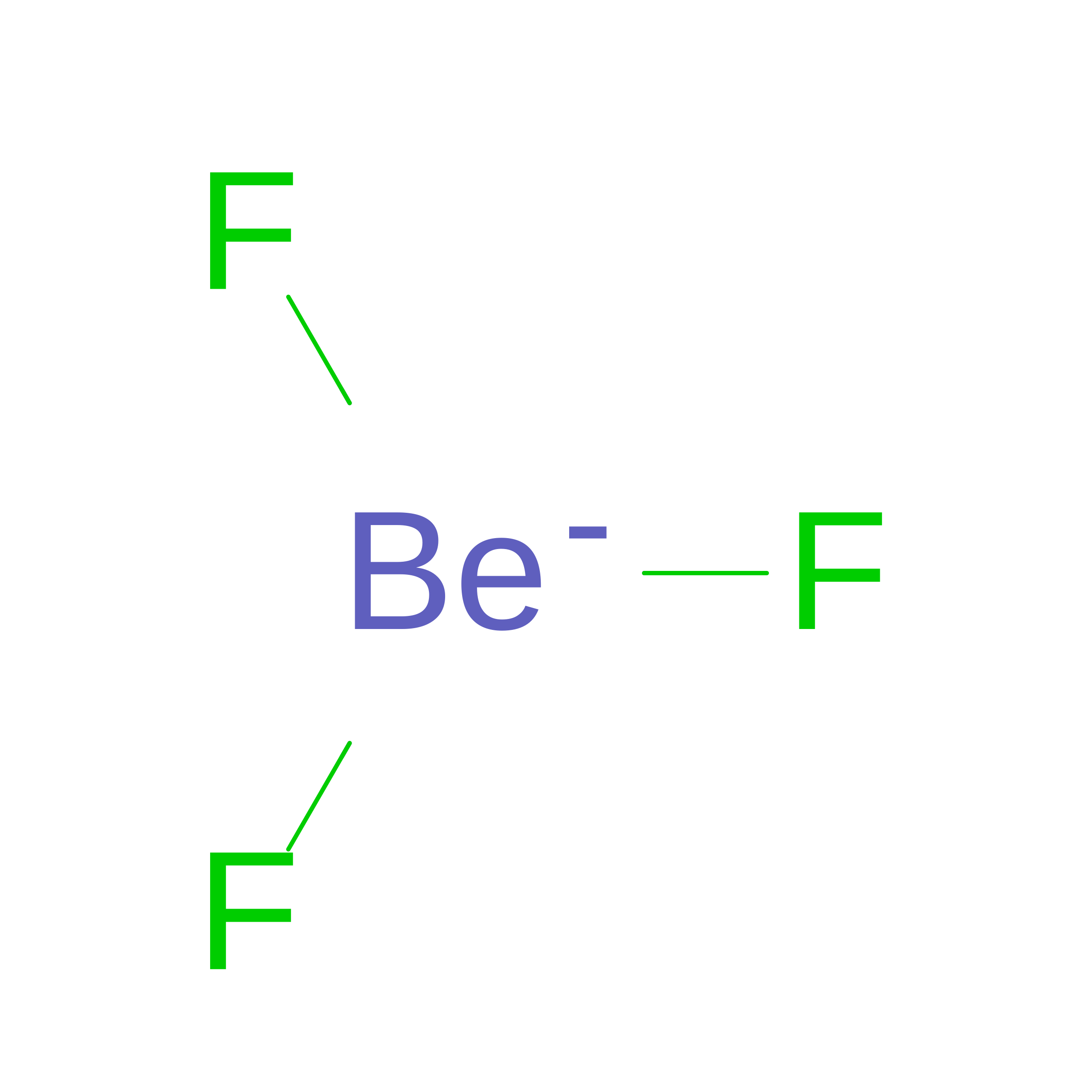
Crystal structure of receiver domain of putative NarL family response regulator spr1814 from Streptococcus pneumoniae in the presence of the phosphoryl analog beryllofluoride


Experimental Data Snapshot

  • Method: X-RAY DIFFRACTION
  • Resolution: 1.89 Å
  • R-Value Free: 
    0.226 (Depositor), 0.221 (DCC) 
  • R-Value Work: 
    0.185 (Depositor), 0.180 (DCC) 
  • R-Value Observed: 
    0.188 (Depositor) 

wwPDB Validation 3D Report Full Report

Validation slider image for 4E7P

This is version 1.1 of the entry. See complete history

Literature

Crystal structure of receiver domain of putative NarL family response regulator spr1814 from Streptococcus pneumoniae in the absence and presence of the phosphoryl analog beryllofluoride.

Park, A.K.Moon, J.H.Lee, K.S.Chi, Y.M.

(2012) Biochem Biophys Res Commun 421: 403-407

  • DOI: https://doi.org/10.1016/j.bbrc.2012.04.035
  • Primary Citation Related Structures: 
    4E7O, 4E7P

  • PubMed Abstract: 

    Spr1814 of Streptococcus pneumoniae is a putative response regulator (RR) that has four-helix helix-turn-helix DNA-binding domain and belongs to the NarL family. The prototypical RR contains two domains, an N-terminal receiver domain linked to a variable effector domain. The receiver domain functions as a phosphorylation-activated switch and contains the typical doubly wound five-stranded α/β fold. Here, we report the crystal structure of the receiver domain of spr1814 (spr1814(R)) determined in the absence and presence of beryllofluoride as a phosphoryl analog. Based on the overall structure, spr1814(R) was shown to contain the typical fold similar with other structures of the receiver domain; however, an additional linker region connecting the receiver and DNA-binding domain was inserted into the dimer interface of spr1814(R), resulting in the formation of unique dimer interface. Upon phosphorylation, the conformational change of the linker region was observed and this suggests that domain rearrangement between the receiver domain and effector domain could occur in full-length spr1814.


  • Organizational Affiliation
    • Division of Biotechnology, College of Life Sciences, Korea University, Seoul 136-713, Republic of Korea.

Macromolecule Content 

  • Total Structure Weight: 33.98 kDa 
  • Atom Count: 2,358 
  • Modeled Residue Count: 262 
  • Deposited Residue Count: 300 
  • Unique protein chains: 1

Macromolecules

Find similar proteins by:|  3D Structure
Entity ID: 1
MoleculeChains  Sequence LengthOrganismDetailsImage
Response regulator
A, B
150Streptococcus pneumoniae R6Mutation(s): 0 
Gene Names: rr11spr1814
UniProt
Find proteins for Q8DNC2 (Streptococcus pneumoniae (strain ATCC BAA-255 / R6))
Explore Q8DNC2 
Go to UniProtKB:  Q8DNC2
Entity Groups
Sequence Clusters30% Identity50% Identity70% Identity90% Identity95% Identity100% Identity
UniProt GroupQ8DNC2
Sequence Annotations
Expand
Reference Sequence

Experimental Data & Validation

Experimental Data

  • Method: X-RAY DIFFRACTION
  • Resolution: 1.89 Å
  • R-Value Free:  0.226 (Depositor), 0.221 (DCC) 
  • R-Value Work:  0.185 (Depositor), 0.180 (DCC) 
  • R-Value Observed: 0.188 (Depositor) 
Space Group: P 21 21 21
Unit Cell:
Length ( Å )Angle ( ˚ )
a = 75.837α = 90
b = 83.984β = 90
c = 49.511γ = 90
Software Package:
Software NamePurpose
HKL-2000data collection
MOLREPphasing
PHENIXrefinement
HKL-2000data reduction
HKL-2000data scaling

Structure Validation

View Full Validation Report


Entry History 

Deposition Data

Revision History  (Full details and data files)

  • Version 1.0: 2012-05-23
    Type: Initial release
  • Version 1.1: 2024-03-20
    Changes: Data collection, Database references, Derived calculations