4E2K | pdb_00004e2k

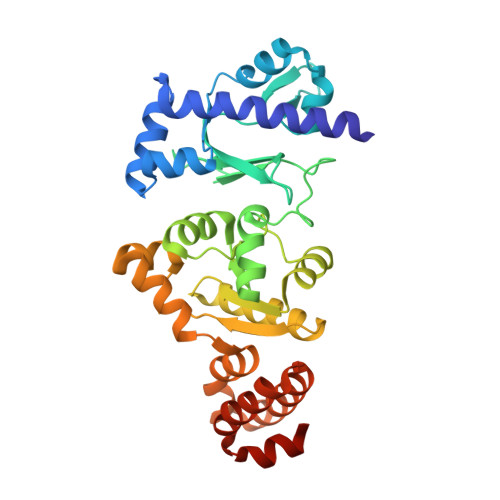
The structure of the S. aureus DnaG RNA Polymerase Domain


Experimental Data Snapshot

  • Method: X-RAY DIFFRACTION
  • Resolution: 2.15 Å
  • R-Value Free: 
    0.219 (Depositor), 0.212 (DCC) 
  • R-Value Work: 
    0.191 (Depositor), 0.184 (DCC) 
  • R-Value Observed: 
    0.192 (Depositor) 

Starting Model: experimental
View more details

wwPDB Validation 3D Report Full Report

Validation slider image for 4E2K

This is version 1.2 of the entry. See complete history

Literature

Binding Mechanism of Metal-NTP Substrates and Stringent-Response Alarmones to Bacterial DnaG-Type Primases.

Rymer, R.U.Solorio, F.A.Tehranchi, A.K.Chu, C.Corn, J.E.Keck, J.L.Wang, J.D.Berger, J.M.

(2012) Structure 20: 1478-1489

  • DOI: https://doi.org/10.1016/j.str.2012.05.017
  • Primary Citation Related Structures: 
    4E2K, 4EDG, 4EDK, 4EDR, 4EDT, 4EDV, 4EE1

  • PubMed Abstract: 

    Primases are DNA-dependent RNA polymerases found in all cellular organisms. In bacteria, primer synthesis is carried out by DnaG, an essential enzyme that serves as a key component of DNA replication initiation, progression, and restart. How DnaG associates with nucleotide substrates and how certain naturally prevalent nucleotide analogs impair DnaG function are unknown. We have examined one of the earliest stages in primer synthesis and its control by solving crystal structures of the S. aureus DnaG catalytic core bound to metal ion cofactors and either individual nucleoside triphosphates or the nucleotidyl alarmones, pppGpp and ppGpp. These structures, together with both biochemical analyses and comparative studies of enzymes that use the same catalytic fold as DnaG, pinpoint the predominant nucleotide-binding site of DnaG and explain how the induction of the stringent response in bacteria interferes with primer synthesis.


  • Organizational Affiliation
    • California Institute for Quantitative Biosciences, 374D Stanley Hall #3220, University of California, Berkeley, Berkeley, CA 94720-3220, USA.

Macromolecule Content 

  • Total Structure Weight: 37.92 kDa 
  • Atom Count: 2,905 
  • Modeled Residue Count: 319 
  • Deposited Residue Count: 329 
  • Unique protein chains: 1

Macromolecules

Find similar proteins by:|  3D Structure
Entity ID: 1
MoleculeChains  Sequence LengthOrganismDetailsImage
DNA primase329Staphylococcus aureusMutation(s): 0 
Gene Names: dnaG
EC: 2.7.7 (PDB Primary Data), 2.7.7.101 (UniProt)
UniProt
Find proteins for O05338 (Staphylococcus aureus)
Explore O05338 
Go to UniProtKB:  O05338
Entity Groups
Sequence Clusters30% Identity50% Identity70% Identity90% Identity95% Identity100% Identity
UniProt GroupO05338
Sequence Annotations
Expand
Reference Sequence

Experimental Data & Validation

Experimental Data

  • Method: X-RAY DIFFRACTION
  • Resolution: 2.15 Å
  • R-Value Free:  0.219 (Depositor), 0.212 (DCC) 
  • R-Value Work:  0.191 (Depositor), 0.184 (DCC) 
  • R-Value Observed: 0.192 (Depositor) 
Space Group: P 61
Unit Cell:
Length ( Å )Angle ( ˚ )
a = 151.334α = 90
b = 151.334β = 90
c = 38.571γ = 120
Software Package:
Software NamePurpose
Blu-Icedata collection
PHASERphasing
PHENIXrefinement
HKL-2000data reduction
HKL-2000data scaling

Structure Validation

View Full Validation Report


Entry History 

Deposition Data

Revision History  (Full details and data files)

  • Version 1.0: 2012-08-01
    Type: Initial release
  • Version 1.1: 2013-06-19
    Changes: Database references
  • Version 1.2: 2023-09-13
    Changes: Data collection, Database references, Derived calculations, Refinement description