4DNS | pdb_00004dns

Crystal structure of Bermuda grass isoallergen BG60 provides insight into the various cross-allergenicity of the pollen group 4 allergens


Experimental Data Snapshot

  • Method: X-RAY DIFFRACTION
  • Resolution: 2.15 Å
  • R-Value Free: 
    0.220 (Depositor), 0.229 (DCC) 
  • R-Value Work: 
    0.180 (Depositor), 0.199 (DCC) 
  • R-Value Observed: 
    0.220 (Depositor) 

Starting Model: experimental
View more details

wwPDB Validation 3D Report Full Report

Validation slider image for 4DNS

Ligand Structure Quality Assessment 


This is version 2.2 of the entry. See complete history

Literature

Various cross-reactivity of the grass pollen group 4 allergens: crystallographic study of the Bermuda grass isoallergen Cyn d 4.

Huang, T.H.Peng, H.J.Su, S.N.Liaw, S.H.

(2012) Acta Crystallogr D Biol Crystallogr 68: 1303-1310

  • DOI: https://doi.org/10.1107/S0907444912027552
  • Primary Citation Related Structures: 
    4DNS

  • PubMed Abstract: 

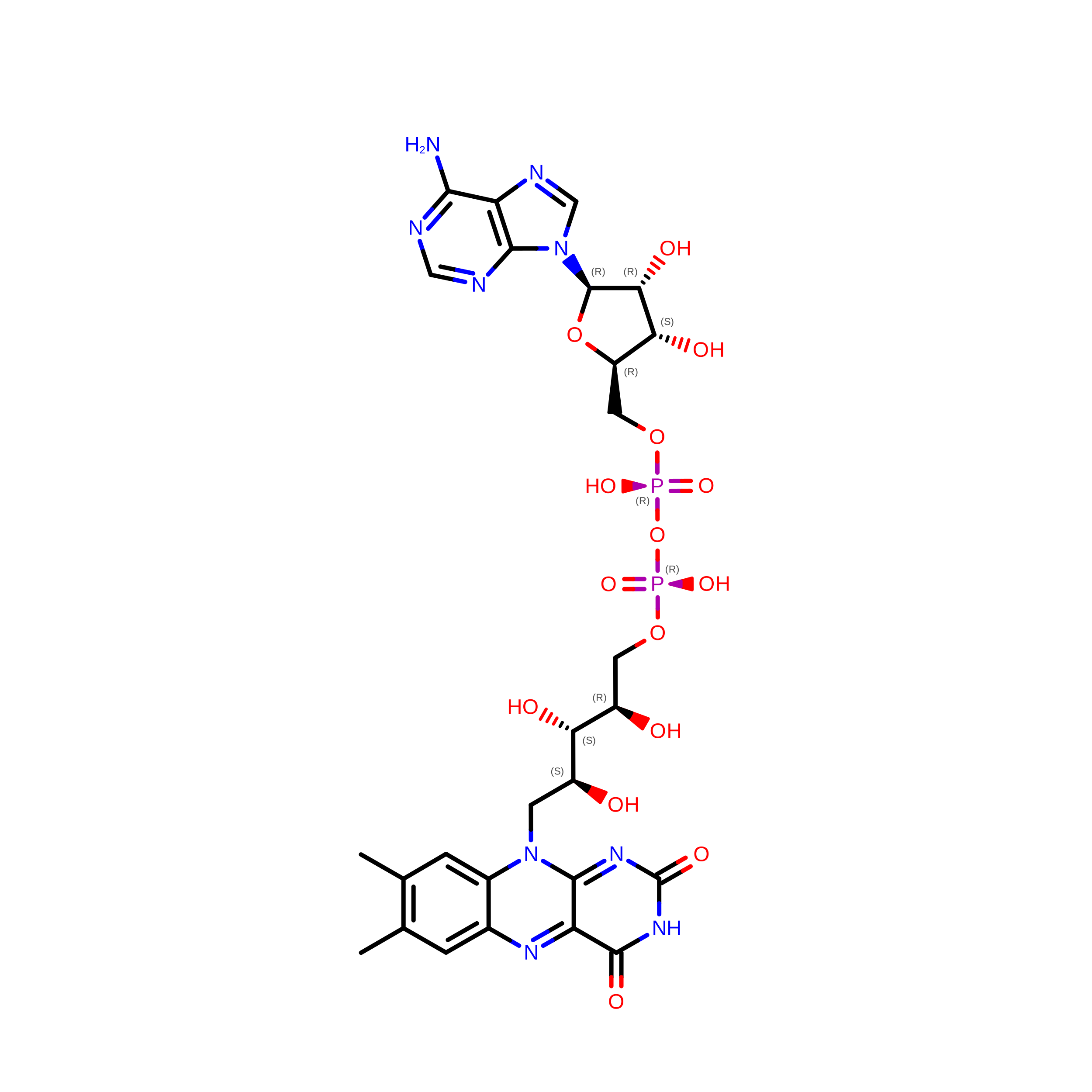
    The structure of Cyn d 4, the group 4 allergen from Bermuda grass, is reported at 2.15 Å resolution and is the first crystal structure of a naturally isolated pollen allergen. A conserved N-terminal segment that is only present in the large isoallergens forms extensive interactions with surrounding residues and hence greatly enhances the structural stability of the protein. Cyn d 4 contains an FAD cofactor that is covalently linked to His88 and Cys152. To date, all identified bicovalent flavoproteins are oxidases and their substrates are either sugars or secondary metabolites. A deep large hydrophobic substrate-binding cleft is present. Thus, Cyn d 4 may be an oxidase that is involved in the biosynthesis of a pollen-specific metabolite. Cyn d 4 shares ~70% sequence identity with the Pooideae group 4 allergens. Various cross-reactivities between grass pollen group 4 allergens have previously been demonstrated using sera from allergic patients. The protein surface displays an unusually large number of positively charged clusters, reflecting the high pI of ~10. 38 decapeptides that cover the solvent-accessible sequences did not show any significant IgE-binding activity using sera with high Cyn d 4 reactivity from four patients, suggesting that the IgE epitopes of Cyn d 4 are predominantly conformational in nature. Several group 4 structures were then modelled and their potential cross-reactive and species-specific IgE epitopes were proposed.


  • Organizational Affiliation
    • Department of Life Sciences, National Yang-Ming University, Taipei 11221, Taiwan.

Macromolecule Content 

  • Total Structure Weight: 112.7 kDa 
  • Atom Count: 8,048 
  • Modeled Residue Count: 971 
  • Deposited Residue Count: 994 
  • Unique protein chains: 1

Macromolecules

Find similar proteins by:|  3D Structure
Entity ID: 1
MoleculeChains  Sequence LengthOrganismDetailsImage
FAD-linked oxidoreductase BG60
A, B
497Cynodon dactylonMutation(s): 0 
EC: 1
UniProt
Find proteins for Q5QJ60 (Cynodon dactylon)
Explore Q5QJ60 
Go to UniProtKB:  Q5QJ60
Entity Groups
Sequence Clusters30% Identity50% Identity70% Identity90% Identity95% Identity100% Identity
UniProt GroupQ5QJ60
Glycosylation
Glycosylation Sites: 2
Sequence Annotations
Expand
Reference Sequence

Oligosaccharides

Help  
Entity ID: 2
MoleculeChains Length2D Diagram GlycosylationD Interactions
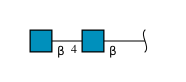
2-acetamido-2-deoxy-beta-D-glucopyranose-(1-4)-2-acetamido-2-deoxy-beta-D-glucopyranose
C, D
2N-Glycosylation
Glycosylation Resources
GlyTouCan: G42666HT
GlyCosmos: G42666HT
GlyGen: G42666HT

Experimental Data & Validation

Experimental Data

  • Method: X-RAY DIFFRACTION
  • Resolution: 2.15 Å
  • R-Value Free:  0.220 (Depositor), 0.229 (DCC) 
  • R-Value Work:  0.180 (Depositor), 0.199 (DCC) 
  • R-Value Observed: 0.220 (Depositor) 
Space Group: P 43 21 2
Unit Cell:
Length ( Å )Angle ( ˚ )
a = 86.043α = 90
b = 86.043β = 90
c = 309.432γ = 90
Software Package:
Software NamePurpose
HKL-2000data collection
CNSrefinement
HKL-2000data reduction
HKL-2000data scaling
CNSphasing

Structure Validation

View Full Validation Report


Ligand Structure Quality Assessment 


Entry History 

Deposition Data

Revision History  (Full details and data files)

  • Version 1.0: 2012-12-05
    Type: Initial release
  • Version 2.0: 2020-07-29
    Type: Remediation
    Reason: Carbohydrate remediation
    Changes: Atomic model, Data collection, Derived calculations, Structure summary
  • Version 2.1: 2023-11-08
    Changes: Data collection, Database references, Refinement description, Structure summary
  • Version 2.2: 2024-10-30
    Changes: Structure summary