4DN8 | pdb_00004dn8

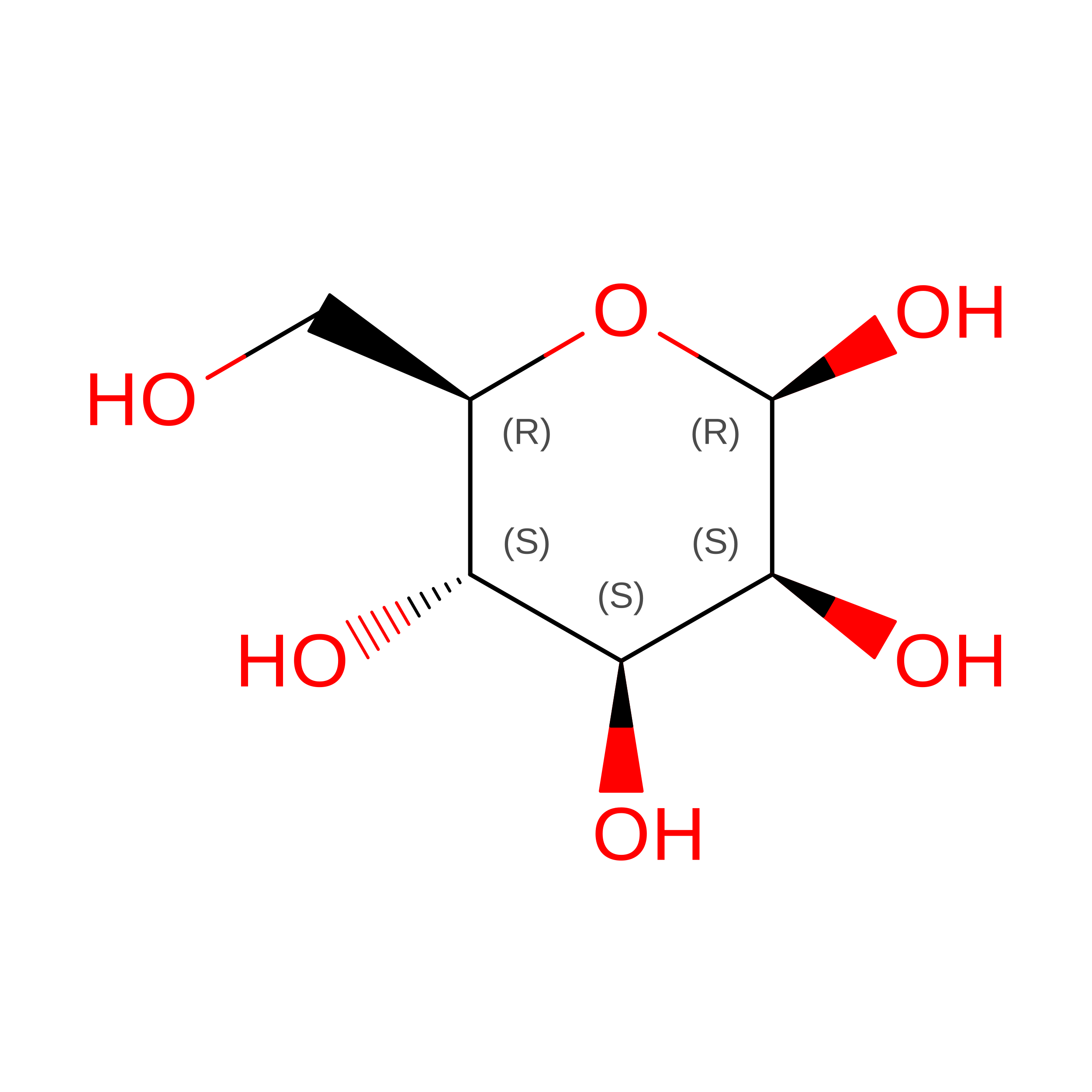
Structure of porcine surfactant protein D neck and carbohydrate recognition domain complexed with mannose


Experimental Data Snapshot

  • Method: X-RAY DIFFRACTION
  • Resolution: 2.20 Å
  • R-Value Free: 
    0.237 (Depositor), 0.237 (DCC) 
  • R-Value Work: 
    0.199 (Depositor), 0.194 (DCC) 
  • R-Value Observed: 
    0.203 (Depositor) 

Starting Model: experimental
View more details

wwPDB Validation 3D Report Full Report

Validation slider image for 4DN8

Ligand Structure Quality Assessment 


This is version 1.5 of the entry. See complete history. 

Literature

A Unique Sugar-binding Site Mediates the Distinct Anti-influenza Activity of Pig Surfactant Protein D.

van Eijk, M., Rynkiewicz, M.J., White, M.R., Hartshorn, K.L., Zou, X., Schulten, K., Luo, D., Crouch, E.C., Cafarella, T.R., Head, J.F., Haagsman, H.P., Seaton, B.A.

(2012) J Biol Chem 287: 26666-26677

  • DOI: https://doi.org/10.1074/jbc.M112.368571
  • Primary Citation Related Structures: 
    4DN8

  • PubMed Abstract: 

    Pigs can act as intermediate hosts by which reassorted influenza A virus (IAV) strains can be transmitted to humans and cause pandemic influenza outbreaks. The innate host defense component surfactant protein D (SP-D) interacts with glycans on the hemagglutinin of IAV and contributes to protection against IAV infection in mammals. This study shows that a recombinant trimeric neck lectin fragment derived from porcine SP-D (pSP-D) exhibits profound inhibitory activity against IAV, in contrast to comparable fragments derived from human SP-D. Crystallographic analysis of the pSP-D fragment complexed with a viral sugar component shows that a unique tripeptide loop alters the lectin site conformation of pSP-D. Molecular dynamics simulations highlight the role of this flexible loop, which adopts a more stable conformation upon sugar binding and may facilitate binding to viral glycans through contact with distal portions of the branched mannoside. The combined data demonstrate that porcine-specific structural features of SP-D contribute significantly to its distinct anti-IAV activity. These findings could help explain why pigs serve as important reservoirs for newly emerging pathogenic IAV strains.


  • Organizational Affiliation: 
    • Department of Infectious Diseases and Immunology, Faculty of Veterinary Medicine, Utrecht University, 3584 CL Utrecht, The Netherlands.

Macromolecule Content 

  • Total Structure Weight: 17.32 kDa 
  • Atom Count: 1,256 
  • Modeled Residue Count: 155 
  • Deposited Residue Count: 156 
  • Unique protein chains: 1

Macromolecules

Find similar proteins by:|  3D Structure
Entity ID: 1
MoleculeChains  Sequence LengthOrganismDetailsImage
Pulmonary surfactant-associated protein D156Sus scrofaMutation(s): 1 
Gene Names: SFTPD
UniProt
Find proteins for Q9N1X4 (Sus scrofa)
Explore Q9N1X4 
Go to UniProtKB:  Q9N1X4
Entity Groups
Sequence Clusters30% Identity50% Identity70% Identity90% Identity95% Identity100% Identity
UniProt GroupQ9N1X4
Sequence Annotations
Expand
Reference Sequence

Experimental Data & Validation

Experimental Data

  • Method: X-RAY DIFFRACTION
  • Resolution: 2.20 Å
  • R-Value Free:  0.237 (Depositor), 0.237 (DCC) 
  • R-Value Work:  0.199 (Depositor), 0.194 (DCC) 
  • R-Value Observed: 0.203 (Depositor) 
Space Group: P 63
Unit Cell:
Length ( Å )Angle ( ˚ )
a = 66.024α = 90
b = 66.024β = 90
c = 66.018γ = 120
Software Package:
Software NamePurpose
CrystalCleardata collection
PHASERphasing
PHENIXrefinement
DENZOdata reduction
SCALEPACKdata scaling

Structure Validation

View Full Validation Report


Ligand Structure Quality Assessment 


Entry History 

Revision History  (Full details and data files)

  • Version 1.0: 2012-06-20
    Type: Initial release
  • Version 1.1: 2012-08-22
    Changes: Database references
  • Version 1.2: 2020-07-29
    Type: Remediation
    Reason: Carbohydrate remediation
    Changes: Advisory, Data collection, Database references, Derived calculations, Structure summary
  • Version 1.3: 2021-05-19
    Changes: Source and taxonomy, Structure summary
  • Version 1.4: 2023-09-13
    Changes: Advisory, Data collection, Database references, Refinement description
  • Version 1.5: 2024-11-20
    Changes: Structure summary