4CQO | pdb_00004cqo

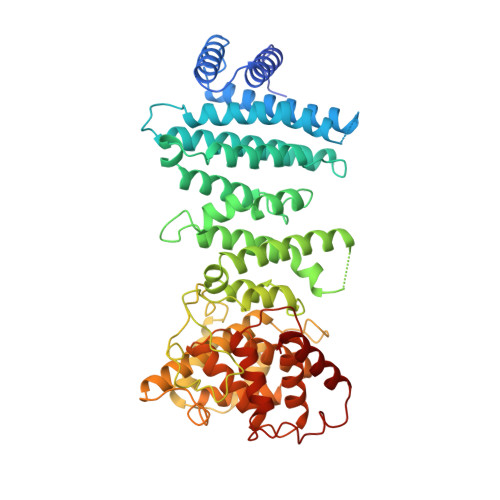
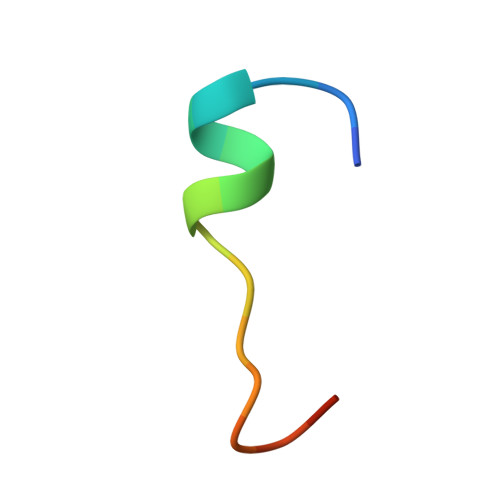
Structure of the human CNOT1 superfamily homology domain in complex with a Nanos1 peptide


Experimental Data Snapshot

  • Method: X-RAY DIFFRACTION
  • Resolution: 2.80 Å
  • R-Value Free: 
    0.243 (Depositor), 0.249 (DCC) 
  • R-Value Work: 
    0.222 (Depositor), 0.230 (DCC) 
  • R-Value Observed: 
    0.223 (Depositor) 

Starting Model: experimental
View more details

wwPDB Validation 3D Report Full Report

Validation slider image for 4CQO

This is version 1.2 of the entry. See complete history

Literature

Structural Basis for the Nanos-Mediated Recruitment of the Ccr4-not Complex and Translational Repression

Bhandari, D.Raisch, T.Weichenrieder, O.Jonas, S.Izaurralde, E.

(2014) Genes Dev 28: 888

  • DOI: https://doi.org/10.1101/gad.237289.113
  • Primary Citation Related Structures: 
    4CQO

  • PubMed Abstract: 

    The RNA-binding proteins of the Nanos family play an essential role in germ cell development and survival in a wide range of metazoan species. They function by suppressing the expression of target mRNAs through the recruitment of effector complexes, which include the CCR4-NOT deadenylase complex. Here, we show that the three human Nanos paralogs (Nanos1-3) interact with the CNOT1 C-terminal domain and determine the structural basis for the specific molecular recognition. Nanos1-3 bind CNOT1 through a short CNOT1-interacting motif (NIM) that is conserved in all vertebrates and some invertebrate species. The crystal structure of the human Nanos1 NIM peptide bound to CNOT1 reveals that the peptide opens a conserved hydrophobic pocket on the CNOT1 surface by inserting conserved aromatic residues. The substitutions of these aromatic residues in the Nanos1-3 NIMs abolish binding to CNOT1 and abrogate the ability of the proteins to repress translation. Our findings provide the structural basis for the recruitment of the CCR4-NOT complex by vertebrate Nanos, indicate that the NIMs are the major determinants of the translational repression mediated by Nanos, and identify the CCR4-NOT complex as the main effector complex for Nanos function.


  • Organizational Affiliation
    • Department of Biochemistry, Max Planck Institute for Developmental Biology, 72076 Tübingen, Germany.

Macromolecule Content 

  • Total Structure Weight: 126.89 kDa 
  • Atom Count: 8,624 
  • Modeled Residue Count: 1,055 
  • Deposited Residue Count: 1,104 
  • Unique protein chains: 2

Macromolecules

Find similar proteins by:|  3D Structure
Entity ID: 1
MoleculeChains  Sequence LengthOrganismDetailsImage
CCR4-NOT TRANSCRIPTION COMPLEX SUBUNIT 1
A, C
535Homo sapiensMutation(s): 0 
UniProt & NIH Common Fund Data Resources
Find proteins for A5YKK6 (Homo sapiens)
Explore A5YKK6 
Go to UniProtKB:  A5YKK6
PHAROS:  A5YKK6
GTEx:  ENSG00000125107 
Entity Groups
Sequence Clusters30% Identity50% Identity70% Identity90% Identity95% Identity100% Identity
UniProt GroupA5YKK6
Sequence Annotations
Expand
Reference Sequence
Find similar proteins by:  Sequence   |   3D Structure  
Entity ID: 2
MoleculeChains  Sequence LengthOrganismDetailsImage
NANOS HOMOLOG 1
B, D
17Homo sapiensMutation(s): 0 
UniProt & NIH Common Fund Data Resources
Find proteins for Q8WY41 (Homo sapiens)
Explore Q8WY41 
Go to UniProtKB:  Q8WY41
PHAROS:  Q8WY41
GTEx:  ENSG00000188613 
Entity Groups
Sequence Clusters30% Identity50% Identity70% Identity90% Identity95% Identity100% Identity
UniProt GroupQ8WY41
Sequence Annotations
Expand
Reference Sequence

Experimental Data & Validation

Experimental Data

  • Method: X-RAY DIFFRACTION
  • Resolution: 2.80 Å
  • R-Value Free:  0.243 (Depositor), 0.249 (DCC) 
  • R-Value Work:  0.222 (Depositor), 0.230 (DCC) 
  • R-Value Observed: 0.223 (Depositor) 
Space Group: P 21 21 2
Unit Cell:
Length ( Å )Angle ( ˚ )
a = 96.53α = 90
b = 167.33β = 90
c = 112.04γ = 90
Software Package:
Software NamePurpose
PHENIXrefinement
XDSdata reduction
XSCALEdata scaling
PHASERphasing

Structure Validation

View Full Validation Report


Entry History 

Deposition Data

Revision History  (Full details and data files)

  • Version 1.0: 2014-04-23
    Type: Initial release
  • Version 1.1: 2014-04-30
    Changes: Database references
  • Version 1.2: 2023-12-20
    Changes: Data collection, Database references, Other, Refinement description