4CD7 | pdb_00004cd7

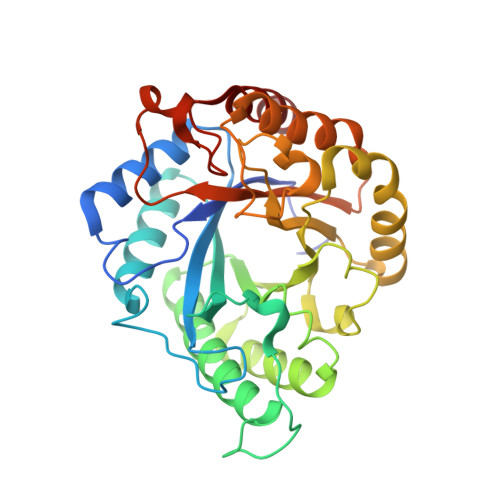
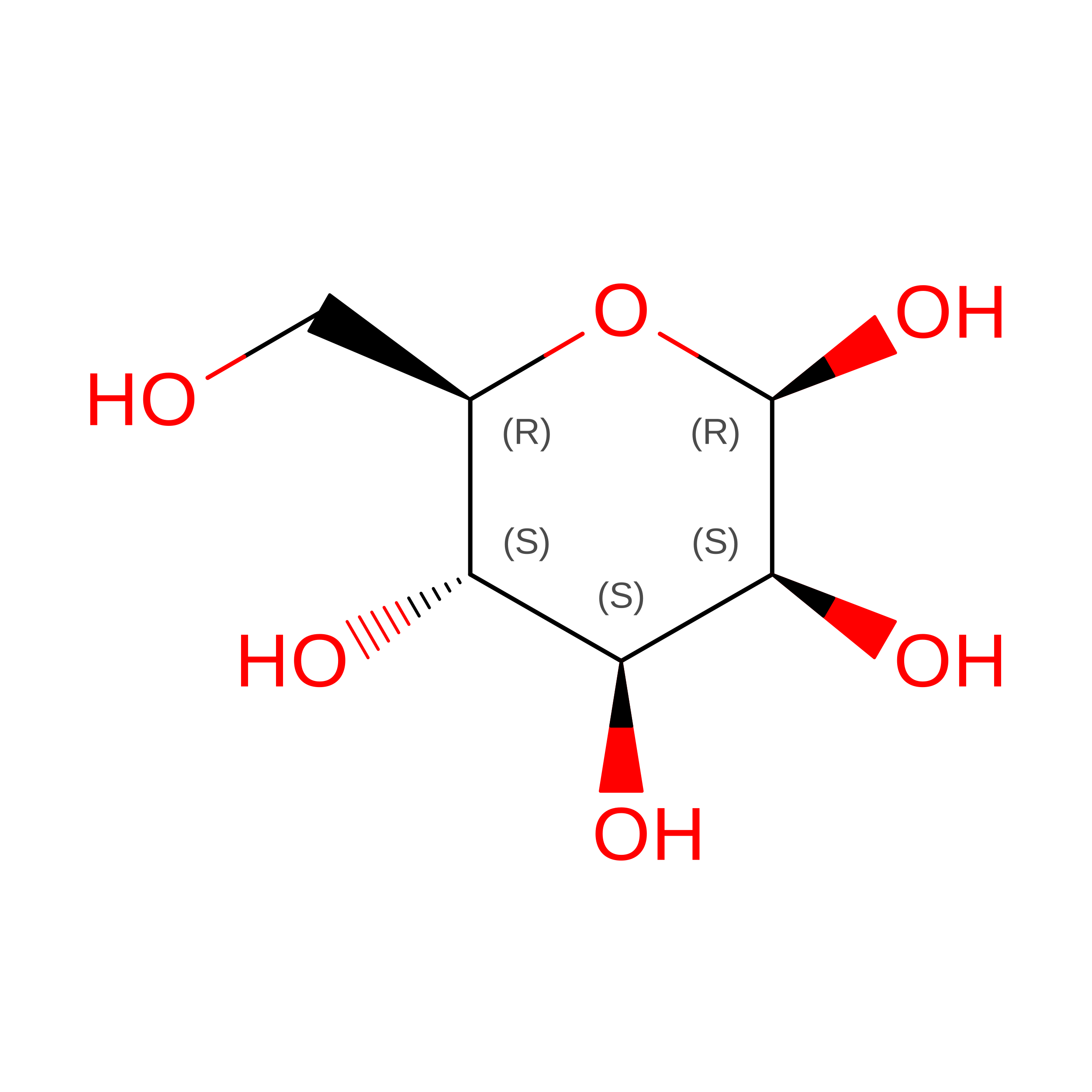
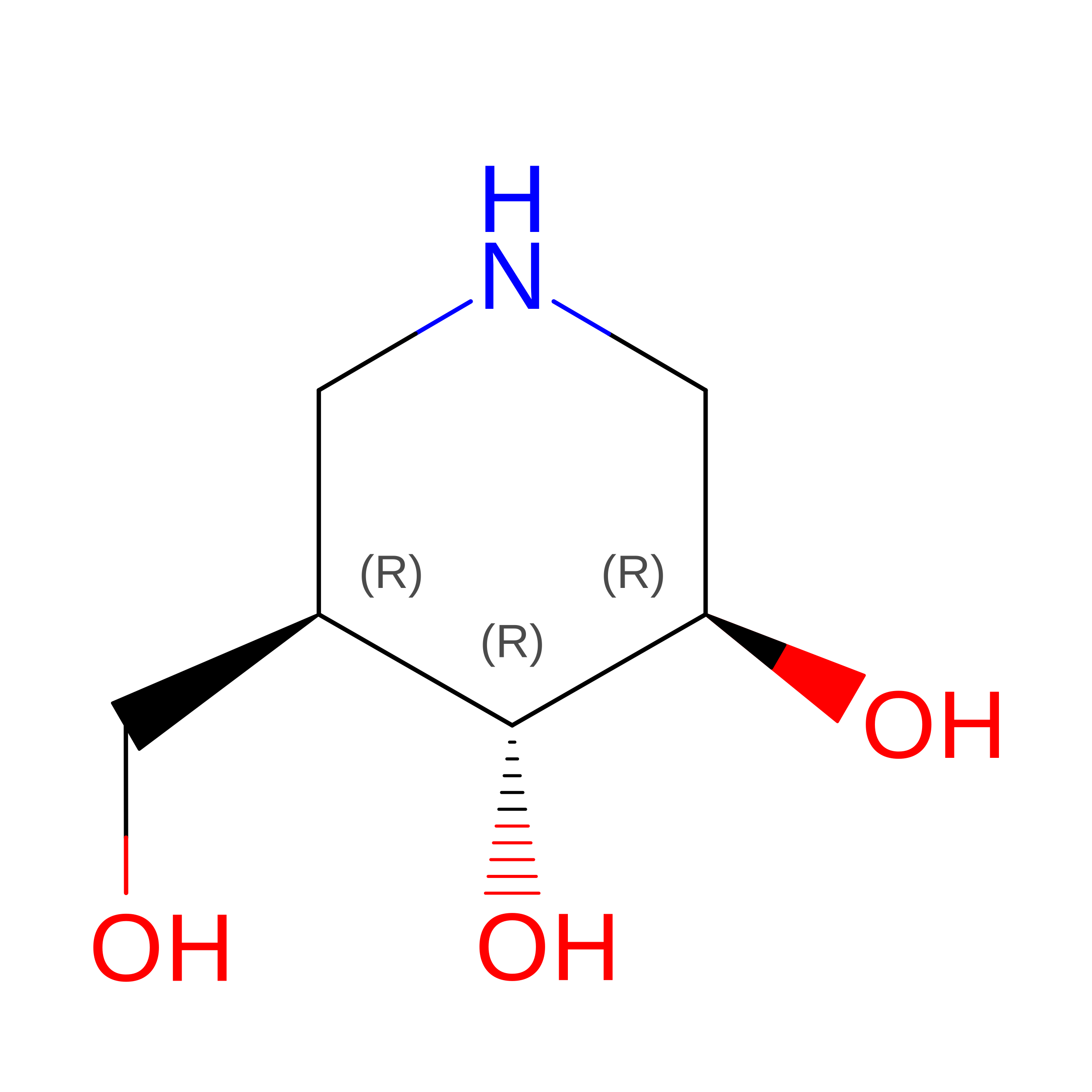
The structure of GH113 beta-mannanase AaManA from Alicyclobacillus acidocaldarius in complex with ManIFG and beta-1,4-mannobiose


Experimental Data Snapshot

  • Method: X-RAY DIFFRACTION
  • Resolution: 1.65 Å
  • R-Value Free: 
    0.196 (Depositor), 0.207 (DCC) 
  • R-Value Work: 
    0.151 (Depositor), 0.166 (DCC) 
  • R-Value Observed: 
    0.153 (Depositor) 

Starting Model: experimental
View more details

wwPDB Validation 3D Report Full Report

Validation slider image for 4CD7

Ligand Structure Quality Assessment 


This is version 2.1 of the entry. See complete history

Literature

Combined Inhibitor Free-Energy Landscape and Structural Analysis Reports on the Mannosidase Conformational Coordinate.

Williams, R.J.Iglesias-Fernandez, J.Stepper, J.Jackson, A.Thompson, A.J.Lowe, E.C.White, J.M.Gilbert, H.J.Rovira, C.Davies, G.J.Williams, S.J.

(2014) Angew Chem Int Ed Engl 53: 1087

  • DOI: https://doi.org/10.1002/anie.201308334
  • Primary Citation Related Structures: 
    4CD4, 4CD5, 4CD6, 4CD7, 4CD8

  • PubMed Abstract: 

    Mannosidases catalyze the hydrolysis of a diverse range of polysaccharides and glycoconjugates, and the various sequence-based mannosidase families have evolved ingenious strategies to overcome the stereoelectronic challenges of mannoside chemistry. Using a combination of computational chemistry, inhibitor design and synthesis, and X-ray crystallography of inhibitor/enzyme complexes, it is demonstrated that mannoimidazole-type inhibitors are energetically poised to report faithfully on mannosidase transition-state conformation, and provide direct evidence for the conformational itinerary used by diverse mannosidases, including β-mannanases from families GH26 and GH113. Isofagomine-type inhibitors are poor mimics of transition-state conformation, owing to the high energy barriers that must be crossed to attain mechanistically relevant conformations, however, these sugar-shaped heterocycles allow the acquisition of ternary complexes that span the active site, thus providing valuable insight into active-site residues involved in substrate recognition.


  • Organizational Affiliation
    • School of Chemistry and Bio21 Molecular Science and Biotechnology Institute, University of Melbourne, Parkville, Vic 3010 (Australia).

Macromolecule Content 

  • Total Structure Weight: 74.03 kDa 
  • Atom Count: 5,595 
  • Modeled Residue Count: 628 
  • Deposited Residue Count: 640 
  • Unique protein chains: 1

Macromolecules

Find similar proteins by:|  3D Structure
Entity ID: 1
MoleculeChains  Sequence LengthOrganismDetailsImage
ENDO-BETA-1,4-MANNANASE
A, B
320Alicyclobacillus acidocaldariusMutation(s): 0 
EC: 3.2.1.78
UniProt
Find proteins for A5H1I6 (Alicyclobacillus acidocaldarius)
Explore A5H1I6 
Go to UniProtKB:  A5H1I6
Entity Groups
Sequence Clusters30% Identity50% Identity70% Identity90% Identity95% Identity100% Identity
UniProt GroupA5H1I6
Sequence Annotations
Expand
Reference Sequence

Oligosaccharides

Help  
Entity ID: 2
MoleculeChains Length2D Diagram GlycosylationD Interactions
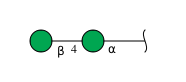
beta-D-mannopyranose-(1-4)-alpha-D-mannopyranose
C, D
2N/A
Glycosylation Resources
GlyTouCan: G78926JO
GlyCosmos: G78926JO
GlyGen: G78926JO

Experimental Data & Validation

Experimental Data

  • Method: X-RAY DIFFRACTION
  • Resolution: 1.65 Å
  • R-Value Free:  0.196 (Depositor), 0.207 (DCC) 
  • R-Value Work:  0.151 (Depositor), 0.166 (DCC) 
  • R-Value Observed: 0.153 (Depositor) 
Space Group: P 21 21 21
Unit Cell:
Length ( Å )Angle ( ˚ )
a = 69.472α = 90
b = 76.586β = 90
c = 140.212γ = 90
Software Package:
Software NamePurpose
REFMACrefinement
xia2data reduction
Aimlessdata scaling
MOLREPphasing

Structure Validation

View Full Validation Report


Ligand Structure Quality Assessment 


Entry History 

Revision History  (Full details and data files)

  • Version 1.0: 2014-04-02
    Type: Initial release
  • Version 1.1: 2015-07-15
    Changes: Non-polymer description
  • Version 2.0: 2020-07-29
    Type: Remediation
    Reason: Carbohydrate remediation
    Changes: Atomic model, Data collection, Derived calculations, Other, Structure summary
  • Version 2.1: 2023-12-20
    Changes: Data collection, Database references, Refinement description, Structure summary