Download Mendeley
The Structural Basis for Serotype-Specific Neutralization of Dengue Virus by a Human Antibody.
Teoh, E.P., Kukkaro, P., Teo, E.W., Lim, A.P.C., Tan, T.T., Yip, A., Schul, W., Aung, M., Kostyuchenko, V.A., Leo, Y.S., Chan, S.H., Smith, K.G.C., Chan, A.H.Y., Zou, G., Ooi, E.E., Kemeny, D.M., Tan, G.K., Ng, J.K.W., Ng, M.L., Alonso, S., Fisher, D., Shi, P., Hanson, B.J., Lok, S., Macary, P.A.(2012) Sci Transl Med 4: 9RA83
- PubMed: 22723463 Search on PubMed
- DOI: https://doi.org/10.1126/scitranslmed.3003888
- Primary Citation Related Structures:
3J05, 4CAU - PubMed Abstract:
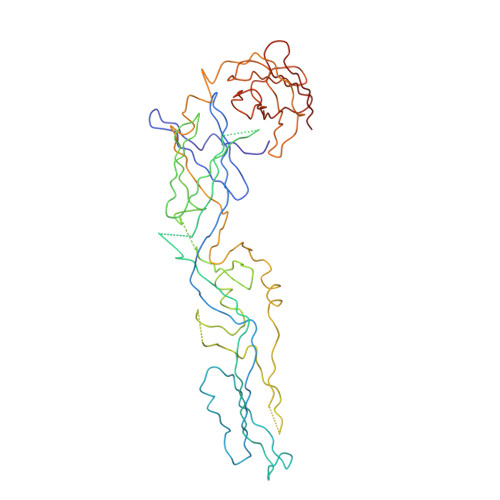
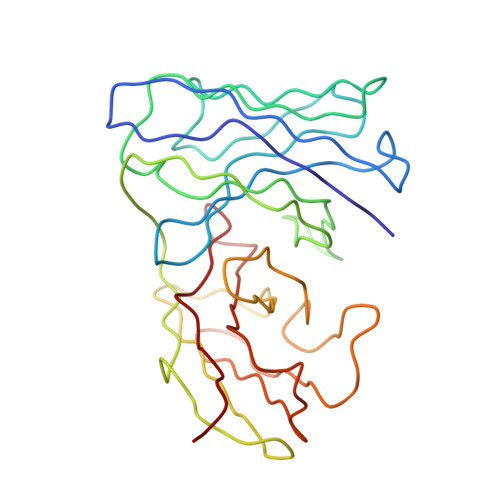
Dengue virus (DENV) is a mosquito-borne flavivirus that affects 2.5 billion people worldwide. There are four dengue serotypes (DENV1 to DENV4), and infection with one elicits lifelong immunity to that serotype but offers only transient protection against the other serotypes. Identification of the protective determinants of the human antibody response to DENV is a vital requirement for the design and evaluation of future preventative therapies and treatments. Here, we describe the isolation of a neutralizing antibody from a DENV1-infected patient. The human antibody 14c10 (HM14c10) binds specifically to DENV1. HM14c10 neutralizes the virus principally by blocking virus attachment; at higher concentrations, a post-attachment step can also be inhibited. In vivo studies show that the HM14c10 antibody has antiviral activity at picomolar concentrations. A 7 Å resolution cryoelectron microscopy map of Fab fragments of HM14c10 in a complex with DENV1 shows targeting of a discontinuous epitope that spans the adjacent surface of envelope protein dimers. As found previously, a human antibody specific for the related West Nile virus binds to a similar quaternary structure, suggesting that this could be an immunodominant epitope. These findings provide a structural and molecular context for durable, serotype-specific immunity to DENV infection.
- Department of Microbiology and Life Sciences Institute Immunology Programme, National University of Singapore, Singapore 117597, Singapore.
Organizational Affiliation: