4C4R | pdb_00004c4r

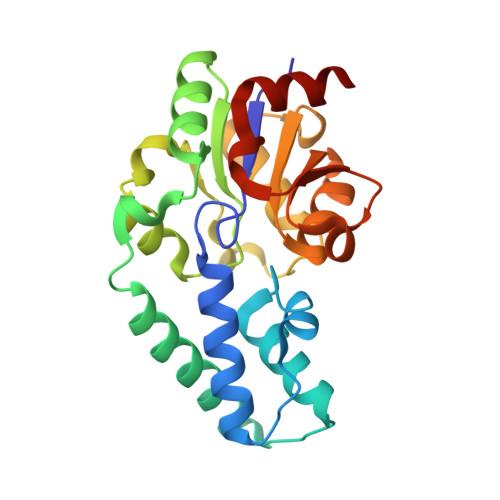
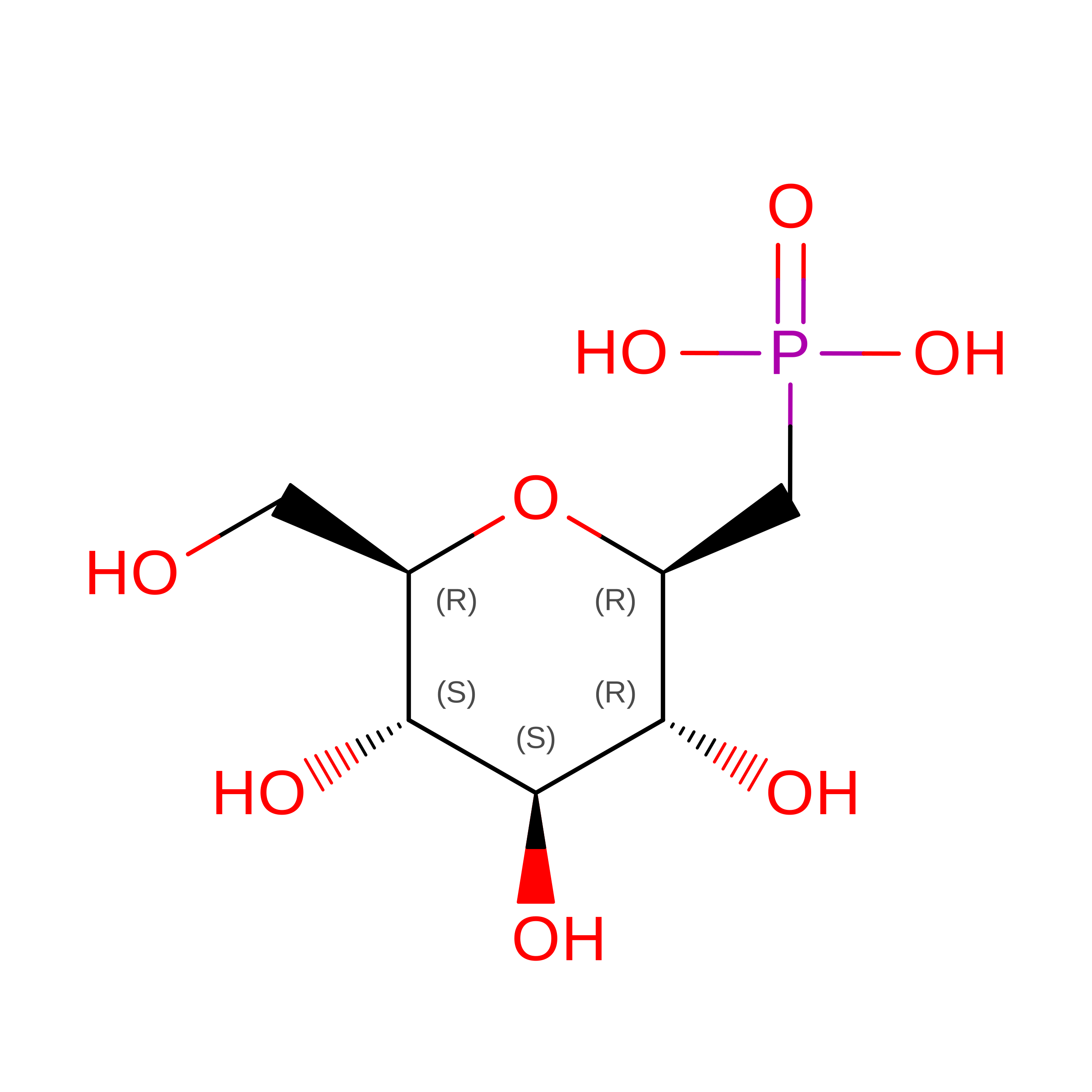
Structure of beta-phosphoglucomutase in complex with a phosphonate analogue of beta-glucose-1-phosphate and magnesium trifluoride


Experimental Data Snapshot

  • Method: X-RAY DIFFRACTION
  • Resolution: 1.10 Å
  • R-Value Free: 
    0.173 (Depositor), 0.173 (DCC) 
  • R-Value Work: 
    0.149 (Depositor), 0.148 (DCC) 
  • R-Value Observed: 
    0.150 (Depositor) 

Starting Model: experimental
View more details

wwPDB Validation 3D Report Full Report

Validation slider image for 4C4R

Ligand Structure Quality Assessment 


This is version 1.4 of the entry. See complete history

Literature

Alpha-Fluorophosphonates Reveal How a Phosphomutase Conserves Transition State Conformation Over Hexose Recognition in its Two-Step Reaction.

Jin, Y.Bhattasali, D.Pellegrini, E.Forget, S.M.Baxter, N.J.Cliff, M.J.Bowler, M.W.Jakeman, D.L.Blackburn, G.M.Waltho, J.P.

(2014) Proc Natl Acad Sci U S A 111: 12384

  • DOI: https://doi.org/10.1073/pnas.1402850111
  • Primary Citation Related Structures: 
    2WF7, 4C4R, 4C4S, 4C4T

  • PubMed Abstract: 

    β-Phosphoglucomutase (βPGM) catalyzes isomerization of β-D-glucose 1-phosphate (βG1P) into D-glucose 6-phosphate (G6P) via sequential phosphoryl transfer steps using a β-D-glucose 1,6-bisphosphate (βG16BP) intermediate. Synthetic fluoromethylenephosphonate and methylenephosphonate analogs of βG1P deliver novel step 1 transition state analog (TSA) complexes for βPGM, incorporating trifluoromagnesate and tetrafluoroaluminate surrogates of the phosphoryl group. Within an invariant protein conformation, the β-D-glucopyranose ring in the βG1P TSA complexes (step 1) is flipped over and shifted relative to the G6P TSA complexes (step 2). Its equatorial hydroxyl groups are hydrogen-bonded directly to the enzyme rather than indirectly via water molecules as in step 2. The (C)O-P bond orientation for binding the phosphate in the inert phosphate site differs by ∼ 30° between steps 1 and 2. By contrast, the orientations for the axial O-Mg-O alignment for the TSA of the phosphoryl group in the catalytic site differ by only ∼ 5°, and the atoms representing the five phosphorus-bonded oxygens in the two transition states (TSs) are virtually superimposable. The conformation of βG16BP in step 1 does not fit into the same invariant active site for step 2 by simple positional interchange of the phosphates: the TS alignment is achieved by conformational change of the hexose rather than the protein.


  • Organizational Affiliation
    • Department of Molecular Biology and Biotechnology, Krebs Institute, University of Sheffield, Western Bank, Sheffield S10 2TN, United Kingdom;

Macromolecule Content 

  • Total Structure Weight: 24.6 kDa 
  • Atom Count: 2,295 
  • Modeled Residue Count: 218 
  • Deposited Residue Count: 221 
  • Unique protein chains: 1

Macromolecules

Find similar proteins by:|  3D Structure
Entity ID: 1
MoleculeChains  Sequence LengthOrganismDetailsImage
BETA-PHOSPHOGLUCOMUTASE221Lactococcus lactisMutation(s): 0 
EC: 5.4.2.6
UniProt
Find proteins for P71447 (Lactococcus lactis subsp. lactis (strain IL1403))
Explore P71447 
Go to UniProtKB:  P71447
Entity Groups
Sequence Clusters30% Identity50% Identity70% Identity90% Identity95% Identity100% Identity
UniProt GroupP71447
Sequence Annotations
Expand
Reference Sequence

Experimental Data & Validation

Experimental Data

  • Method: X-RAY DIFFRACTION
  • Resolution: 1.10 Å
  • R-Value Free:  0.173 (Depositor), 0.173 (DCC) 
  • R-Value Work:  0.149 (Depositor), 0.148 (DCC) 
  • R-Value Observed: 0.150 (Depositor) 
Space Group: P 21 21 21
Unit Cell:
Length ( Å )Angle ( ˚ )
a = 38.012α = 90
b = 54.201β = 90
c = 105.407γ = 90
Software Package:
Software NamePurpose
PHENIXrefinement
XDSdata reduction
SCALAdata scaling
MOLREPphasing

Structure Validation

View Full Validation Report


Ligand Structure Quality Assessment 


Entry History 

Deposition Data

Revision History  (Full details and data files)

  • Version 1.0: 2014-07-16
    Type: Initial release
  • Version 1.1: 2014-08-20
    Changes: Database references
  • Version 1.2: 2014-09-10
    Changes: Database references
  • Version 1.3: 2020-07-29
    Type: Remediation
    Reason: Carbohydrate remediation
    Changes: Derived calculations, Other, Structure summary
  • Version 1.4: 2023-12-20
    Changes: Data collection, Database references, Refinement description, Structure summary