4BRY | pdb_00004bry

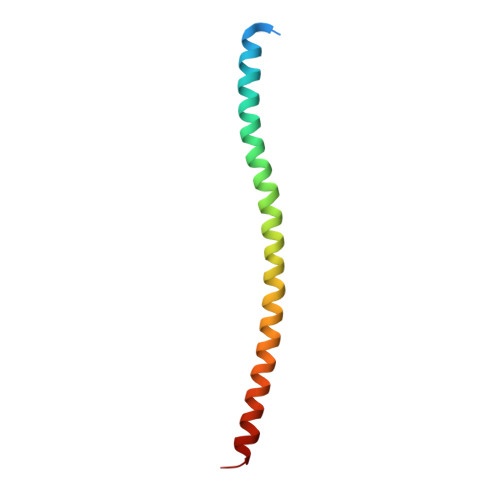
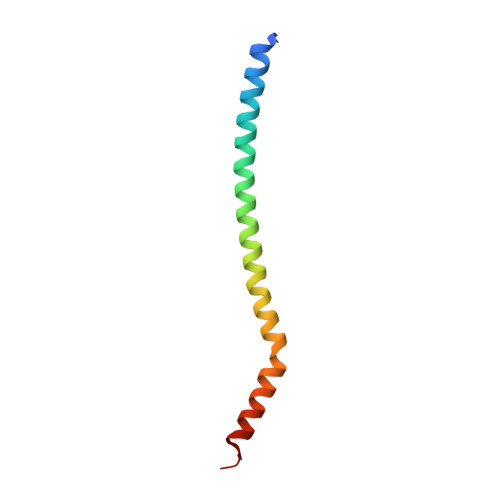
The Idas:Geminin heterodimeric parallel coiled-coil


Experimental Data Snapshot

  • Method: X-RAY DIFFRACTION
  • Resolution: 2.89 Å
  • R-Value Free: 
    0.226 (Depositor), 0.235 (DCC) 
  • R-Value Work: 
    0.203 (Depositor), 0.205 (DCC) 
  • R-Value Observed: 
    0.204 (Depositor) 

Starting Model: experimental
View more details

wwPDB Validation 3D Report Full Report

Validation slider image for 4BRY

This is version 1.3 of the entry. See complete history

Literature

The Geminin and Idas Coiled Coils Preferentially Form a Heterodimer that Inhibits Geminin Function in DNA Replication Licensing

Caillate, C.Pefani, E.D.Gillespie, P.J.Taraviras, S.Blow, J.J.Lygerou, Z.Perrakis, A.

(2013) J Biological Chem 288: 31624

  • DOI: https://doi.org/10.1074/jbc.M113.491928
  • Primary Citation Related Structures: 
    4BRY

  • PubMed Abstract: 

    Geminin is an important regulator of proliferation and differentiation in metazoans, which predominantly inhibits the DNA replication licensing factor Cdt1, preventing genome over-replication. We show that Geminin preferentially forms stable coiled-coil heterodimers with its homologue, Idas. In contrast to Idas-Geminin heterodimers, Idas homodimers are thermodynamically unstable and are unlikely to exist as a stable macromolecule under physiological conditions. The crystal structure of the homology regions of Idas in complex with Geminin showed a tight head-to-head heterodimeric coiled-coil. This Idas-Geminin heterodimer binds Cdt1 less strongly than Geminin-Geminin, still with high affinity (∼30 nm), but with notably different thermodynamic properties. Consistently, in Xenopus egg extracts, Idas-Geminin is less active in licensing inhibition compared with a Geminin-Geminin homodimer. In human cultured cells, ectopic expression of Idas leads to limited over-replication, which is counteracted by Geminin co-expression. The properties of the Idas-Geminin complex suggest it as the functional form of Idas and provide a possible mechanism to modulate Geminin activity.


  • Organizational Affiliation
    • From the Division of Biochemistry, The Netherlands Cancer Institute, 1066 CX Amsterdam, The Netherlands.

Macromolecule Content 

  • Total Structure Weight: 18.34 kDa 
  • Atom Count: 1,175 
  • Modeled Residue Count: 138 
  • Deposited Residue Count: 151 
  • Unique protein chains: 2

Macromolecules

Find similar proteins by:|  3D Structure
Entity ID: 1
MoleculeChains  Sequence LengthOrganismDetailsImage
GEMININ78Homo sapiensMutation(s): 0 
UniProt & NIH Common Fund Data Resources
Find proteins for O75496 (Homo sapiens)
Explore O75496 
Go to UniProtKB:  O75496
PHAROS:  O75496
GTEx:  ENSG00000112312 
Entity Groups
Sequence Clusters30% Identity50% Identity70% Identity90% Identity95% Identity100% Identity
UniProt GroupO75496
Sequence Annotations
Expand
Reference Sequence
Find similar proteins by:|  3D Structure
Entity ID: 2
MoleculeChains  Sequence LengthOrganismDetailsImage
MULTICILIN73Homo sapiensMutation(s): 0 
UniProt & NIH Common Fund Data Resources
Find proteins for D6RGH6 (Homo sapiens)
Explore D6RGH6 
Go to UniProtKB:  D6RGH6
PHAROS:  D6RGH6
GTEx:  ENSG00000234602 
Entity Groups
Sequence Clusters30% Identity50% Identity70% Identity90% Identity95% Identity100% Identity
UniProt GroupD6RGH6
Sequence Annotations
Expand
Reference Sequence

Experimental Data & Validation

Experimental Data

  • Method: X-RAY DIFFRACTION
  • Resolution: 2.89 Å
  • R-Value Free:  0.226 (Depositor), 0.235 (DCC) 
  • R-Value Work:  0.203 (Depositor), 0.205 (DCC) 
  • R-Value Observed: 0.204 (Depositor) 
Space Group: I 41 2 2
Unit Cell:
Length ( Å )Angle ( ˚ )
a = 117.799α = 90
b = 117.799β = 90
c = 103.462γ = 90
Software Package:
Software NamePurpose
REFMACrefinement
XDSdata reduction
SCALAdata scaling
PHASERphasing

Structure Validation

View Full Validation Report


Entry History 

Deposition Data

Revision History  (Full details and data files)

  • Version 1.0: 2013-10-02
    Type: Initial release
  • Version 1.1: 2013-10-09
    Changes: Database references
  • Version 1.2: 2013-11-20
    Changes: Database references
  • Version 1.3: 2023-12-20
    Changes: Data collection, Database references, Derived calculations, Other, Refinement description