4BH6 | pdb_00004bh6

Insights into degron recognition by APC coactivators from the structure of an Acm1-Cdh1 complex


Experimental Data Snapshot

  • Method: X-RAY DIFFRACTION
  • Resolution: 2.90 Å
  • R-Value Free: 
    0.257 (Depositor), 0.257 (DCC) 
  • R-Value Work: 
    0.219 (Depositor), 0.218 (DCC) 
  • R-Value Observed: 
    0.221 (Depositor) 

Starting Model: experimental
View more details

wwPDB Validation 3D Report Full Report

Validation slider image for 4BH6

This is version 1.3 of the entry. See complete history

Literature

Insights Into Degron Recognition by Apc/C Coactivators from the Structure of an Acm1-Cdh1 Complex.

He, J.Chao, W.C.Zhang, Z.Yang, J.Cronin, N.Barford, D.

(2013) Mol Cell 50: 649

  • DOI: https://doi.org/10.1016/j.molcel.2013.04.024
  • Primary Citation Related Structures: 
    4BH6

  • PubMed Abstract: 

    The anaphase-promoting complex/cyclosome (APC/C) regulates sister chromatid segregation and the exit from mitosis. Selection of most APC/C substrates is controlled by coactivator subunits (either Cdc20 or Cdh1) that interact with substrate destruction motifs--predominantly the destruction (D) box and KEN box degrons. How coactivators recognize D box degrons and how this is inhibited by APC/C regulatory proteins is not defined at the atomic level. Here, from the crystal structure of S. cerevisiae Cdh1 in complex with its specific inhibitor Acm1, which incorporates D and KEN box pseudosubstrate motifs, we describe the molecular basis for D box recognition. Additional interactions between Acm1 and Cdh1 identify a third protein-binding site on Cdh1 that is likely to confer coactivator-specific protein functions including substrate association. We provide a structural rationalization for D box and KEN box recognition by coactivators and demonstrate that many noncanonical APC/C degrons bind APC/C coactivators at the D box coreceptor.


  • Organizational Affiliation
    • Division of Structural Biology, Institute of Cancer Research, Chester Beatty Laboratories, 237 Fulham Road, London SW3 6JB, UK.

Macromolecule Content 

  • Total Structure Weight: 339.3 kDa 
  • Atom Count: 21,491 
  • Modeled Residue Count: 2,753 
  • Deposited Residue Count: 3,024 
  • Unique protein chains: 2

Macromolecules

Find similar proteins by:|  3D Structure
Entity ID: 1
MoleculeChains  Sequence LengthOrganismDetailsImage
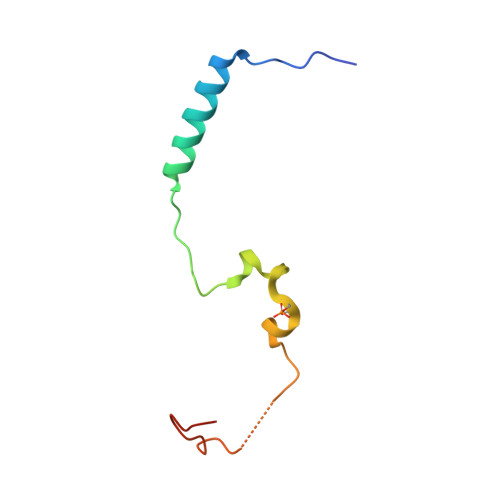
APC/C ACTIVATOR PROTEIN CDH1
A, B, C, D, E
A, B, C, D, E, F, G, H
308Saccharomyces cerevisiaeMutation(s): 0 
UniProt
Find proteins for P53197 (Saccharomyces cerevisiae (strain ATCC 204508 / S288c))
Explore P53197 
Go to UniProtKB:  P53197
Entity Groups
Sequence Clusters30% Identity50% Identity70% Identity90% Identity95% Identity100% Identity
UniProt GroupP53197
Sequence Annotations
Expand
Reference Sequence
Find similar proteins by:|  3D Structure
Entity ID: 2
MoleculeChains  Sequence LengthOrganismDetailsImage
APC/C-CDH1 MODULATOR 1
I, J, K, L, M
I, J, K, L, M, N, O, P
70Saccharomyces cerevisiaeMutation(s): 0 
UniProt
Find proteins for Q08981 (Saccharomyces cerevisiae (strain ATCC 204508 / S288c))
Explore Q08981 
Go to UniProtKB:  Q08981
Entity Groups
Sequence Clusters30% Identity50% Identity70% Identity90% Identity95% Identity100% Identity
UniProt GroupQ08981
Sequence Annotations
Expand
Reference Sequence

Small Molecules

Modified Residues  1 Unique
IDChains TypeFormula2D DiagramParent
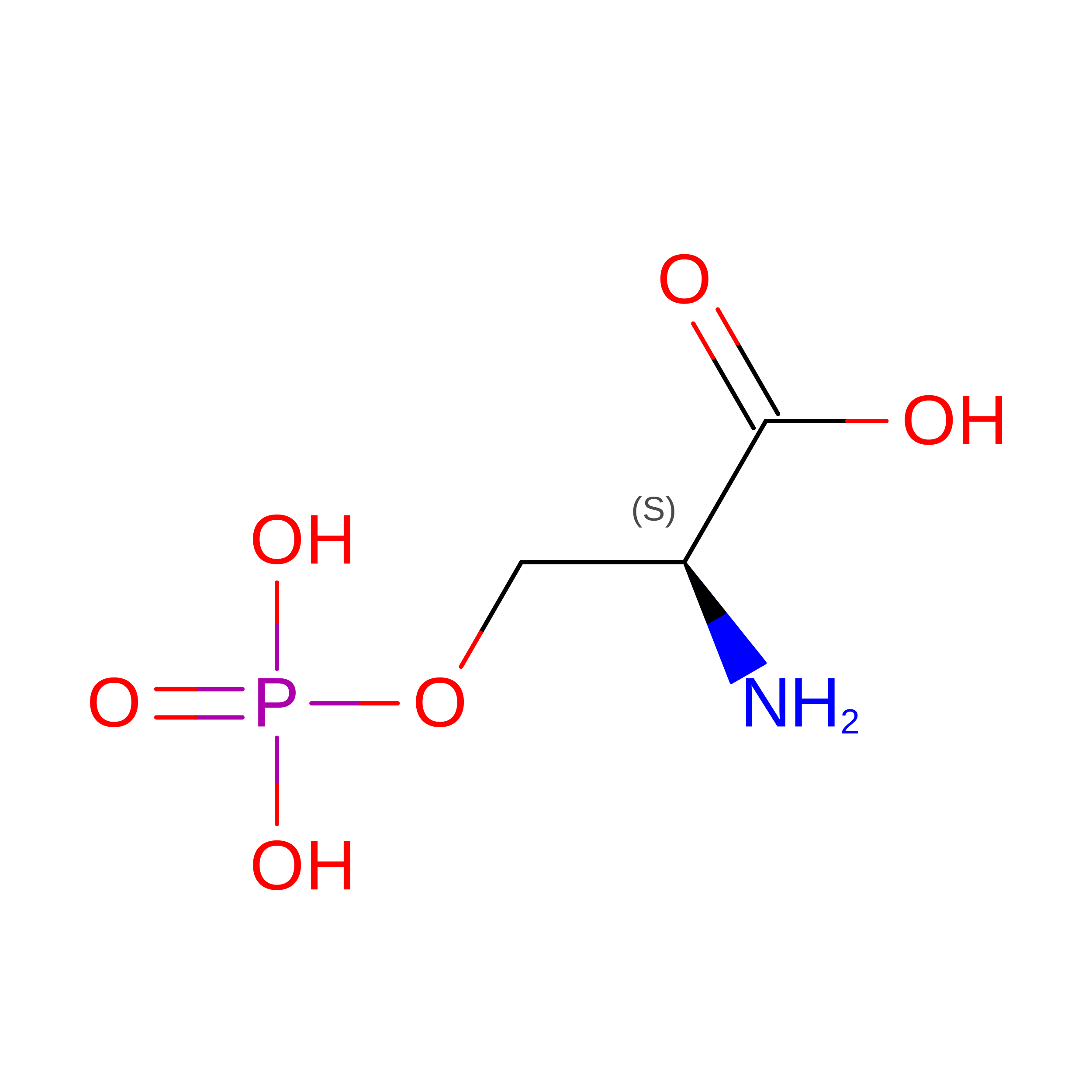
SEP
Query on SEP
I, J, K, L, M
I, J, K, L, M, N, O, P
L-PEPTIDE LINKINGC3 H8 N O6 PSER

Experimental Data & Validation

Experimental Data

  • Method: X-RAY DIFFRACTION
  • Resolution: 2.90 Å
  • R-Value Free:  0.257 (Depositor), 0.257 (DCC) 
  • R-Value Work:  0.219 (Depositor), 0.218 (DCC) 
  • R-Value Observed: 0.221 (Depositor) 
Space Group: C 1 2 1
Unit Cell:
Length ( Å )Angle ( ˚ )
a = 198.431α = 90
b = 188.142β = 92.13
c = 93.44γ = 90
Software Package:
Software NamePurpose
REFMACrefinement
XDSdata reduction
SCALAdata scaling
PHASERphasing

Structure Validation

View Full Validation Report


Entry History 

Deposition Data

Revision History  (Full details and data files)

  • Version 1.0: 2013-06-05
    Type: Initial release
  • Version 1.1: 2013-06-19
    Changes: Database references
  • Version 1.2: 2023-12-20
    Changes: Data collection, Database references, Derived calculations, Other, Refinement description
  • Version 1.3: 2024-10-23
    Changes: Structure summary