4B5C | pdb_00004b5c

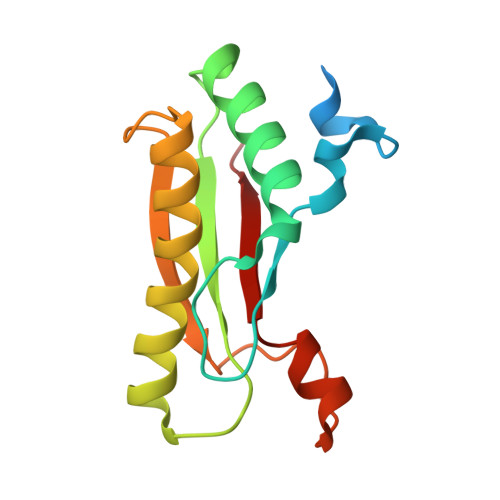
Crystal structure of the peptidoglycan-associated lipoprotein from Burkholderia pseudomallei


Experimental Data Snapshot

  • Method: X-RAY DIFFRACTION
  • Resolution: 2.30 Å
  • R-Value Free: 
    0.248 (Depositor), 0.244 (DCC) 
  • R-Value Work: 
    0.206 (Depositor), 0.202 (DCC) 
  • R-Value Observed: 
    0.209 (Depositor) 

Starting Model: experimental
View more details

wwPDB Validation 3D Report Full Report

Validation slider image for 4B5C

This is version 1.3 of the entry. See complete history

Literature

Exploiting the Burkholderia Pseudomallei Acute Phase Antigen Bpsl2765 for Structure-Based Epitope Discovery/Design in Structural Vaccinology.

Gourlay, L.J.Peri, C.Ferrer-Navarro, M.Conchillo-Sole, O.Gori, A.Rinchai, D.Thomas, R.J.Champion, O.L.Michell, S.L.Kewcharoenwong, C.Nithichanon, A.Lassaux, P.Perletti, L.Longhi, R.Lertmemongkolchai, G.Titball, R.W.Daura, X.Colombo, G.Bolognesi, M.

(2013) Chem Biol 20: 1147

  • DOI: https://doi.org/10.1016/j.chembiol.2013.07.010
  • Primary Citation Related Structures: 
    4B5C

  • PubMed Abstract: 

    We solved the crystal structure of Burkholderia pseudomallei acute phase antigen BPSL2765 in the context of a structural vaccinology study, in the area of melioidosis vaccine development. Based on the structure, we applied a recently developed method for epitope design that combines computational epitope predictions with in vitro mapping experiments and successfully identified a consensus sequence within the antigen that, when engineered as a synthetic peptide, was selectively immunorecognized to the same extent as the recombinant protein in sera from melioidosis-affected subjects. Antibodies raised against the consensus peptide were successfully tested in opsonization bacterial killing experiments and antibody-dependent agglutination tests of B. pseudomallei. Our strategy represents a step in the development of immunodiagnostics, in the production of specific antibodies and in the optimization of antigens for vaccine development, starting from structural and physicochemical principles.


  • Organizational Affiliation
    • Department of Biosciences, University of Milan, 20133 Milan, Italy.

Macromolecule Content 

  • Total Structure Weight: 46.16 kDa 
  • Atom Count: 2,930 
  • Modeled Residue Count: 357 
  • Deposited Residue Count: 414 
  • Unique protein chains: 1

Macromolecules

Find similar proteins by:|  3D Structure
Entity ID: 1
MoleculeChains  Sequence LengthOrganismDetailsImage
PUTATIVE OMPA FAMILY LIPOPROTEIN
A, B, C
138Burkholderia pseudomalleiMutation(s): 0 
UniProt
Find proteins for Q63RA7 (Burkholderia pseudomallei (strain K96243))
Explore Q63RA7 
Go to UniProtKB:  Q63RA7
Entity Groups
Sequence Clusters30% Identity50% Identity70% Identity90% Identity95% Identity100% Identity
UniProt GroupQ63RA7
Sequence Annotations
Expand
Reference Sequence

Experimental Data & Validation

Experimental Data

  • Method: X-RAY DIFFRACTION
  • Resolution: 2.30 Å
  • R-Value Free:  0.248 (Depositor), 0.244 (DCC) 
  • R-Value Work:  0.206 (Depositor), 0.202 (DCC) 
  • R-Value Observed: 0.209 (Depositor) 
Space Group: C 1 2 1
Unit Cell:
Length ( Å )Angle ( ˚ )
a = 101.94α = 90
b = 74.95β = 135.28
c = 72.92γ = 90
Software Package:
Software NamePurpose
PHENIXrefinement
XDSdata reduction
SCALAdata scaling
PHENIXphasing

Structure Validation

View Full Validation Report


Entry History 

Revision History  (Full details and data files)

  • Version 1.0: 2013-08-14
    Type: Initial release
  • Version 1.1: 2013-11-13
    Changes: Database references
  • Version 1.2: 2017-07-12
    Changes: Refinement description
  • Version 1.3: 2023-12-20
    Changes: Advisory, Data collection, Database references, Derived calculations, Other, Refinement description