4AQK | pdb_00004aqk

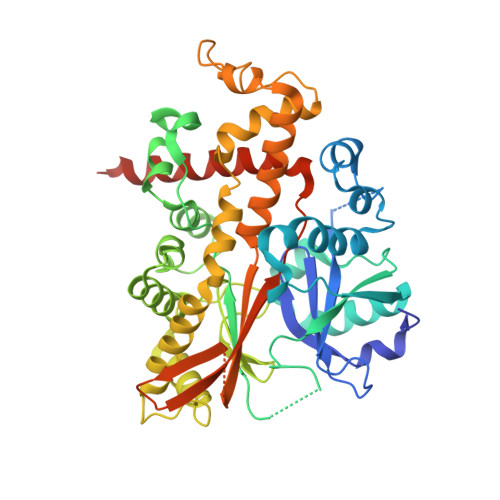
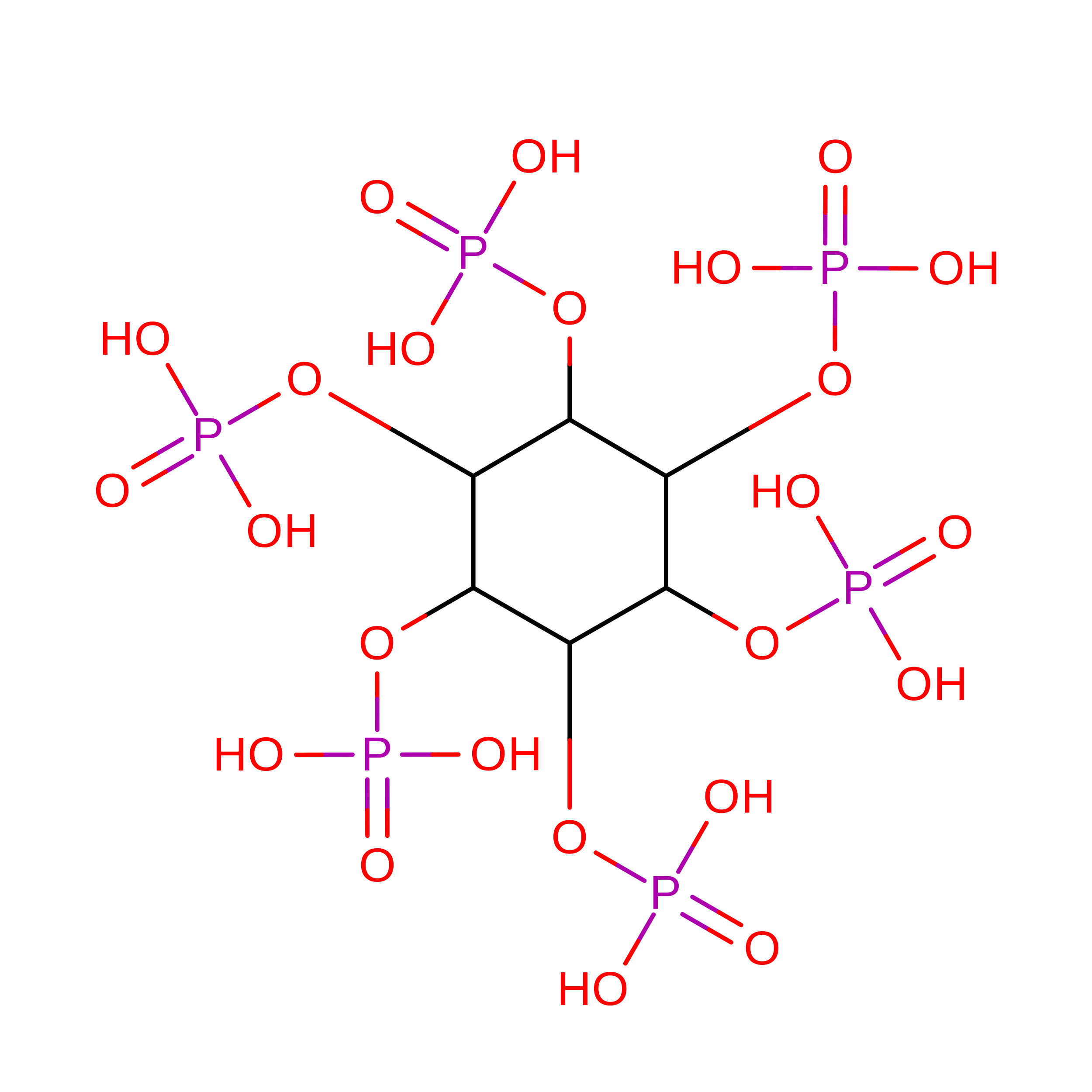
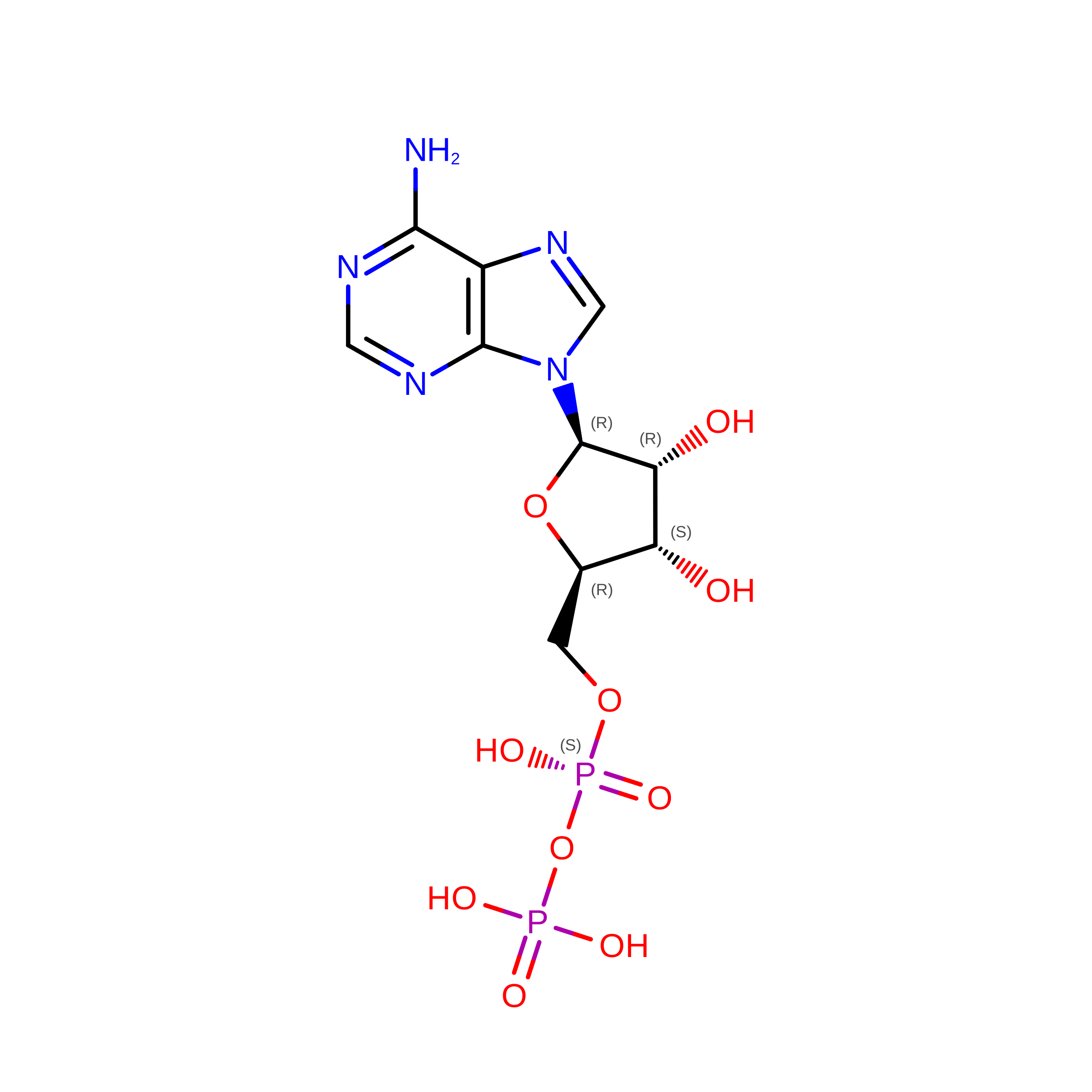
Inositol 1,3,4,5,6-pentakisphosphate 2-kinase in complex with ADP and IP6


Experimental Data Snapshot

  • Method: X-RAY DIFFRACTION
  • Resolution: 2.40 Å
  • R-Value Free: 
    0.292 (Depositor), 0.287 (DCC) 
  • R-Value Work: 
    0.244 (Depositor), 0.241 (DCC) 
  • R-Value Observed: 
    0.246 (Depositor) 

Starting Model: experimental
View more details

wwPDB Validation 3D Report Full Report

Validation slider image for 4AQK

Ligand Structure Quality Assessment 


This is version 2.1 of the entry. See complete history

Literature

Expression, Purification, Crystallization and Preliminary X-Ray Diffraction Analysis of the Apo Form of Insp5 2-K from Arabidopsis Thaliana.

Banos-Sanz, J.I.Sanz-Aparicio, J.Brearley, C.A.Gonzalez, B.

(2012) Acta Crystallogr Sect F Struct Biol Cryst Commun 68: 701

  • DOI: https://doi.org/10.1107/S1744309112017307
  • Primary Citation Related Structures: 
    4AQK

  • PubMed Abstract: 

    Inositol 1,3,4,5,6-pentakisphosphate 2-kinase (IP(5) 2-K) is a key enzyme that catalyzes the synthesis of phytic acid (IP(6)) from inositol 1,3,4,5,6-pentakisphosphate (IP(5)) and ATP. The first structure of IP(5) 2-K, that from Arabidopsis thaliana, has been solved previously; it only crystallized in the presence of inositol, either the substrate IP(5) or the product IP(6), and failed to crystallize in its free state (without inositol). Based on structural analysis, a point mutation of IP(5) 2-K (W129A) has been produced in order to overcome this limitation and obtain information about protein conformational changes upon substrate binding. Here, the production and crystallization of W129A IP(5) 2-K in its free state and with bound nucleotide is described. These crystals differed from the native crystals and belonged to the orthorhombic space group P2(1)2(1)2, with unit-cell parameters a = 66.00, b = 68.23, c = 105.80 Å and a = 63.06, b = 71.80, c = 100.23 Å, respectively. The crystals diffracted to resolutions of 2.22 Å (apo) and 2.05 Å (nucleotide bound) using synchrotron radiation and contained one molecule per asymmetric unit. The structures have been determined using the molecular-replacement method and refinement is being undertaken.


  • Organizational Affiliation
    • Grupo de Cristalografía Macromolecular y Biología Estructural, Instituto de Química-Física Rocasolano, CSIC, Serrano 119, 28006 Madrid, Spain.

Macromolecule Content 

  • Total Structure Weight: 52.5 kDa 
  • Atom Count: 3,422 
  • Modeled Residue Count: 415 
  • Deposited Residue Count: 456 
  • Unique protein chains: 1

Macromolecules

Find similar proteins by:|  3D Structure
Entity ID: 1
MoleculeChains  Sequence LengthOrganismDetailsImage
INOSITOL-PENTAKISPHOSPHATE 2-KINASE456Arabidopsis thalianaMutation(s): 0 
EC: 2.7.1.158
UniProt
Find proteins for Q93YN9 (Arabidopsis thaliana)
Explore Q93YN9 
Go to UniProtKB:  Q93YN9
Entity Groups
Sequence Clusters30% Identity50% Identity70% Identity90% Identity95% Identity100% Identity
UniProt GroupQ93YN9
Sequence Annotations
Expand
Reference Sequence

Experimental Data & Validation

Experimental Data

  • Method: X-RAY DIFFRACTION
  • Resolution: 2.40 Å
  • R-Value Free:  0.292 (Depositor), 0.287 (DCC) 
  • R-Value Work:  0.244 (Depositor), 0.241 (DCC) 
  • R-Value Observed: 0.246 (Depositor) 
Space Group: P 21 21 21
Unit Cell:
Length ( Å )Angle ( ˚ )
a = 62.11α = 90
b = 65.66β = 90
c = 121.79γ = 90
Software Package:
Software NamePurpose
REFMACrefinement
MOSFLMdata reduction
SCALAdata scaling
MOLREPphasing

Structure Validation

View Full Validation Report


Ligand Structure Quality Assessment 


Entry History 

Deposition Data

Revision History  (Full details and data files)

  • Version 1.0: 2012-05-02
    Type: Initial release
  • Version 1.1: 2014-02-05
    Changes: Database references
  • Version 2.0: 2020-10-07
    Changes: Atomic model, Data collection, Derived calculations, Non-polymer description, Other, Structure summary
  • Version 2.1: 2023-12-20
    Changes: Data collection, Database references, Refinement description