4ADS | pdb_00004ads

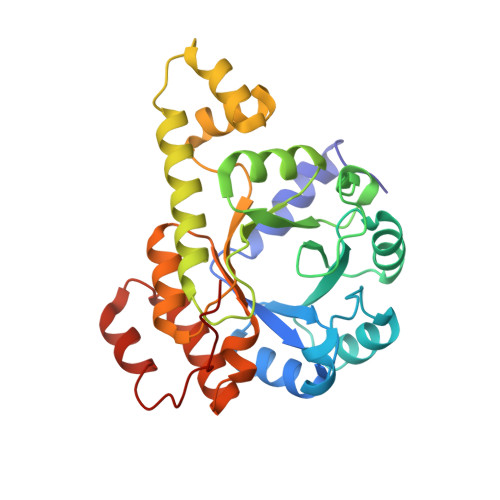
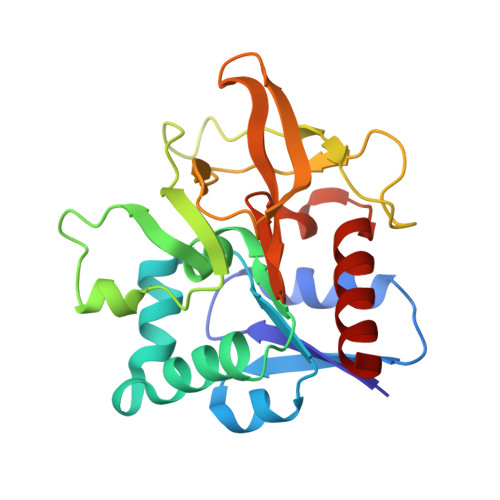
Crystal structure of plasmodial PLP synthase complex


Experimental Data Snapshot

  • Method: X-RAY DIFFRACTION
  • Resolution: 3.61 Å
  • R-Value Free: 
    0.314 (Depositor), 0.308 (DCC) 
  • R-Value Work: 
    0.293 (Depositor), 0.288 (DCC) 
  • R-Value Observed: 
    0.294 (Depositor) 

Starting Model: experimental
View more details

wwPDB Validation 3D Report Full Report

Validation slider image for 4ADS

This is version 1.1 of the entry. See complete history

Literature

Assembly of the Eukaryotic Plp-Synthase Complex from Plasmodium and Activation of the Pdx1 Enzyme.

Guedez, G.Hipp, K.Windeisen, V.Derrer, B.Gengenbacher, M.Boettcher, B.Sinning, I.Kappes, B.Tews, I.

(2012) Structure 20: 172

  • DOI: https://doi.org/10.1016/j.str.2011.11.015
  • Primary Citation Related Structures: 
    4ADS, 4ADT, 4ADU

  • PubMed Abstract: 

    Biosynthesis of vitamins is fundamental to malaria parasites. Plasmodia synthesize the active form of vitamin B(6) (pyridoxal 5'-phosphate, PLP) using a PLP synthase complex. The EM analysis shown here reveals a random association pattern of up to 12 Pdx2 glutaminase subunits to the dodecameric Pdx1 core complex. Interestingly, Plasmodium falciparum PLP synthase organizes in fibers. The crystal structure shows differences in complex formation to bacterial orthologs as interface variations. Alternative positioning of an α helix distinguishes an open conformation from a closed state when the enzyme binds substrate. The pentose substrate is covalently attached through its C1 and forms a Schiff base with Lys84. Ammonia transfer between Pdx2 glutaminase and Pdx1 active sites is regulated by a transient tunnel. The mutagenesis analysis allows defining the requirement for conservation of critical methionines, whereas there is also plasticity in ammonia tunnel construction as seen from comparison across different species.


  • Organizational Affiliation
    • Heidelberg University Biochemistry Center (BZH), Im Neuenheimer Feld 328, 69120 Heidelberg, Germany.

Macromolecule Content 

  • Total Structure Weight: 332.07 kDa 
  • Atom Count: 23,152 
  • Modeled Residue Count: 2,994 
  • Deposited Residue Count: 2,994 
  • Unique protein chains: 2

Macromolecules

Find similar proteins by:|  3D Structure
Entity ID: 1
MoleculeChains  Sequence LengthOrganismDetailsImage
PYRIDOXINE BIOSYNTHETIC ENZYME PDX1 HOMOLOGUE, PUTATIVE
A, B, C, D, E
A, B, C, D, E, F
282Plasmodium bergheiMutation(s): 0 
Find similar proteins by:|  3D Structure
Entity ID: 2
MoleculeChains  Sequence LengthOrganismDetailsImage
PDX2 PROTEIN
G, H, I, J, K
G, H, I, J, K, L
217Plasmodium falciparum 3D7Mutation(s): 1 
EC: 4.3.3.6 (UniProt), 3.5.1.2 (UniProt)
UniProt
Find proteins for Q8IIK4 (Plasmodium falciparum (isolate 3D7))
Explore Q8IIK4 
Go to UniProtKB:  Q8IIK4
Entity Groups
Sequence Clusters30% Identity50% Identity70% Identity90% Identity95% Identity100% Identity
UniProt GroupQ8IIK4
Sequence Annotations
Expand
Reference Sequence

Small Molecules

Ligands 1 Unique
IDChains Name / Formula / InChI Key2D Diagram3D Interactions
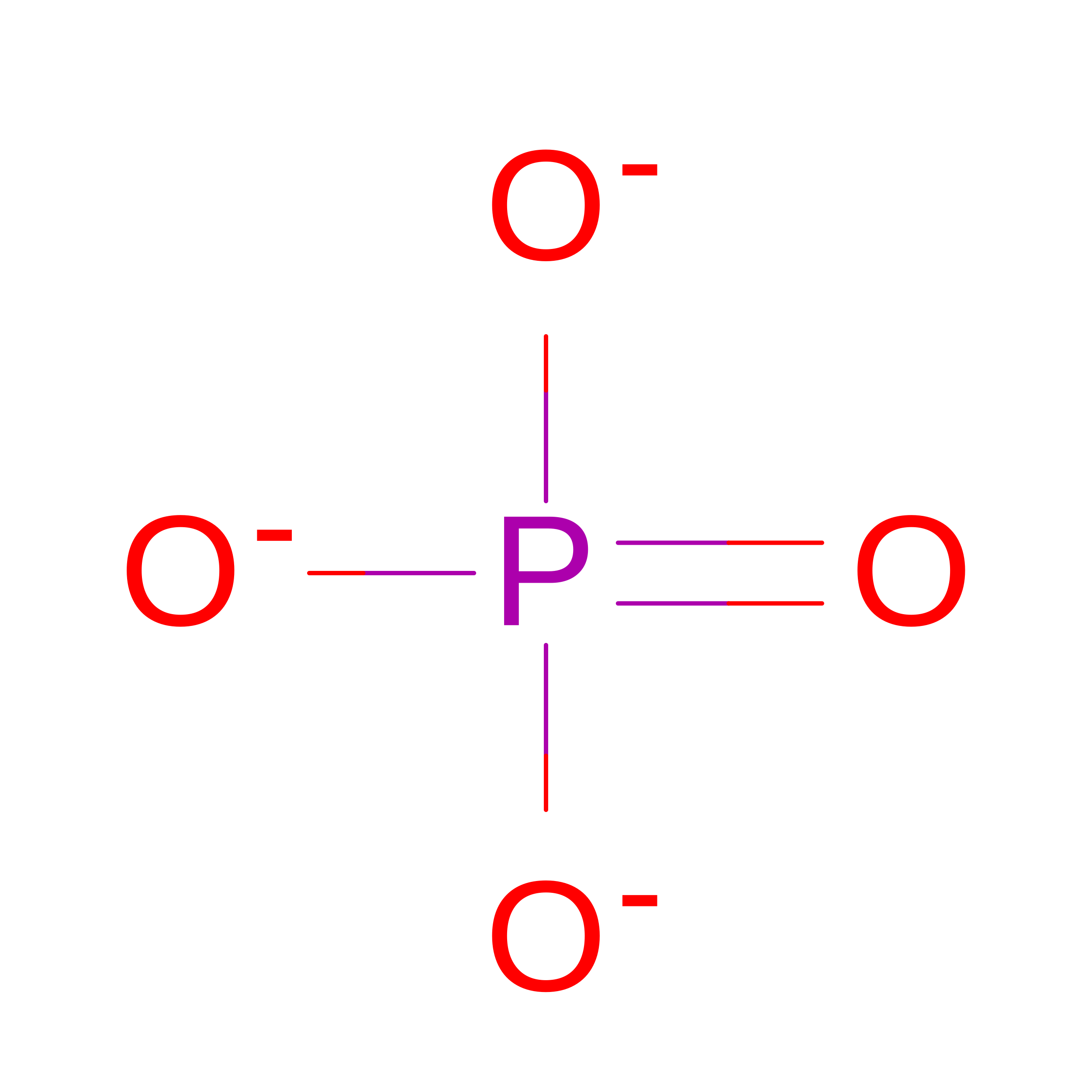
PO4

Query on PO4


Download:Ideal Coordinates CCD File
M [auth A]
N [auth A]
O [auth B]
P [auth B]
Q [auth C]
M [auth A],
N [auth A],
O [auth B],
P [auth B],
Q [auth C],
R [auth C],
S [auth D],
T [auth D],
U [auth E],
V [auth E],
W [auth F],
X [auth F]
PHOSPHATE ION
O4 P
NBIIXXVUZAFLBC-UHFFFAOYSA-K

Experimental Data & Validation

Experimental Data

  • Method: X-RAY DIFFRACTION
  • Resolution: 3.61 Å
  • R-Value Free:  0.314 (Depositor), 0.308 (DCC) 
  • R-Value Work:  0.293 (Depositor), 0.288 (DCC) 
  • R-Value Observed: 0.294 (Depositor) 
Space Group: P 61 2 2
Unit Cell:
Length ( Å )Angle ( ˚ )
a = 160.008α = 90
b = 160.008β = 90
c = 583.243γ = 120
Software Package:
Software NamePurpose
REFMACrefinement
DENZOdata reduction
SCALEPACKdata scaling
MOLREPphasing

Structure Validation

View Full Validation Report


Entry History 

Deposition Data

Revision History  (Full details and data files)

  • Version 1.0: 2012-01-25
    Type: Initial release
  • Version 1.1: 2023-12-20
    Changes: Data collection, Database references, Derived calculations, Other, Refinement description