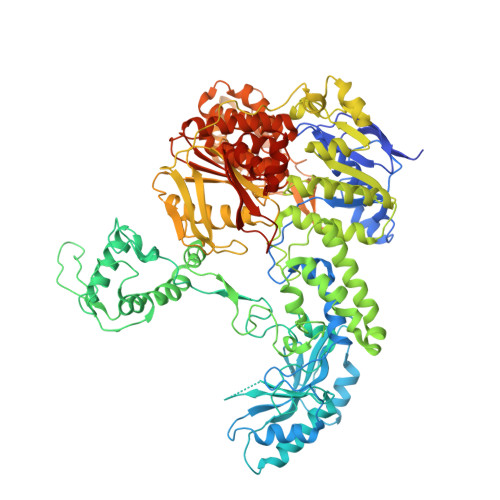
3ZQJ | pdb_00003zqj

Mycobacterium tuberculosis UvrA


Experimental Data Snapshot

  • Method: X-RAY DIFFRACTION
  • Resolution: 3.40 Å
  • R-Value Free: 
    0.324 (Depositor), 0.323 (DCC) 
  • R-Value Work: 
    0.273 (Depositor), 0.268 (DCC) 
  • R-Value Observed: 
    0.273 (Depositor) 

Starting Model: experimental
View more details

wwPDB Validation 3D Report Full Report

Validation slider image for 3ZQJ

This is version 1.2 of the entry. See complete history

Literature

The Biological and Structural Characterization of Mycobacterium Tuberculosis Uvra Provides Novel Insights Into its Mechanism of Action

Rossi, F.Khanduja, J.S.Bortoluzzi, A.Houghton, J.Sander, P.Guthlein, C.Davis, E.O.Springer, B.Bottger, E.C.Relini, A.Penco, A.Muniyappa, K.Rizzi, M.

(2011) Nucleic Acids Res 39: 7316

  • DOI: https://doi.org/10.1093/nar/gkr271
  • Primary Citation Related Structures: 
    3ZQJ

  • PubMed Abstract: 

    Mycobacterium tuberculosis is an extremely well adapted intracellular human pathogen that is exposed to multiple DNA damaging chemical assaults originating from the host defence mechanisms. As a consequence, this bacterium is thought to possess highly efficient DNA repair machineries, the nucleotide excision repair (NER) system amongst these. Although NER is of central importance to DNA repair in M. tuberculosis, our understanding of the processes in this species is limited. The conserved UvrABC endonuclease represents the multi-enzymatic core in bacterial NER, where the UvrA ATPase provides the DNA lesion-sensing function. The herein reported genetic analysis demonstrates that M. tuberculosis UvrA is important for the repair of nitrosative and oxidative DNA damage. Moreover, our biochemical and structural characterization of recombinant M. tuberculosis UvrA contributes new insights into its mechanism of action. In particular, the structural investigation reveals an unprecedented conformation of the UvrB-binding domain that we propose to be of functional relevance. Taken together, our data suggest UvrA as a potential target for the development of novel anti-tubercular agents and provide a biochemical framework for the identification of small-molecule inhibitors interfering with the NER activity in M. tuberculosis.


  • Organizational Affiliation
    • DiSCAFF, University of Piemonte Orientale Amedeo Avogadro, Via Bovio 6, 28100 Novara, Italy.

Macromolecule Content 

  • Total Structure Weight: 653.75 kDa 
  • Atom Count: 39,998 
  • Modeled Residue Count: 5,199 
  • Deposited Residue Count: 5,958 
  • Unique protein chains: 1

Macromolecules

Find similar proteins by:|  3D Structure
Entity ID: 1
MoleculeChains  Sequence LengthOrganismDetailsImage
UVRABC SYSTEM PROTEIN A
A, B, C, D, E
A, B, C, D, E, F
993Mycobacterium tuberculosisMutation(s): 0 
UniProt
Find proteins for P9WQK7 (Mycobacterium tuberculosis (strain ATCC 25618 / H37Rv))
Explore P9WQK7 
Go to UniProtKB:  P9WQK7
Entity Groups
Sequence Clusters30% Identity50% Identity70% Identity90% Identity95% Identity100% Identity
UniProt GroupP9WQK7
Sequence Annotations
Expand
Reference Sequence

Small Molecules

Ligands 1 Unique
IDChains Name / Formula / InChI Key2D Diagram3D Interactions
ZN

Query on ZN


Download:Ideal Coordinates CCD File
G [auth A]
H [auth A]
I [auth A]
J [auth B]
K [auth B]
G [auth A],
H [auth A],
I [auth A],
J [auth B],
K [auth B],
L [auth B],
M [auth C],
N [auth C],
O [auth C],
P [auth D],
Q [auth D],
R [auth D],
S [auth E],
T [auth E]
ZINC ION
Zn
PTFCDOFLOPIGGS-UHFFFAOYSA-N

Experimental Data & Validation

Experimental Data

  • Method: X-RAY DIFFRACTION
  • Resolution: 3.40 Å
  • R-Value Free:  0.324 (Depositor), 0.323 (DCC) 
  • R-Value Work:  0.273 (Depositor), 0.268 (DCC) 
  • R-Value Observed: 0.273 (Depositor) 
Space Group: P 32 2 1
Unit Cell:
Length ( Å )Angle ( ˚ )
a = 258.227α = 90
b = 258.227β = 90
c = 204.554γ = 120
Software Package:
Software NamePurpose
REFMACrefinement
MOSFLMdata reduction
SCALAdata scaling
PHASERphasing

Structure Validation

View Full Validation Report


Entry History 

Deposition Data

Revision History  (Full details and data files)

  • Version 1.0: 2011-06-22
    Type: Initial release
  • Version 1.1: 2011-09-14
    Changes: Database references
  • Version 1.2: 2023-12-20
    Changes: Data collection, Database references, Derived calculations, Other, Refinement description