Download Mendeley
Identification, Structural and Pharmacological Characterization of Tau-Cnva, a Conopeptide that Selectively Interacts with Somatostatin Sst3 Receptor.
Petrel, C., Hocking, H.G., Reynaud, M., Upert, G., Favreau, P., Biass, D., Paolini-Bertrand, M., Peigneur, S., Tytgat, J., Gilles, N., Hartley, O., Boelens, R., Stocklin, R., Servent, D.(2013) Biochem Pharmacol 85: 1663
- PubMed: 23567999 Search on PubMed
- DOI: https://doi.org/10.1016/j.bcp.2013.03.019
- Primary Citation Related Structures:
3ZKT - PubMed Abstract:
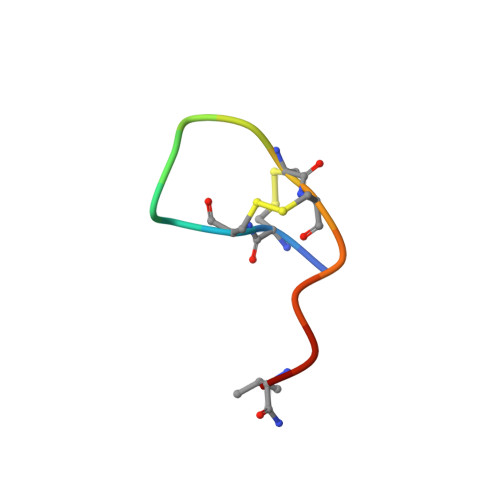
Conopeptides are a diverse array of small linear and reticulated peptides that interact with high potency and selectivity with a large diversity of receptors and ion channels. They are used by cone snails for prey capture or defense. Recent advances in venom gland transcriptomic and venom peptidomic/proteomic technologies combined with bioactivity screening approaches lead to the identification of new toxins with original pharmacological profiles. Here, from transcriptomic/proteomic analyses of the Conus consors cone snail, we identified a new conopeptide called τ-CnVA, which displays the typical cysteine framework V of the T1-conotoxin superfamily. This peptide was chemically synthesized and its three-dimensional structure was solved by NMR analysis and compared to that of TxVA belonging to the same family, revealing very few common structural features apart a common orientation of the intercysteine loop. Because of the lack of a clear biological function associated with the T-conotoxin family, τ-CnVA was screened against more than fifty different ion channels and receptors, highlighting its capacity to interact selectively with the somatostatine sst3 receptor. Pharmacological and functional studies show that τ-CnVA displays a micromolar (Ki of 1.5μM) antagonist property for the sst3 receptor, being currently the only known toxin to interact with this GPCR subfamily.
- CEA, iBiTecS, Service d'Ingénierie Moléculaire des Protéines, Laboratoire de Toxinologie Moléculaire et Biotechnologies, Gif-sur-Yvette, France.
Organizational Affiliation: