3ZKD | pdb_00003zkd

CRYSTAL STRUCTURE OF THE ATPASE REGION OF Mycobacterium tuberculosis GyrB WITH AMPPNP


Experimental Data Snapshot

  • Method: X-RAY DIFFRACTION
  • Resolution: 2.95 Å
  • R-Value Free: 
    0.257 (Depositor), 0.305 (DCC) 
  • R-Value Work: 
    0.182 (Depositor) 
  • R-Value Observed: 
    0.185 (Depositor) 

Starting Model: experimental
View more details

wwPDB Validation 3D Report Full Report

Validation slider image for 3ZKD

Ligand Structure Quality Assessment 


This is version 1.2 of the entry. See complete history

Literature

Mycobacterium Tuberculosis DNA Gyrase ATPase Domain Structures Suggest a Dissociative Mechanism that Explains How ATP Hydrolysis is Coupled to Domain Motion.

Agrawal, A.Roue, M.Spitzfaden, C.Petrella, S.Aubry, A.Hann, M.M.Bax, B.Mayer, C.

(2013) Biochem J 456: 263

  • DOI: https://doi.org/10.1042/BJ20130538
  • Primary Citation Related Structures: 
    3ZKB, 3ZKD, 3ZM7

  • PubMed Abstract: 

    DNA gyrase, a type II topoisomerase, regulates DNA topology by creating a double-stranded break in one DNA duplex and transporting another DNA duplex [T-DNA (transported DNA)] through this break. The ATPase domains dimerize, in the presence of ATP, to trap the T-DNA segment. Hydrolysis of only one of the two ATPs, and release of the resulting Pi, is rate-limiting in DNA strand passage. A long unresolved puzzle is how the non-hydrolysable ATP analogue AMP-PNP (adenosine 5'-[β,γ-imido]triphosphate) can catalyse one round of DNA strand passage without Pi release. In the present paper we discuss two crystal structures of the Mycobacterium tuberculosis DNA gyrase ATPase domain: one complexed with AMP-PCP (adenosine 5'-[β,γ-methylene]triphosphate) was unexpectedly monomeric, the other, an AMP-PNP complex, crystallized as a dimer. In the AMP-PNP structure, the unprotonated nitrogen (P-N=P imino) accepts hydrogen bonds from a well-ordered 'ATP lid', which is known to be required for dimerization. The equivalent CH2 group, in AMP-PCP, cannot accept hydrogen bonds, leaving the 'ATP lid' region disordered. Further analysis suggested that AMP-PNP can be converted from the imino (P-N=P) form into the imido form (P-NH-P) during the catalytic cycle. A main-chain NH is proposed to move to either protonate AMP-P-N=P to AMP-P-NH-P, or to protonate ATP to initiate ATP hydrolysis. This suggests a novel dissociative mechanism for ATP hydrolysis that could be applicable not only to GHKL phosphotransferases, but also to unrelated ATPases and GTPases such as Ras. On the basis of the domain orientation in our AMP-PCP structure we propose a mechanochemical scheme to explain how ATP hydrolysis is coupled to domain motion.


  • Organizational Affiliation
    • *Platform Technology Sciences, GlaxoSmithKline, Medicines Research Centre, Gunnels Wood Road, Stevenage, Hertfordshire SG1 2NY, U.K.

Macromolecule Content 

  • Total Structure Weight: 378.69 kDa 
  • Atom Count: 23,192 
  • Modeled Residue Count: 3,035 
  • Deposited Residue Count: 3,456 
  • Unique protein chains: 1

Macromolecules

Find similar proteins by:|  3D Structure
Entity ID: 1
MoleculeChains  Sequence LengthOrganismDetailsImage
DNA GYRASE SUBUNIT B
A, B, C, D, E
A, B, C, D, E, F, G, H
432Mycobacterium tuberculosisMutation(s): 0 
EC: 5.99.1.3 (PDB Primary Data), 5.6.2.2 (UniProt)
UniProt
Find proteins for P9WG45 (Mycobacterium tuberculosis (strain ATCC 25618 / H37Rv))
Explore P9WG45 
Go to UniProtKB:  P9WG45
Entity Groups
Sequence Clusters30% Identity50% Identity70% Identity90% Identity95% Identity100% Identity
UniProt GroupP9WG45
Sequence Annotations
Expand
Reference Sequence

Small Molecules

Ligands 2 Unique
IDChains Name / Formula / InChI Key2D Diagram3D Interactions
ANP

Query on ANP


Download:Ideal Coordinates CCD File
I [auth A]
K [auth B]
M [auth C]
O [auth D]
Q [auth E]
I [auth A],
K [auth B],
M [auth C],
O [auth D],
Q [auth E],
S [auth F],
U [auth G],
W [auth H]
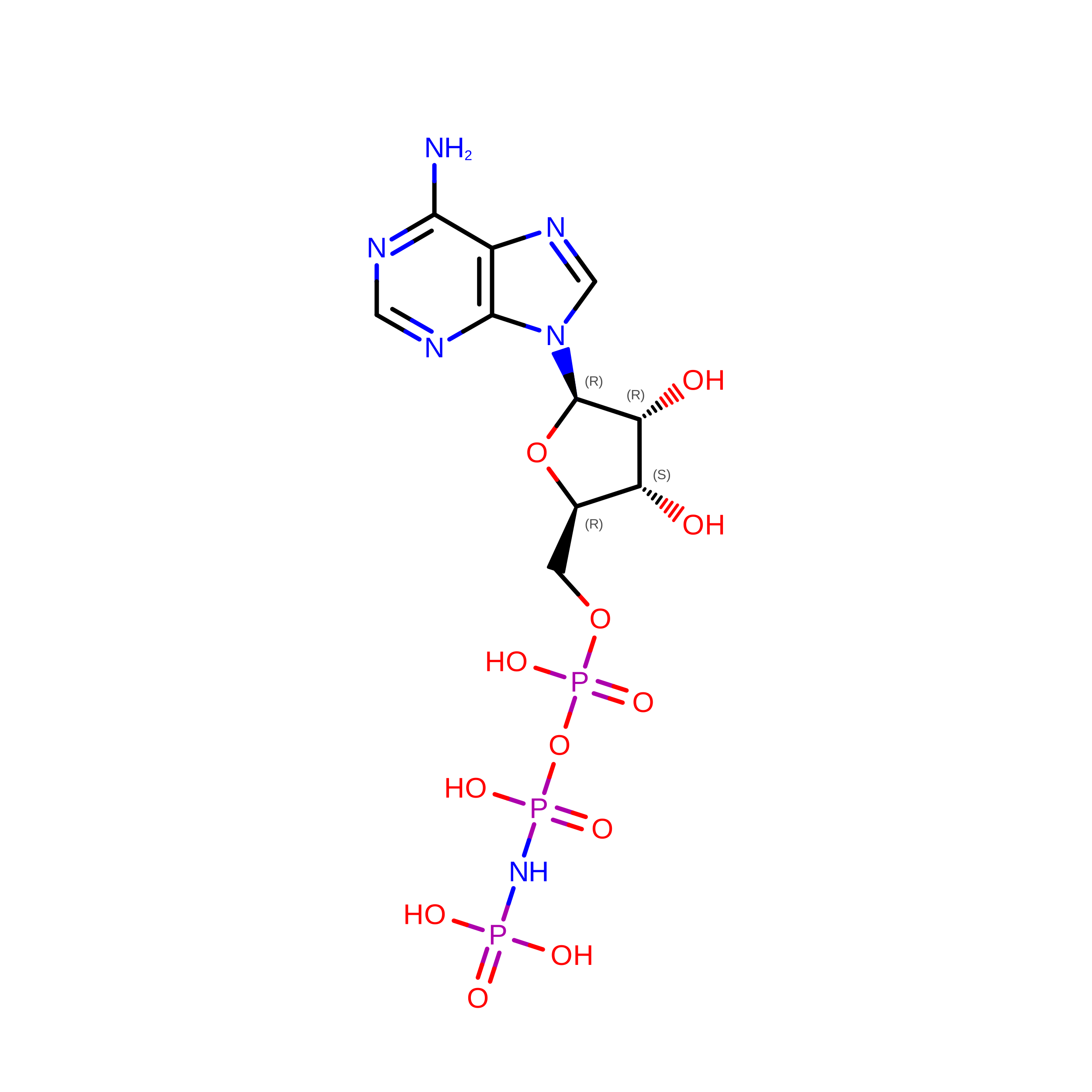
PHOSPHOAMINOPHOSPHONIC ACID-ADENYLATE ESTER
C10 H17 N6 O12 P3
PVKSNHVPLWYQGJ-KQYNXXCUSA-N
MG

Query on MG


Download:Ideal Coordinates CCD File
J [auth A]
L [auth B]
N [auth C]
P [auth D]
R [auth E]
J [auth A],
L [auth B],
N [auth C],
P [auth D],
R [auth E],
T [auth F],
V [auth G],
X [auth H]
MAGNESIUM ION
Mg
JLVVSXFLKOJNIY-UHFFFAOYSA-N

Experimental Data & Validation

Experimental Data

  • Method: X-RAY DIFFRACTION
  • Resolution: 2.95 Å
  • R-Value Free:  0.257 (Depositor), 0.305 (DCC) 
  • R-Value Work:  0.182 (Depositor) 
  • R-Value Observed: 0.185 (Depositor) 
Space Group: P 1
Unit Cell:
Length ( Å )Angle ( ˚ )
a = 71.953α = 108.21
b = 97.851β = 105.18
c = 138.075γ = 91.04
Software Package:
Software NamePurpose
BUSTERrefinement
DENZOdata reduction
SCALEPACKdata scaling
PHASERphasing

Structure Validation

View Full Validation Report


Ligand Structure Quality Assessment 


Entry History 

Deposition Data

Revision History  (Full details and data files)

  • Version 1.0: 2013-09-18
    Type: Initial release
  • Version 1.1: 2013-11-20
    Changes: Database references
  • Version 1.2: 2023-12-20
    Changes: Data collection, Database references, Derived calculations, Other, Refinement description