3WUG | pdb_00003wug

The mutant crystal structure of b-1,4-Xylanase (XynAS9_V43P/G44E) with xylobiose from Streptomyces sp. 9


Experimental Data Snapshot

  • Method: X-RAY DIFFRACTION
  • Resolution: 1.88 Å
  • R-Value Free: 
    0.215 (Depositor), 0.219 (DCC) 
  • R-Value Work: 
    0.200 (Depositor), 0.205 (DCC) 

Starting Model: experimental
View more details

wwPDB Validation 3D Report Full Report

Validation slider image for 3WUG

This is version 2.2 of the entry. See complete history

Literature

Structural perspectives of an engineered beta-1,4-xylanase with enhanced thermostability.

Chen, C.C.Luo, H.Han, X.Lv, P.Ko, T.P.Peng, W.Huang, C.H.Wang, K.Gao, J.Zheng, Y.Yang, Y.Zhang, J.Yao, B.Guo, R.T.

(2014) J Biotechnol 189C: 175-182

  • DOI: https://doi.org/10.1016/j.jbiotec.2014.08.030
  • Primary Citation Related Structures: 
    3WUB, 3WUE, 3WUF, 3WUG

  • PubMed Abstract: 

    The glycoside hydrolase 10 (GH10) xylanase from Streptomyces sp. 9 (XynAS9) can operate in a broad range of pH and temperature, and thus is a potential candidate for commercial applications. Recently, we engineered XynAS9 via mutating several residues in accordance with the consensus sequences of GH10 thermophilic xylanases in an attempt to improve the enzyme thermostability and thermotolerance. The most promising effects were observed in the double mutant V81P/G82E. In order to investigate the molecular mechanism of the improved thermal profile of XynAS9, complex crystal structures of the wild type (WT) and mutant (MT) enzyme were solved at 1.88-2.05Å resolution. The structures reveal a classical GH10 (β/α)8 TIM-barrel fold. In MT XynAS9, E82 forms several interactions to its neighboring residues, which might aid in stabilizing the local structure. Furthermore, the MT structure showed lower B factors for individual residues compared to the WT structure, reflecting the increased MT protein rigidity. Analyses of the XynAS9 structures also delineate the detailed enzyme-substrate interaction network. More importantly, possible explanations for the enhanced thermal profiles of MT XynAS9 are proposed, which may be a useful strategy for enzyme engineering in the future.


  • Organizational Affiliation
    • Industrial Enzymes National Engineering Laboratory, Tianjin Institute of Industrial Biotechnology, Chinese Academy of Sciences, Tianjin 300308, China.

Macromolecule Content 

  • Total Structure Weight: 35.7 kDa 
  • Atom Count: 2,799 
  • Modeled Residue Count: 312 
  • Deposited Residue Count: 313 
  • Unique protein chains: 1

Macromolecules

Find similar proteins by:|  3D Structure
Entity ID: 1
MoleculeChains  Sequence LengthOrganismDetailsImage
Endo-1,4-beta-xylanase A313Streptomyces sp.Mutation(s): 2 
Gene Names: xynAS9
EC: 3.2.1.8
UniProt
Find proteins for B4XVN1 (Streptomyces sp)
Explore B4XVN1 
Go to UniProtKB:  B4XVN1
Entity Groups
Sequence Clusters30% Identity50% Identity70% Identity90% Identity95% Identity100% Identity
UniProt GroupB4XVN1
Sequence Annotations
Expand
Reference Sequence

Oligosaccharides

Help  
Entity ID: 2
MoleculeChains Length2D Diagram GlycosylationD Interactions
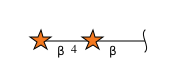
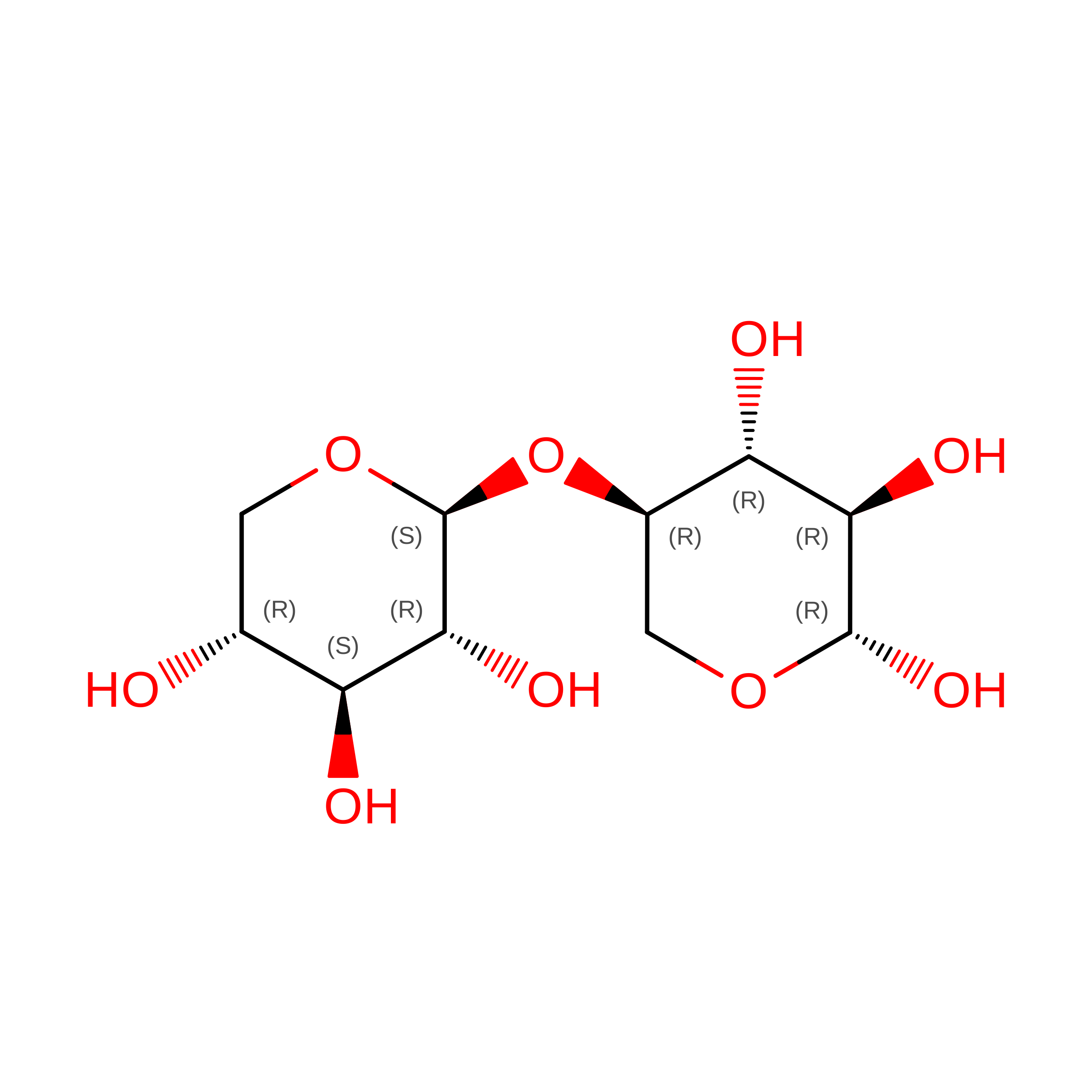
beta-D-xylopyranose-(1-4)-beta-D-xylopyranose
B, C
2N/A
Glycosylation Resources
GlyTouCan: G87728WL
GlyCosmos: G87728WL

Biologically Interesting Molecules (External Reference) 

1 Unique

Experimental Data & Validation

Experimental Data

  • Method: X-RAY DIFFRACTION
  • Resolution: 1.88 Å
  • R-Value Free:  0.215 (Depositor), 0.219 (DCC) 
  • R-Value Work:  0.200 (Depositor), 0.205 (DCC) 
Space Group: P 65 2 2
Unit Cell:
Length ( Å )Angle ( ˚ )
a = 80.798α = 90
b = 80.798β = 90
c = 288.589γ = 120
Software Package:
Software NamePurpose
HKL-2000data collection
PHASESphasing
CNSrefinement
HKL-2000data reduction
HKL-2000data scaling

Structure Validation

View Full Validation Report


Entry History 

Deposition Data

Revision History  (Full details and data files)

  • Version 1.0: 2014-10-29
    Type: Initial release
  • Version 2.0: 2020-07-29
    Type: Remediation
    Reason: Carbohydrate remediation
    Changes: Atomic model, Data collection, Database references, Derived calculations, Structure summary
  • Version 2.1: 2023-11-08
    Changes: Data collection, Database references, Refinement description, Structure summary
  • Version 2.2: 2024-10-30
    Changes: Structure summary