3WLV | pdb_00003wlv

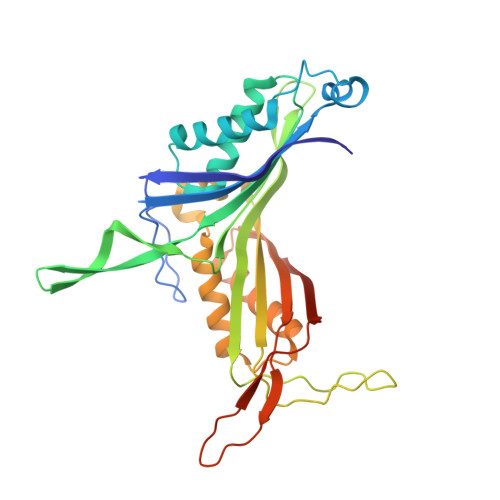
Thermostable urate oxidase from Bacillus sp. TB-90


Experimental Data Snapshot

  • Method: X-RAY DIFFRACTION
  • Resolution: 1.75 Å
  • R-Value Free: 
    0.190 (Depositor), 0.198 (DCC) 
  • R-Value Work: 
    0.159 (Depositor), 0.171 (DCC) 
  • R-Value Observed: 
    0.160 (Depositor) 

wwPDB Validation 3D Report Full Report

Validation slider image for 3WLV

Ligand Structure Quality Assessment 


This is version 1.2 of the entry. See complete history

Literature

Intersubunit salt bridges with a sulfate anion control subunit dissociation and thermal stabilization of Bacillus sp. TB-90 urate oxidase.

Hibi, T.Hayashi, Y.Fukada, H.Itoh, T.Nago, T.Nishiya, Y.

(2014) Biochemistry 53: 3879-3888

  • DOI: https://doi.org/10.1021/bi500137b
  • Primary Citation Related Structures: 
    3WLV

  • PubMed Abstract: 

    The optimal activity of Bacillus sp. TB-90 urate oxidase (BTUO) is 45 °C, but this enzyme is one of the most thermostable urate oxidases. A marked increase (>10 °C) in its thermal stability is induced by high concentrations (0.8–1.2 M) of sodium sulfate. Calorimetric measurements and size exclusion chromatographic analyses suggested that sulfate-induced thermal stabilization is related to the binding of a sulfate anion that repressed the dissociation of BTUO tetramers into dimers. To determine the sulfate binding site, the crystal structure was determined at 1.75 Å resolution. The bound sulfate anion was found at the subunit interface of the symmetrical related subunits and formed a salt bridge with two Arg298 residues in the flexible loop that is involved in subunit assembly. Site-directed mutagenesis of Arg298 to Glu was used to extensively characterize the sulfate binding site at the subunit interface. The network of charged hydrogen bonds via the bound sulfate is suggested to contribute significantly to the thermal stabilization of both subunit dimers and the tetrameric assembly of BTUO. Knowledge of the mechanism of salt-induced stabilization will help to develop new strategies for enhancing protein thermal stabilization.

Macromolecule Content 

  • Total Structure Weight: 143.69 kDa 
  • Atom Count: 10,861 
  • Modeled Residue Count: 1,212 
  • Deposited Residue Count: 1,248 
  • Unique protein chains: 1

Macromolecules

Find similar proteins by:|  3D Structure
Entity ID: 1
MoleculeChains  Sequence LengthOrganismDetailsImage
Urate oxidase
A, B, C, D
312Bacillus sp. TB-90Mutation(s): 0 
Gene Names: uao
EC: 1.7.3.3 (PDB Primary Data), 4.1.1.97 (UniProt)
UniProt
Find proteins for Q45697 (Bacillus sp. (strain TB-90))
Explore Q45697 
Go to UniProtKB:  Q45697
Entity Groups
Sequence Clusters30% Identity50% Identity70% Identity90% Identity95% Identity100% Identity
UniProt GroupQ45697
Sequence Annotations
Expand
Reference Sequence

Small Molecules

Ligands 4 Unique
IDChains Name / Formula / InChI Key2D Diagram3D Interactions
AZA

Query on AZA


Download:Ideal Coordinates CCD File
E [auth A],
H [auth B],
L [auth C],
O [auth D]
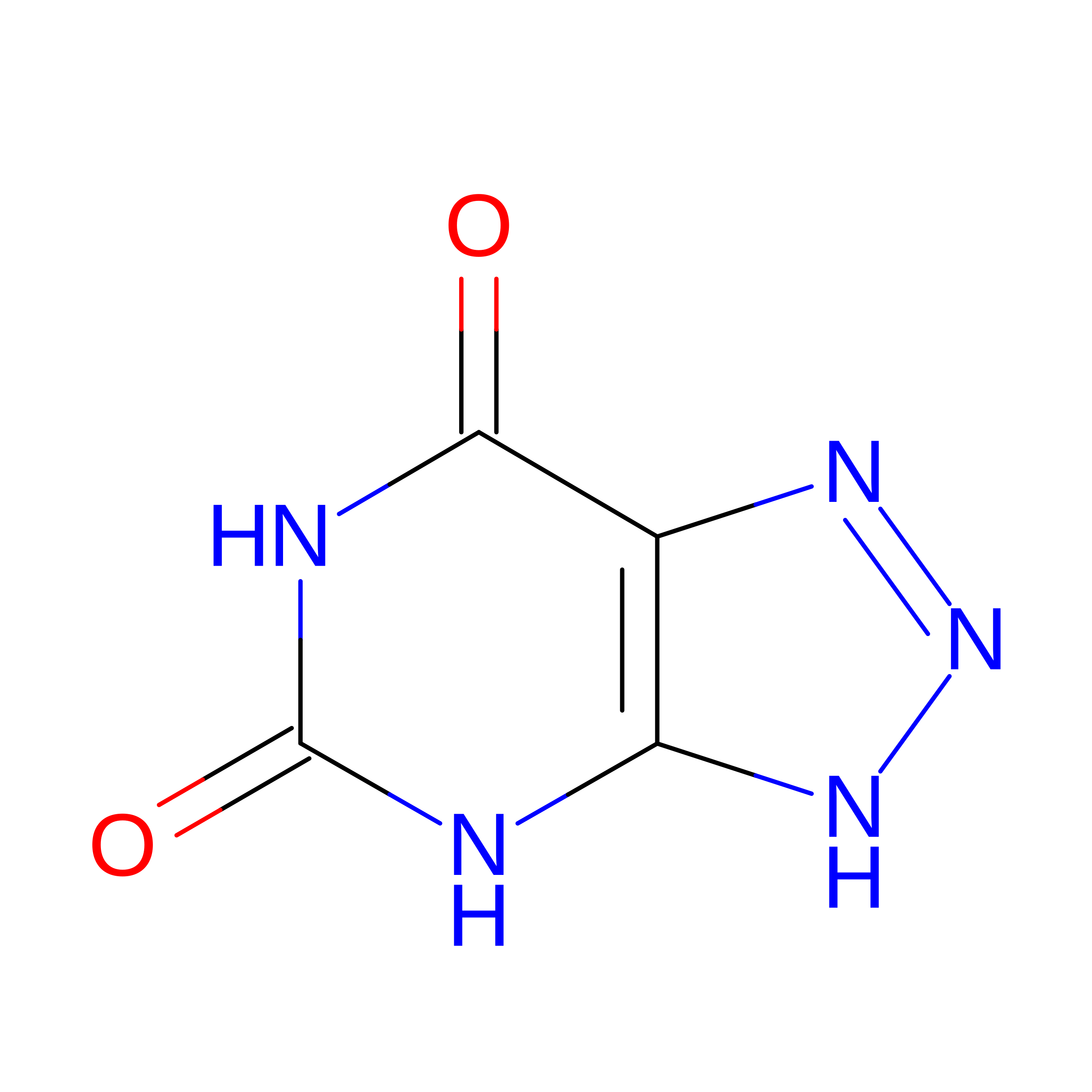
8-AZAXANTHINE
C4 H3 N5 O2
KVGVQTOQSNJTJI-UHFFFAOYSA-N
SO4

Query on SO4


Download:Ideal Coordinates CCD File
F [auth A],
I [auth B]
SULFATE ION
O4 S
QAOWNCQODCNURD-UHFFFAOYSA-L
K

Query on K


Download:Ideal Coordinates CCD File
J [auth B],
M [auth C]
POTASSIUM ION
K
NPYPAHLBTDXSSS-UHFFFAOYSA-N
CL

Query on CL


Download:Ideal Coordinates CCD File
G [auth A],
K [auth B],
N [auth C],
P [auth D]
CHLORIDE ION
Cl
VEXZGXHMUGYJMC-UHFFFAOYSA-M

Experimental Data & Validation

Experimental Data

  • Method: X-RAY DIFFRACTION
  • Resolution: 1.75 Å
  • R-Value Free:  0.190 (Depositor), 0.198 (DCC) 
  • R-Value Work:  0.159 (Depositor), 0.171 (DCC) 
  • R-Value Observed: 0.160 (Depositor) 
Space Group: P 21 21 2
Unit Cell:
Length ( Å )Angle ( ˚ )
a = 133.571α = 90
b = 144.635β = 90
c = 70.794γ = 90
Software Package:
Software NamePurpose
HKL-2000data collection
PHASERphasing
PHENIXrefinement
HKL-2000data reduction
HKL-2000data scaling

Structure Validation

View Full Validation Report


Ligand Structure Quality Assessment 


Entry History 

Deposition Data

Revision History  (Full details and data files)

  • Version 1.0: 2014-06-18
    Type: Initial release
  • Version 1.1: 2022-08-24
    Changes: Database references, Derived calculations
  • Version 1.2: 2024-05-29
    Changes: Data collection