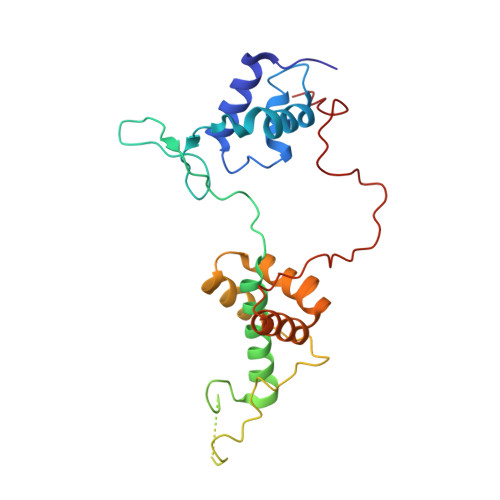
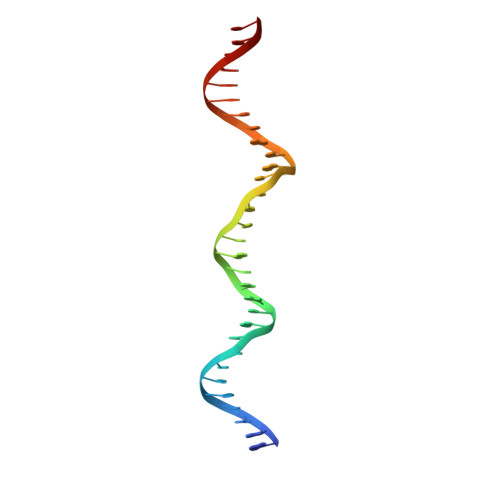
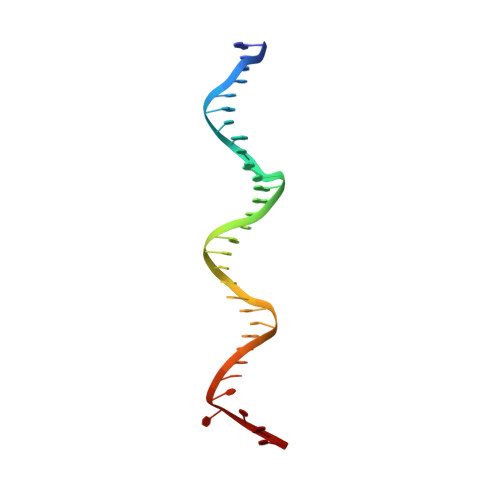
3UKG | pdb_00003ukg

Crystal structure of Rap1/DNA complex


Experimental Data Snapshot

  • Method: X-RAY DIFFRACTION
  • Resolution: 2.95 Å
  • R-Value Free: 
    0.265 (Depositor) 
  • R-Value Work: 
    0.191 (Depositor), 0.213 (DCC) 
  • R-Value Observed: 
    0.198 (Depositor) 

Starting Model: experimental
View more details

wwPDB Validation 3D Report Full Report

Validation slider image for 3UKG

This is version 1.3 of the entry. See complete history

Literature

The orientation of the C-terminal domain of the Saccharomyces cerevisiae Rap1 protein is determined by its binding to DNA.

Matot, B.Le Bihan, Y.V.Lescasse, R.Perez, J.Miron, S.David, G.Castaing, B.Weber, P.Raynal, B.Zinn-Justin, S.Gasparini, S.Le Du, M.H.

(2012) Nucleic Acids Res 40: 3197-3207

  • DOI: https://doi.org/10.1093/nar/gkr1166
  • Primary Citation Related Structures: 
    3UKG

  • PubMed Abstract: 

    Rap1 is an essential DNA-binding factor from the yeast Saccharomyces cerevisiae involved in transcription and telomere maintenance. Its binding to DNA targets Rap1 at particular loci, and may optimize its ability to form functional macromolecular assemblies. It is a modular protein, rich in large potentially unfolded regions, and comprising BRCT, Myb and RCT well-structured domains. Here, we present the architectures of Rap1 and a Rap1/DNA complex, built through a step-by-step integration of small angle X-ray scattering, X-ray crystallography and nuclear magnetic resonance data. Our results reveal Rap1 structural adjustment upon DNA binding that involves a specific orientation of the C-terminal (RCT) domain with regard to the DNA binding domain (DBD). Crystal structure of DBD in complex with a long DNA identifies an essential wrapping loop, which constrains the orientation of the RCT and affects Rap1 affinity to DNA. Based on our structural information, we propose a model for Rap1 assembly at telomere.


  • Organizational Affiliation
    • Commissariat à l'Energie Atomique, Direction des Sciences du Vivant, Institut de Biologie et Technologie de Saclay, Laboratoire de Biologie Structurale et Radiobiologie, CNRS-URA2096, 91191 Gif-sur-Yvette, France.

Macromolecule Content 

  • Total Structure Weight: 47.48 kDa 
  • Atom Count: 3,140 
  • Modeled Residue Count: 285 
  • Deposited Residue Count: 304 
  • Unique protein chains: 1
  • Unique nucleic acid chains: 2

Macromolecules


Find similar proteins by:|  3D Structure
Entity ID: 1
MoleculeChains  Sequence LengthOrganismDetailsImage
DNA-binding protein RAP1242Saccharomyces cerevisiae S288CMutation(s): 0 
Gene Names: RAP1GRF1TUF1YNL216WN1310
UniProt
Find proteins for P11938 (Saccharomyces cerevisiae (strain ATCC 204508 / S288c))
Explore P11938 
Go to UniProtKB:  P11938
Entity Groups
Sequence Clusters30% Identity50% Identity70% Identity90% Identity95% Identity100% Identity
UniProt GroupP11938
Sequence Annotations
Expand
Reference Sequence
Find similar nucleic acids by:  (by identity cutoff) 
Entity ID: 2
MoleculeChains LengthOrganismImage
telomeric DNAB [auth C]31N/A
Sequence Annotations
Expand
Reference Sequence
Find similar nucleic acids by:  (by identity cutoff) 
Entity ID: 3
MoleculeChains LengthOrganismImage
telomeric DNAC [auth D]31N/A
Sequence Annotations
Expand
Reference Sequence

Small Molecules

Ligands 1 Unique
IDChains Name / Formula / InChI Key2D Diagram3D Interactions
CA

Query on CA


Download:Ideal Coordinates CCD File
D [auth A]CALCIUM ION
Ca
BHPQYMZQTOCNFJ-UHFFFAOYSA-N

Experimental Data & Validation

Experimental Data

  • Method: X-RAY DIFFRACTION
  • Resolution: 2.95 Å
  • R-Value Free:  0.265 (Depositor) 
  • R-Value Work:  0.191 (Depositor), 0.213 (DCC) 
  • R-Value Observed: 0.198 (Depositor) 
Space Group: P 21 21 21
Unit Cell:
Length ( Å )Angle ( ˚ )
a = 40.595α = 90
b = 102.944β = 90
c = 116.755γ = 90
Software Package:
Software NamePurpose
ADSCdata collection
PHASERphasing
BUSTERrefinement
MOSFLMdata reduction
SCALAdata scaling

Structure Validation

View Full Validation Report


Entry History 

Deposition Data

Revision History  (Full details and data files)

  • Version 1.0: 2011-12-07
    Type: Initial release
  • Version 1.1: 2012-01-11
    Changes: Database references
  • Version 1.2: 2012-05-09
    Changes: Database references
  • Version 1.3: 2023-09-13
    Changes: Data collection, Database references, Derived calculations, Refinement description