3U90 | pdb_00003u90

apoferritin: complex with SDS


Experimental Data Snapshot

  • Method: X-RAY DIFFRACTION
  • Resolution: 1.90 Å
  • R-Value Free: 
    0.208 (Depositor), 0.205 (DCC) 
  • R-Value Work: 
    0.185 (Depositor), 0.180 (DCC) 
  • R-Value Observed: 
    0.187 (Depositor) 

Starting Model: experimental
View more details

wwPDB Validation 3D Report Full Report

Validation slider image for 3U90

Ligand Structure Quality Assessment 


This is version 1.3 of the entry. See complete history

Literature

Beyond the detergent effect: a binding site for sodium dodecyl sulfate (SDS) in mammalian apoferritin.

Liu, R.Bu, W.Xi, J.Mortazavi, S.R.Cheung-Lau, J.C.Dmochowski, I.J.Loll, P.J.

(2012) Acta Crystallogr D Biol Crystallogr 68: 497-504

  • DOI: https://doi.org/10.1107/S0907444912002740
  • Primary Citation Related Structures: 
    3U90

  • PubMed Abstract: 

    Although sodium dodecyl sulfate (SDS) is widely used as an anionic detergent, it can also exert specific pharmacological effects that are independent of the surfactant properties of the molecule. However, structural details of how proteins recognize SDS are scarce. Here, it is demonstrated that SDS binds specifically to a naturally occurring four-helix bundle protein: horse apoferritin. The X-ray crystal structure of the apoferritin-SDS complex was determined at a resolution of 1.9 Å and revealed that the SDS binds in an internal cavity that has previously been shown to recognize various general anesthetics. A dissociation constant of 24 ± 9 µM at 293 K was determined by isothermal titration calorimetry. SDS binds in this cavity by bending its alkyl tail into a horseshoe shape; the charged SDS head group lies in the opening of the cavity at the protein surface. This crystal structure provides insights into the protein-SDS interactions that give rise to binding and may prove useful in the design of novel SDS-like ligands for some proteins.


  • Organizational Affiliation
    • Department of Anesthesia and Critical Care, University of Pennsylvania, Philadelphia, Pennsylvania, USA. renyu.liu@uphs.upenn.edu

Macromolecule Content 

  • Total Structure Weight: 21.26 kDa 
  • Atom Count: 1,556 
  • Modeled Residue Count: 168 
  • Deposited Residue Count: 174 
  • Unique protein chains: 1

Macromolecules

Find similar proteins by:|  3D Structure
Entity ID: 1
MoleculeChains  Sequence LengthOrganismDetailsImage
Ferritin light chain174Equus caballusMutation(s): 0 
UniProt
Find proteins for P02791 (Equus caballus)
Explore P02791 
Go to UniProtKB:  P02791
Entity Groups
Sequence Clusters30% Identity50% Identity70% Identity90% Identity95% Identity100% Identity
UniProt GroupP02791
Sequence Annotations
Expand
Reference Sequence

Small Molecules

Ligands 2 Unique
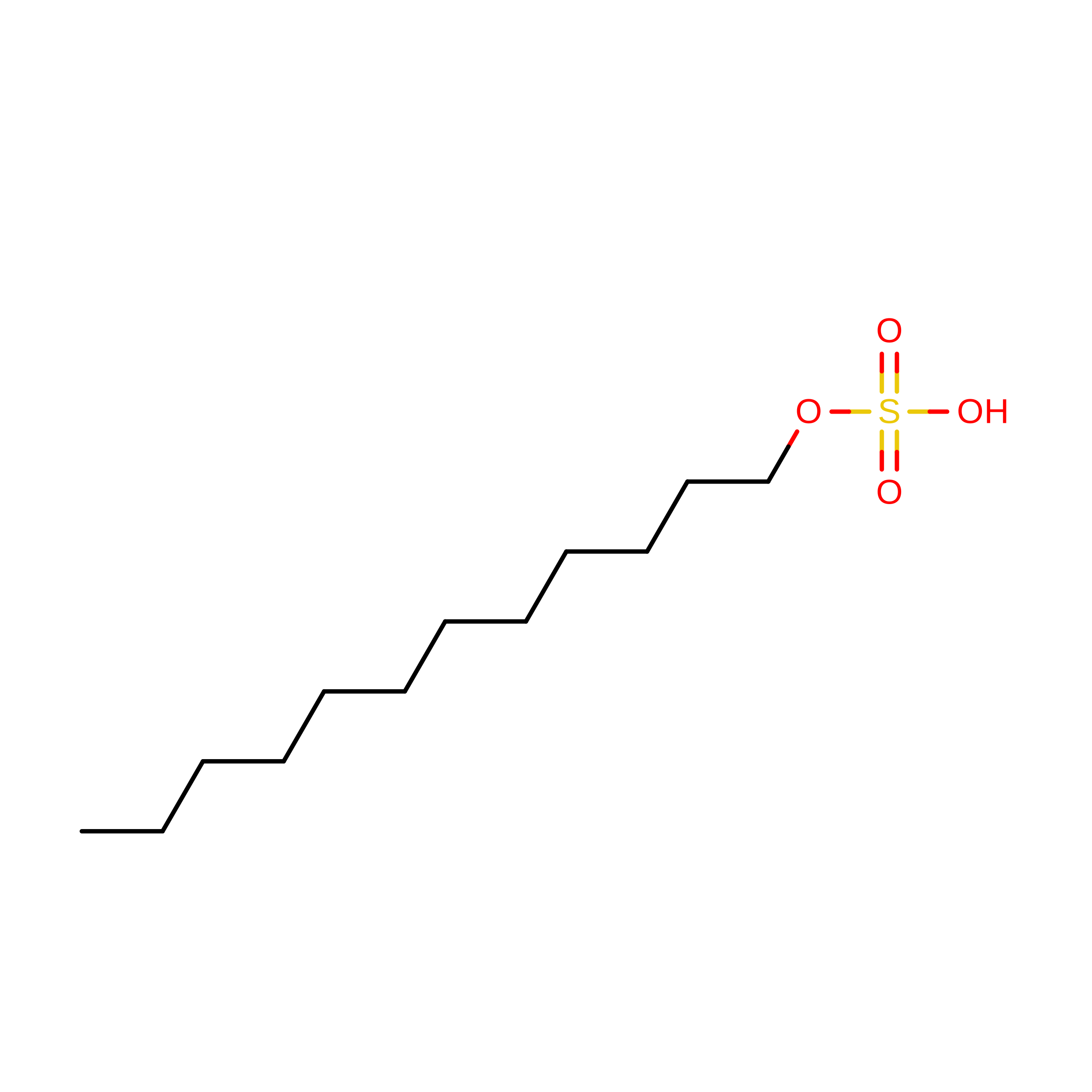
IDChains Name / Formula / InChI Key2D Diagram3D Interactions
SDS

Query on SDS


Download:Ideal Coordinates CCD File
B [auth A]DODECYL SULFATE
C12 H26 O4 S
MOTZDAYCYVMXPC-UHFFFAOYSA-N
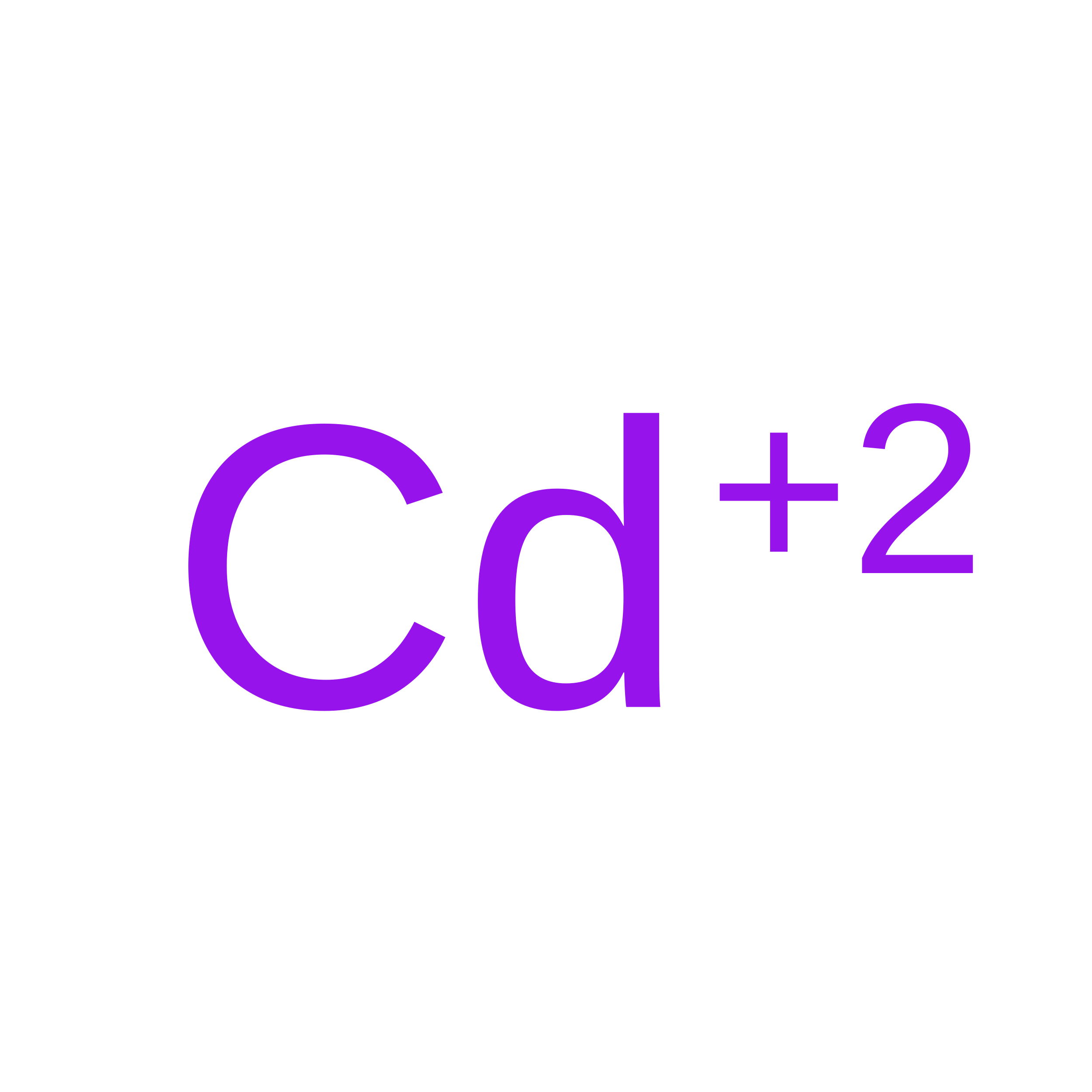
CD

Query on CD


Download:Ideal Coordinates CCD File
C [auth A]
D [auth A]
E [auth A]
F [auth A]
G [auth A]
C [auth A],
D [auth A],
E [auth A],
F [auth A],
G [auth A],
H [auth A],
I [auth A],
J [auth A],
K [auth A],
L [auth A]
CADMIUM ION
Cd
WLZRMCYVCSSEQC-UHFFFAOYSA-N

Experimental Data & Validation

Experimental Data

  • Method: X-RAY DIFFRACTION
  • Resolution: 1.90 Å
  • R-Value Free:  0.208 (Depositor), 0.205 (DCC) 
  • R-Value Work:  0.185 (Depositor), 0.180 (DCC) 
  • R-Value Observed: 0.187 (Depositor) 
Space Group: F 4 3 2
Unit Cell:
Length ( Å )Angle ( ˚ )
a = 181.83α = 90
b = 181.83β = 90
c = 181.83γ = 90
Software Package:
Software NamePurpose
PHENIXrefinement
CNSrefinement
ADSCdata collection
d*TREKdata reduction
d*TREKdata scaling
CNSphasing

Structure Validation

View Full Validation Report


Ligand Structure Quality Assessment 


Entry History 

Deposition Data

Revision History  (Full details and data files)

  • Version 1.0: 2012-04-25
    Type: Initial release
  • Version 1.1: 2013-01-23
    Changes: Database references
  • Version 1.2: 2019-07-17
    Changes: Data collection, Derived calculations, Refinement description
  • Version 1.3: 2023-09-13
    Changes: Data collection, Database references, Derived calculations, Refinement description