3TWD | pdb_00003twd

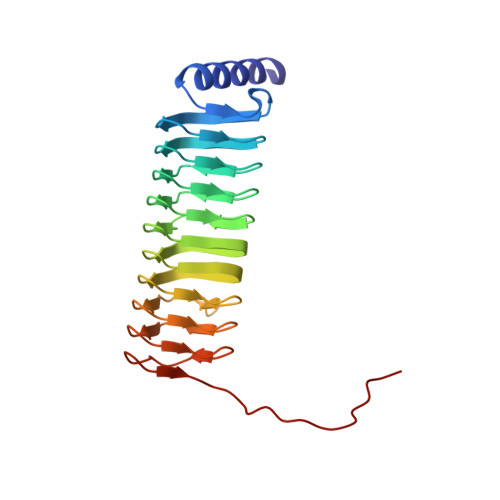
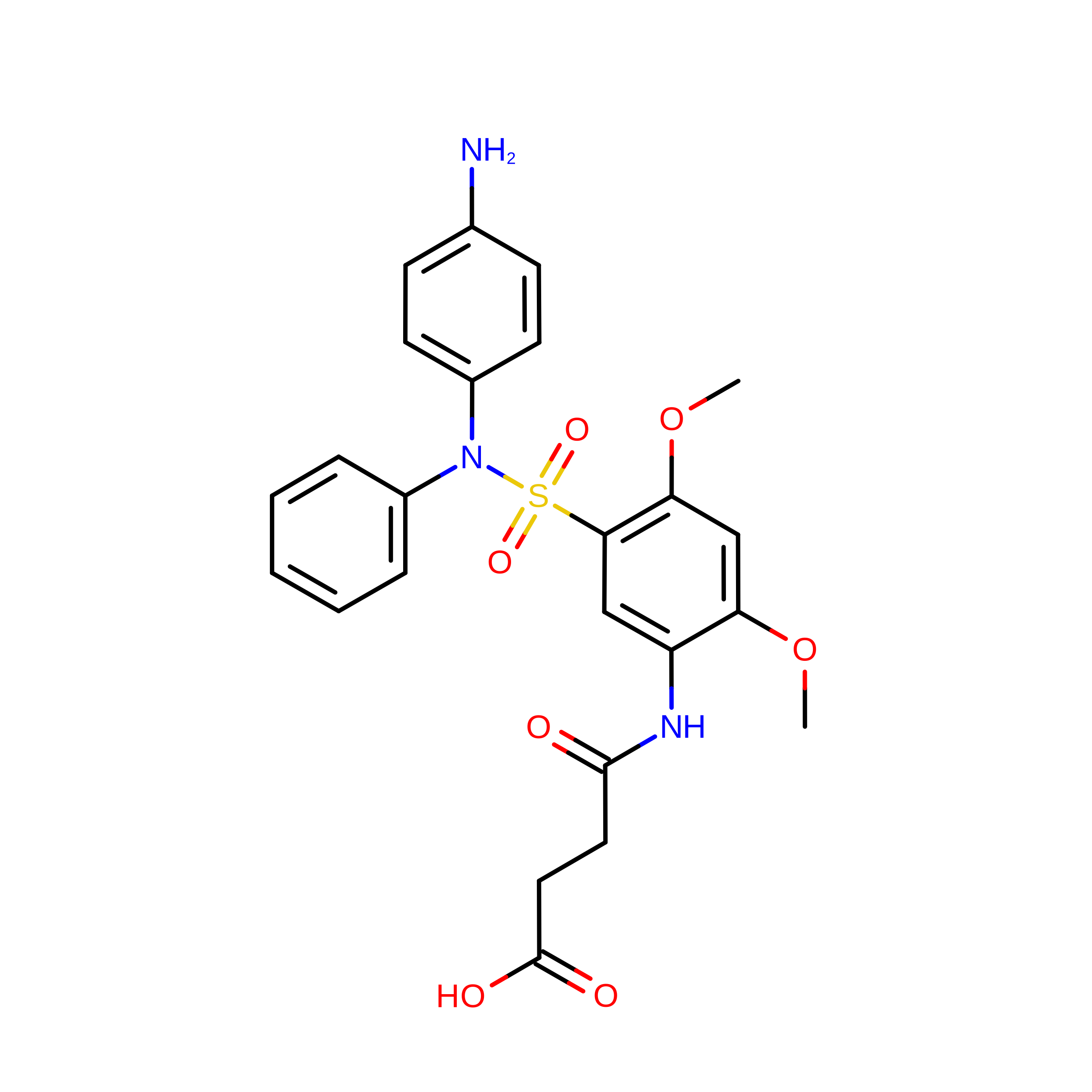
glmuC1 in complex with an antibacterial inhibitor


Experimental Data Snapshot

  • Method: X-RAY DIFFRACTION
  • Resolution: 1.90 Å
  • R-Value Free: 
    0.217 (Depositor), 0.228 (DCC) 
  • R-Value Work: 
    0.188 (DCC) 

wwPDB Validation 3D Report Full Report

Validation slider image for 3TWD

Ligand Structure Quality Assessment 


This is version 1.3 of the entry. See complete history

Literature

In Vitro Validation of Acetyltransferase Activity of GlmU as an Antibacterial Target in Haemophilus influenzae.

Buurman, E.T.Andrews, B.Gao, N.Hu, J.Keating, T.A.Lahiri, S.Otterbein, L.R.Patten, A.D.Stokes, S.S.Shapiro, A.B.

(2011) J Biological Chem 286: 40734-40742

  • DOI: https://doi.org/10.1074/jbc.M111.274068
  • Primary Citation Related Structures: 
    3TWD

  • PubMed Abstract: 

    GlmU is a bifunctional enzyme that is essential for bacterial growth, converting D-glucosamine 1-phosphate into UDP-GlcNAc via acetylation and subsequent uridyl transfer. A biochemical screen of AstraZeneca's compound library using GlmU of Escherichia coli identified novel sulfonamide inhibitors of the acetyltransferase reaction. Steady-state kinetics, ligand-observe NMR, isothermal titration calorimetry, and x-ray crystallography showed that the inhibitors were competitive with acetyl-CoA substrate. Iterative chemistry efforts improved biochemical potency against gram-negative isozymes 300-fold and afforded antimicrobial activity against a strain of Haemophilus influenzae lacking its major efflux pump. Inhibition of precursor incorporation into bacterial macromolecules was consistent with the antimicrobial activity being caused by disruption of peptidoglycan and fatty acid biosyntheses. Isolation and characterization of two different resistant mutant strains identified the GlmU acetyltransferase domain as the molecular target. These data, along with x-ray co-crystal structures, confirmed the binding mode of the inhibitors and explained their relative lack of potency against gram-positive GlmU isozymes. This is the first example of antimicrobial compounds mediating their growth inhibitory effects specifically via GlmU.


  • Organizational Affiliation
    • AstraZeneca R&D Boston, Infection Innovative Medicines Unit, Waltham, Massachusetts 02451, USA. Ed.Buurman@astrazeneca.com

Macromolecule Content 

  • Total Structure Weight: 48.19 kDa 
  • Atom Count: 3,762 
  • Modeled Residue Count: 444 
  • Deposited Residue Count: 444 
  • Unique protein chains: 1

Macromolecules

Find similar proteins by:|  3D Structure
Entity ID: 1
MoleculeChains  Sequence LengthOrganismDetailsImage
Bifunctional protein glmU
A, B
222Escherichia coli K-12Mutation(s): 0 
Gene Names: glmUyieAb3730JW3708
EC: 2.7.7.23 (PDB Primary Data), 2.3.1.157 (PDB Primary Data)
UniProt
Find proteins for P0ACC7 (Escherichia coli (strain K12))
Explore P0ACC7 
Go to UniProtKB:  P0ACC7
Entity Groups
Sequence Clusters30% Identity50% Identity70% Identity90% Identity95% Identity100% Identity
UniProt GroupP0ACC7
Sequence Annotations
Expand
Reference Sequence

Small Molecules

Binding Affinity Annotations 
IDSourceBinding Affinity
GOB BindingDB:  3TWD IC50: min: 18, max: 20 (nM) from 2 assay(s)

Experimental Data & Validation

Experimental Data

  • Method: X-RAY DIFFRACTION
  • Resolution: 1.90 Å
  • R-Value Free:  0.217 (Depositor), 0.228 (DCC) 
  • R-Value Work:  0.188 (DCC) 
Space Group: P 63
Unit Cell:
Length ( Å )Angle ( ˚ )
a = 80.526α = 90
b = 80.526β = 90
c = 139.85γ = 120
Software Package:
Software NamePurpose
REFMACrefinement
PDB_EXTRACTdata extraction
CrystalCleardata collection
d*TREKdata reduction
d*TREKdata scaling
AMoREphasing

Structure Validation

View Full Validation Report


Ligand Structure Quality Assessment 


Entry History 

Deposition Data

Revision History  (Full details and data files)

  • Version 1.0: 2011-10-19
    Type: Initial release
  • Version 1.1: 2011-10-26
    Changes: Database references
  • Version 1.2: 2011-12-14
    Changes: Database references
  • Version 1.3: 2024-02-28
    Changes: Data collection, Database references, Derived calculations