3TC5 | pdb_00003tc5

Selective targeting of disease-relevant protein binding domains by O-phosphorylated natural product derivatives


Experimental Data Snapshot

  • Method: X-RAY DIFFRACTION
  • Resolution: 1.40 Å
  • R-Value Free: 
    0.211 (Depositor), 0.215 (DCC) 
  • R-Value Work: 
    0.175 (Depositor), 0.178 (DCC) 
  • R-Value Observed: 
    0.177 (Depositor) 

Starting Model: experimental
View more details

wwPDB Validation 3D Report Full Report

Validation slider image for 3TC5

Ligand Structure Quality Assessment 


This is version 1.3 of the entry. See complete history

Literature

Selective targeting of disease-relevant protein binding domains by o-phosphorylated natural product derivatives.

Graber, M.Janczyk, W.Sperl, B.Elumalai, N.Kozany, C.Hausch, F.Holak, T.A.Berg, T.

(2011) ACS Chem Biol 6: 1008-1014

  • DOI: https://doi.org/10.1021/cb2001796
  • Primary Citation Related Structures: 
    3TC5

  • PubMed Abstract: 

    Phosphorylation-dependent protein binding domains are crucially important for intracellular signaling pathways and thus highly relevant targets in chemical biology. By screening of chemical libraries against 12 structurally diverse phosphorylation-dependent protein binding domains, we have identified fosfosal and dexamethasone-21-phosphate as selective inhibitors of two antitumor targets: the SH2 domain of the transcription factor STAT5b and the substrate-binding domain of the peptidyl-prolyl isomerase Pin1, respectively. Both compounds are phosphate prodrugs with documented clinical use as anti-inflammatory agents in humans and were discovered with a high hit rate from a small subgroup within the screening library. Our study indicates O-phosphorylation of appropriately preselected natural products or natural product derivatives as a generally applicable strategy for the identification of non-reactive and non-peptidic ligands of phosphorylation-dependent protein binding domains. Moreover, our data indicate that it would be advisable to monitor the bioactivities of clinically used prodrugs in their uncleaved state against phosphorylation-dependent protein binding domains.

Macromolecule Content 

  • Total Structure Weight: 19.22 kDa 
  • Atom Count: 1,452 
  • Modeled Residue Count: 144 
  • Deposited Residue Count: 166 
  • Unique protein chains: 1

Macromolecules

Find similar proteins by:|  3D Structure
Entity ID: 1
MoleculeChains  Sequence LengthOrganismDetailsImage
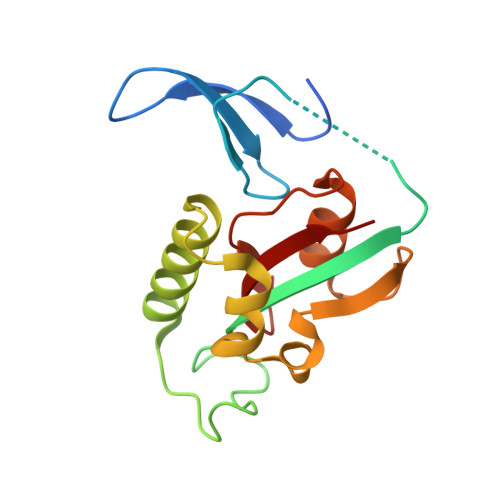
Peptidyl-prolyl cis-trans isomerase NIMA-interacting 1166Homo sapiensMutation(s): 1 
Gene Names: PIN1
EC: 5.2.1.8
UniProt & NIH Common Fund Data Resources
Find proteins for Q13526 (Homo sapiens)
Explore Q13526 
Go to UniProtKB:  Q13526
PHAROS:  Q13526
GTEx:  ENSG00000127445 
Entity Groups
Sequence Clusters30% Identity50% Identity70% Identity90% Identity95% Identity100% Identity
UniProt GroupQ13526
Sequence Annotations
Expand
Reference Sequence

Small Molecules

Ligands 2 Unique
IDChains Name / Formula / InChI Key2D Diagram3D Interactions
3T5

Query on 3T5


Download:Ideal Coordinates CCD File
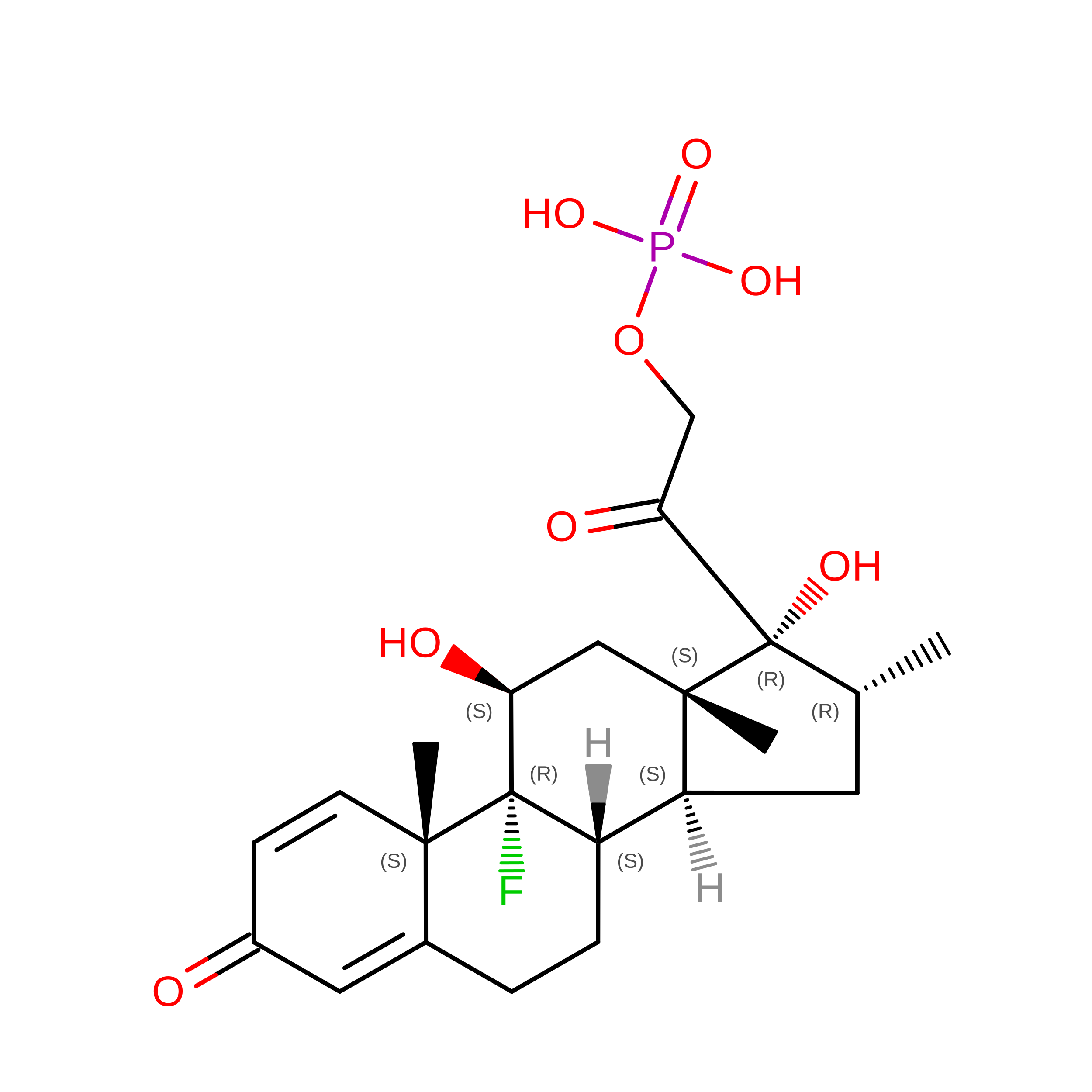
B [auth A](11alpha,16alpha)-9-fluoro-11,17-dihydroxy-16-methyl-3,20-dioxopregna-1,4-dien-21-yl dihydrogen phosphate
C22 H30 F O8 P
VQODGRNSFPNSQE-CXSFZGCWSA-N
P6G

Query on P6G


Download:Ideal Coordinates CCD File
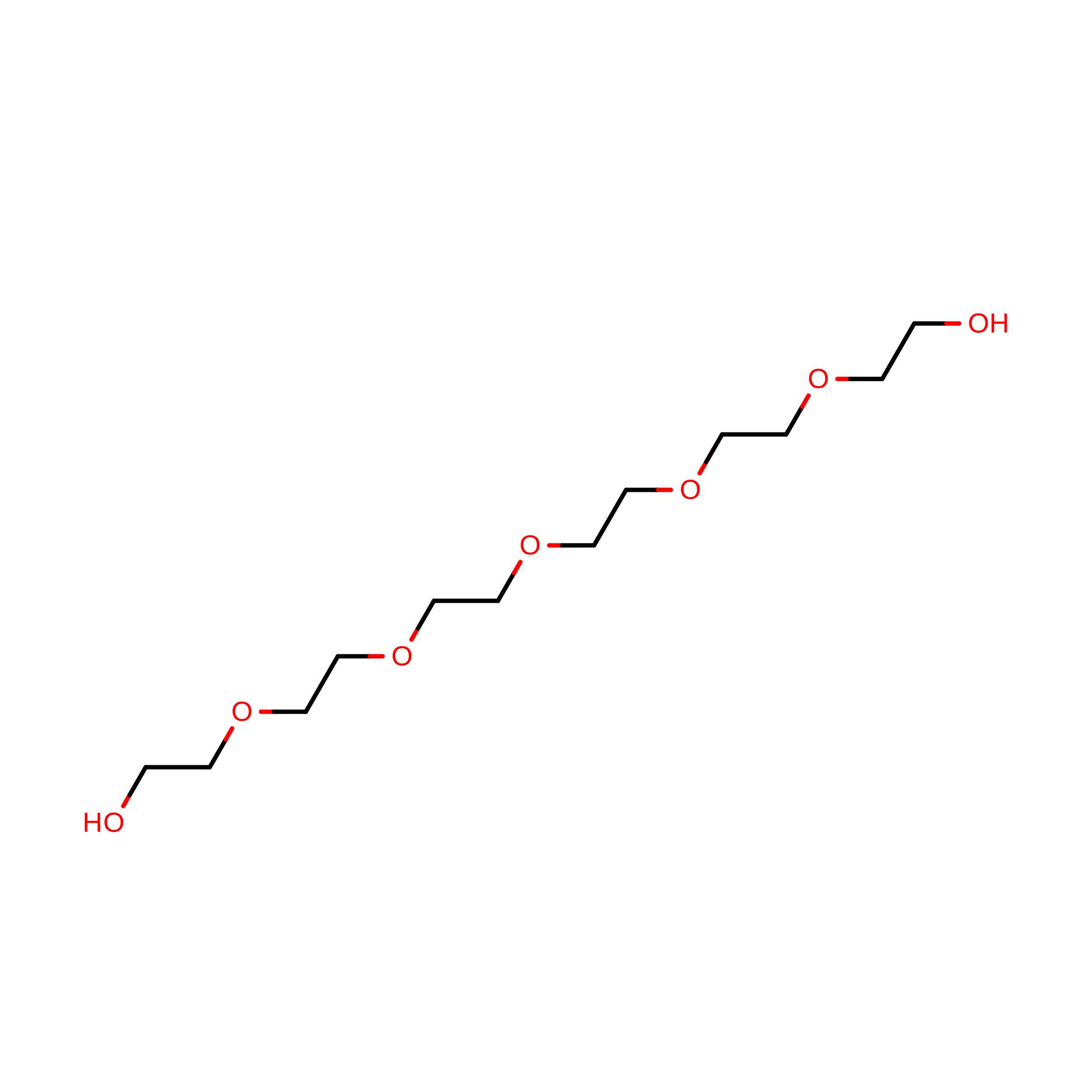
C [auth A]HEXAETHYLENE GLYCOL
C12 H26 O7
IIRDTKBZINWQAW-UHFFFAOYSA-N

Experimental Data & Validation

Experimental Data

  • Method: X-RAY DIFFRACTION
  • Resolution: 1.40 Å
  • R-Value Free:  0.211 (Depositor), 0.215 (DCC) 
  • R-Value Work:  0.175 (Depositor), 0.178 (DCC) 
  • R-Value Observed: 0.177 (Depositor) 
Space Group: P 31 2 1
Unit Cell:
Length ( Å )Angle ( ˚ )
a = 68.36α = 90
b = 68.36β = 90
c = 79.37γ = 120
Software Package:
Software NamePurpose
MAR345data collection
MOLREPphasing
REFMACrefinement
XDSdata reduction
XSCALEdata scaling

Structure Validation

View Full Validation Report


Ligand Structure Quality Assessment 


Entry History 

Deposition Data

Revision History  (Full details and data files)

  • Version 1.0: 2011-08-31
    Type: Initial release
  • Version 1.1: 2011-11-02
    Changes: Database references
  • Version 1.2: 2017-11-08
    Changes: Refinement description
  • Version 1.3: 2023-09-13
    Changes: Data collection, Database references, Derived calculations, Refinement description