3T1G | pdb_00003t1g

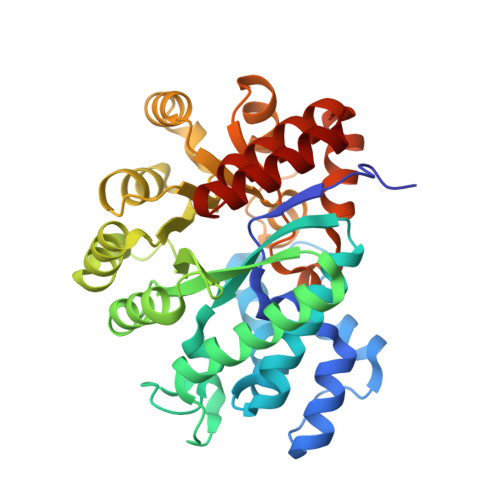
Engineering of organophosphate hydrolase by computational design and directed evolution


Experimental Data Snapshot

  • Method: X-RAY DIFFRACTION
  • Resolution: 2.35 Å
  • R-Value Free: 
    0.250 (Depositor), 0.251 (DCC) 
  • R-Value Work: 
    0.189 (Depositor), 0.194 (DCC) 
  • R-Value Observed: 
    0.193 (Depositor) 

Starting Model: experimental
View more details

wwPDB Validation 3D Report Full Report

Validation slider image for 3T1G

This is version 1.2 of the entry. See complete history. 

Literature

Computational redesign of a mononuclear zinc metalloenzyme for organophosphate hydrolysis.

Khare, S.D., Kipnis, Y., Greisen, P.J., Takeuchi, R., Ashani, Y., Goldsmith, M., Song, Y., Gallaher, J.L., Silman, I., Leader, H., Sussman, J.L., Stoddard, B.L., Tawfik, D.S., Baker, D.

(2012) Nat Chem Biol 8: 294-300

  • DOI: https://doi.org/10.1038/nchembio.777
  • Primary Citation Related Structures: 
    3T1G

  • PubMed Abstract: 

    The ability to redesign enzymes to catalyze noncognate chemical transformations would have wide-ranging applications. We developed a computational method for repurposing the reactivity of metalloenzyme active site functional groups to catalyze new reactions. Using this method, we engineered a zinc-containing mouse adenosine deaminase to catalyze the hydrolysis of a model organophosphate with a catalytic efficiency (k(cat)/K(m)) of ~10(4) M(-1) s(-1) after directed evolution. In the high-resolution crystal structure of the enzyme, all but one of the designed residues adopt the designed conformation. The designed enzyme efficiently catalyzes the hydrolysis of the R(P) isomer of a coumarinyl analog of the nerve agent cyclosarin, and it shows marked substrate selectivity for coumarinyl leaving groups. Computational redesign of native enzyme active sites complements directed evolution methods and offers a general approach for exploring their untapped catalytic potential for new reactivities.


  • Organizational Affiliation: 
    • Department of Biochemistry, University of Washington, Seattle, Washington, USA.

Macromolecule Content 

  • Total Structure Weight: 40.48 kDa 
  • Atom Count: 2,937 
  • Modeled Residue Count: 349 
  • Deposited Residue Count: 353 
  • Unique protein chains: 1

Macromolecules

Find similar proteins by:|  3D Structure
Entity ID: 1
MoleculeChains  Sequence LengthOrganismDetailsImage
organophosphate hydrolase353Mus musculusMutation(s): 9 
Gene Names: Adenosine deaminase, ADA
EC: 3 (PDB Primary Data), 3.5.4.4 (UniProt)
UniProt
Find proteins for P03958 (Mus musculus)
Explore P03958 
Go to UniProtKB:  P03958
Entity Groups
Sequence Clusters30% Identity50% Identity70% Identity90% Identity95% Identity100% Identity
UniProt GroupP03958
Sequence Annotations
Expand
Reference Sequence

Experimental Data & Validation

Experimental Data

  • Method: X-RAY DIFFRACTION
  • Resolution: 2.35 Å
  • R-Value Free:  0.250 (Depositor), 0.251 (DCC) 
  • R-Value Work:  0.189 (Depositor), 0.194 (DCC) 
  • R-Value Observed: 0.193 (Depositor) 
Space Group: P 2 21 21
Unit Cell:
Length ( Å )Angle ( ˚ )
a = 47.391α = 90
b = 77.592β = 90
c = 94.972γ = 90
Software Package:
Software NamePurpose
HKL-2000data collection
PHASERphasing
REFMACrefinement
HKL-2000data reduction
HKL-2000data scaling

Structure Validation

View Full Validation Report


Entry History 

Deposition Data

Revision History  (Full details and data files)

  • Version 1.0: 2012-02-08
    Type: Initial release
  • Version 1.1: 2012-02-29
    Changes: Database references
  • Version 1.2: 2023-09-13
    Changes: Data collection, Database references, Derived calculations, Refinement description