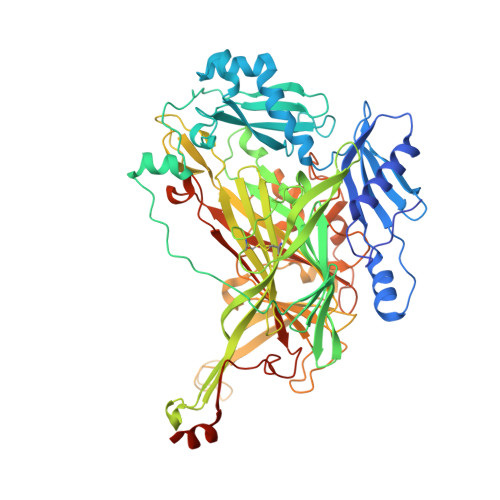
3SX1 | pdb_00003sx1

Hansenula polymorpha copper amine oxidase-1 in its apo form


Experimental Data Snapshot

  • Method: X-RAY DIFFRACTION
  • Resolution: 1.73 Å
  • R-Value Free: 
    0.163 (Depositor), 0.162 (DCC) 
  • R-Value Work: 
    0.132 (Depositor), 0.132 (DCC) 
  • R-Value Observed: 
    0.134 (Depositor) 

Starting Model: experimental
View more details

wwPDB Validation 3D Report Full Report

Validation slider image for 3SX1

This is version 1.3 of the entry. See complete history

Literature

The precursor form of Hansenula polymorpha copper amine oxidase 1 in complex with CuI and CoII.

Klema, V.J.Johnson, B.J.Klinman, J.P.Wilmot, C.M.

(2012) Acta Crystallogr Sect F Struct Biol Cryst Commun 68: 501-510

  • DOI: https://doi.org/10.1107/S1744309112012857
  • Primary Citation Related Structures: 
    3SX1, 3SXX, 3T0U

  • PubMed Abstract: 

    Copper amine oxidases (CAOs) catalyze the oxidative deamination of primary amines to their corresponding aldehydes, with the concomitant reduction of O(2) to H(2)O(2). Catalysis requires two cofactors: a mononuclear copper center and the cofactor 2,4,5-trihydroxyphenylalanine quinone (TPQ). TPQ is synthesized through the post-translational modification of an endogenous tyrosine residue and requires only oxygen and copper to proceed. TPQ biogenesis in CAO can be supported by alternate metals, albeit at decreased rates. A variety of factors are thought to contribute to the degree to which a metal can support TPQ biogenesis, including Lewis acidity, redox potential and electrostatic stabilization capability. The crystal structure has been solved of one of two characterized CAOs from the yeast Hansenula polymorpha (HPAO-1) in its metal-free (apo) form, which contains an unmodified precursor tyrosine residue instead of fully processed TPQ (HPAO-1 was denoted HPAO in the literature prior to 2010). Structures of apoHPAO-1 in complex with Cu(I) and Co(II) have also been solved, providing structural insight into metal binding prior to biogenesis.


  • Organizational Affiliation
    • Department of Biochemistry, Molecular Biology and Biophysics, University of Minnesota, 321 Church Street SE, Minneapolis, MN 55455, USA.

Macromolecule Content 

  • Total Structure Weight: 234.28 kDa 
  • Atom Count: 18,571 
  • Modeled Residue Count: 1,970 
  • Deposited Residue Count: 2,076 
  • Unique protein chains: 1

Macromolecules

Find similar proteins by:|  3D Structure
Entity ID: 1
MoleculeChains  Sequence LengthOrganismDetailsImage
Peroxisomal primary amine oxidase
A, B, C
692Ogataea angustaMutation(s): 0 
Gene Names: AMO
EC: 1.4.3.21
UniProt
Find proteins for P12807 (Pichia angusta)
Explore P12807 
Go to UniProtKB:  P12807
Entity Groups
Sequence Clusters30% Identity50% Identity70% Identity90% Identity95% Identity100% Identity
UniProt GroupP12807
Sequence Annotations
Expand
Reference Sequence

Small Molecules

Ligands 2 Unique
IDChains Name / Formula / InChI Key2D Diagram3D Interactions
PO4

Query on PO4


Download:Ideal Coordinates CCD File
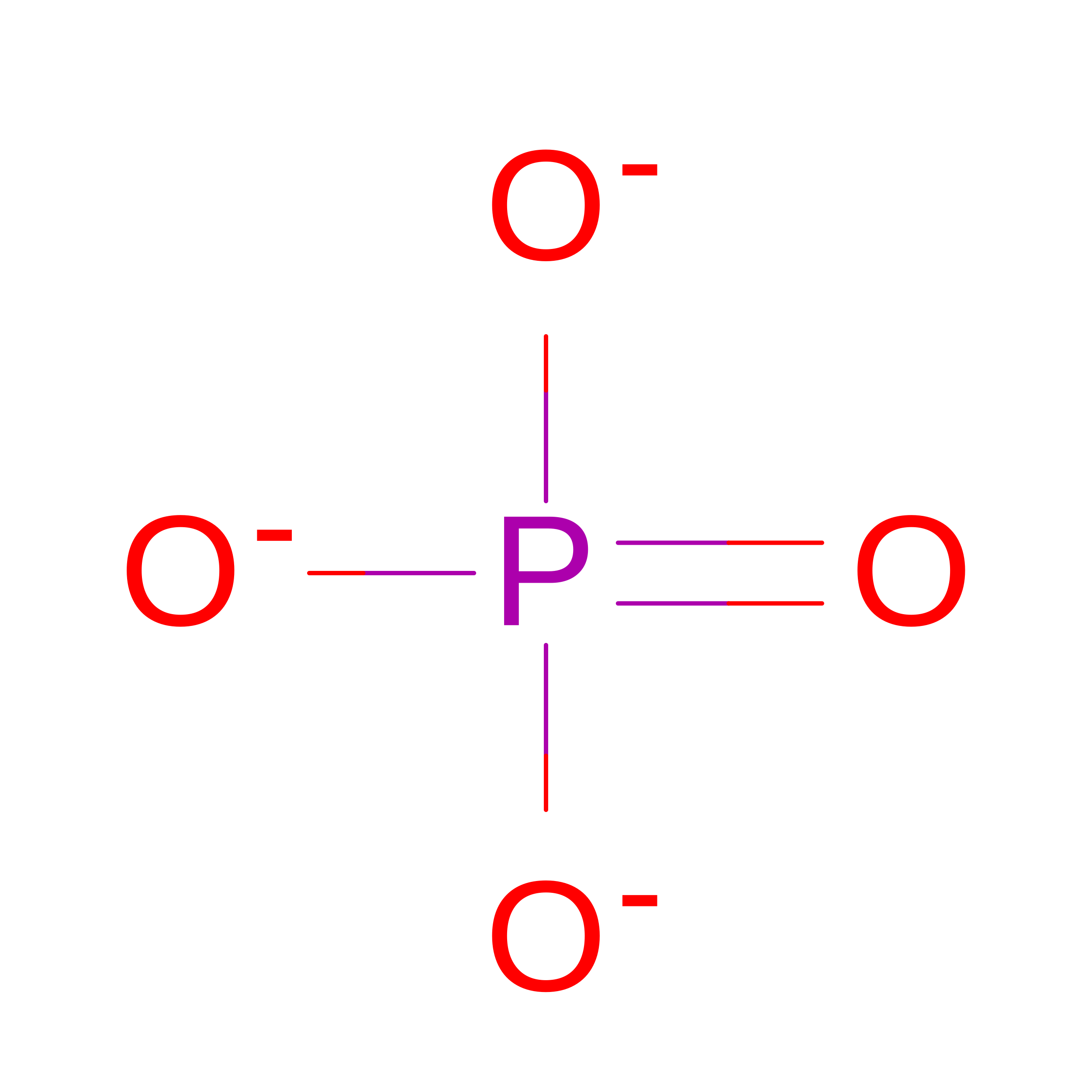
R [auth C]PHOSPHATE ION
O4 P
NBIIXXVUZAFLBC-UHFFFAOYSA-K
GOL

Query on GOL


Download:Ideal Coordinates CCD File
D [auth A]
E [auth A]
F [auth A]
G [auth A]
H [auth A]
D [auth A],
E [auth A],
F [auth A],
G [auth A],
H [auth A],
I [auth A],
J [auth B],
K [auth B],
L [auth B],
M [auth B],
N [auth B],
O [auth C],
P [auth C],
Q [auth C]
GLYCEROL
C3 H8 O3
PEDCQBHIVMGVHV-UHFFFAOYSA-N

Experimental Data & Validation

Experimental Data

  • Method: X-RAY DIFFRACTION
  • Resolution: 1.73 Å
  • R-Value Free:  0.163 (Depositor), 0.162 (DCC) 
  • R-Value Work:  0.132 (Depositor), 0.132 (DCC) 
  • R-Value Observed: 0.134 (Depositor) 
Space Group: C 2 2 21
Unit Cell:
Length ( Å )Angle ( ˚ )
a = 139.617α = 90
b = 153.636β = 90
c = 223.562γ = 90
Software Package:
Software NamePurpose
HKL-2000data collection
PHASERphasing
REFMACrefinement
HKL-2000data reduction
SCALEPACKdata scaling

Structure Validation

View Full Validation Report


Entry History 

Deposition Data

Revision History  (Full details and data files)

  • Version 1.0: 2012-05-02
    Type: Initial release
  • Version 1.1: 2013-01-23
    Changes: Database references
  • Version 1.2: 2023-09-13
    Changes: Data collection, Database references, Derived calculations, Refinement description
  • Version 1.3: 2024-10-30
    Changes: Structure summary