3SIS | pdb_00003sis

Crystal structure of Porcine CRW-8 Rotavirus VP8* in complex with aceramido-GM3_Gc


Experimental Data Snapshot

  • Method: X-RAY DIFFRACTION
  • Resolution: 2.20 Å
  • R-Value Free: 
    0.238 (Depositor), 0.235 (DCC) 
  • R-Value Work: 
    0.193 (Depositor), 0.192 (DCC) 
  • R-Value Observed: 
    0.195 (Depositor) 

Starting Model: experimental
View more details

wwPDB Validation 3D Report Full Report

Validation slider image for 3SIS

Ligand Structure Quality Assessment 


This is version 2.1 of the entry. See complete history

Literature

Novel structural insights into rotavirus recognition of ganglioside glycan receptors.

Yu, X.Coulson, B.S.Fleming, F.E.Dyason, J.C.von Itzstein, M.Blanchard, H.

(2011) J Mol Biology 413: 929-939

  • DOI: https://doi.org/10.1016/j.jmb.2011.09.005
  • Primary Citation Related Structures: 
    3SIS, 3SIT

  • PubMed Abstract: 

    Rotaviruses ubiquitously infect children under the age of 5, being responsible for more than half a million diarrhoeal deaths each year worldwide. Host cell oligosaccharides containing sialic acid(s) are critical for attachment by rotaviruses. However, to date, no detailed three-dimensional atomic model showing the exact rotavirus interactions with these glycoconjugate receptors has been reported. Here, we present the first crystallographic structures of the rotavirus carbohydrate-recognizing protein VP8* in complex with ganglioside G(M3) glycans. In combination with assessment of the inhibition of rotavirus infectivity by N-acetyl and N-glycolyl forms of this ganglioside, our results reveal key details of rotavirus-ganglioside G(M3) glycan recognition. In addition, they show a direct correlation between the carbohydrate specificities exhibited by VP8* from porcine and by monkey rotaviruses and the respective infectious virus particles. These novel results also indicate the potential binding interactions of rotavirus VP8* with other sialic acid-containing gangliosides.


  • Organizational Affiliation
    • Institute for Glycomics, Gold Coast campus, Griffith University, Queensland 4222, Australia.

Macromolecule Content 

  • Total Structure Weight: 38.07 kDa 
  • Atom Count: 2,814 
  • Modeled Residue Count: 322 
  • Deposited Residue Count: 326 
  • Unique protein chains: 1

Macromolecules

Find similar proteins by:|  3D Structure
Entity ID: 1
MoleculeChains  Sequence LengthOrganismDetailsImage
Outer capsid protein VP4
A, B
163Porcine rotavirus (serotype 3 / strain CRW-8)Mutation(s): 4 
UniProt
Find proteins for P0C6Y8 (Rotavirus A (isolate RVA/Pig/Australia/CRW-8/1987/G3P9[7]))
Explore P0C6Y8 
Go to UniProtKB:  P0C6Y8
Entity Groups
Sequence Clusters30% Identity50% Identity70% Identity90% Identity95% Identity100% Identity
UniProt GroupP0C6Y8
Sequence Annotations
Expand
Reference Sequence

Oligosaccharides

Help  
Entity ID: 2
MoleculeChains Length2D Diagram GlycosylationD Interactions
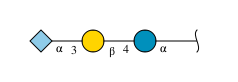
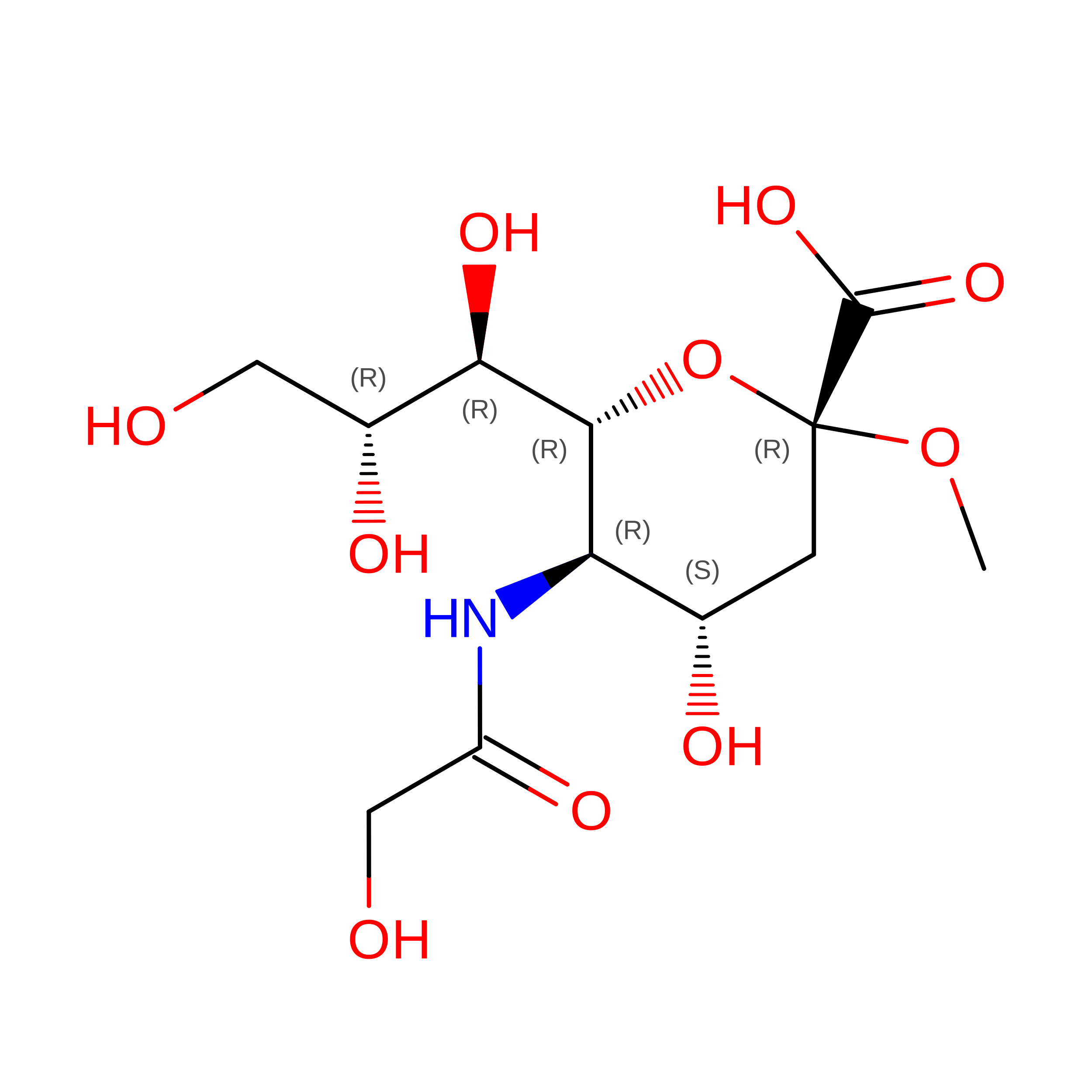
N-glycolyl-alpha-neuraminic acid-(2-3)-beta-D-galactopyranose-(1-4)-alpha-D-glucopyranose
C
3N/A
Glycosylation Resources
GlyTouCan: G50281RU
GlyCosmos: G50281RU
GlyGen: G50281RU

Experimental Data & Validation

Experimental Data

  • Method: X-RAY DIFFRACTION
  • Resolution: 2.20 Å
  • R-Value Free:  0.238 (Depositor), 0.235 (DCC) 
  • R-Value Work:  0.193 (Depositor), 0.192 (DCC) 
  • R-Value Observed: 0.195 (Depositor) 
Space Group: P 21 21 21
Unit Cell:
Length ( Å )Angle ( ˚ )
a = 55.31α = 90
b = 56.77β = 90
c = 110.7γ = 90
Software Package:
Software NamePurpose
Blu-Icedata collection
AMoREphasing
REFMACrefinement
MOSFLMdata reduction
SCALAdata scaling

Structure Validation

View Full Validation Report


Ligand Structure Quality Assessment 


Entry History 

Deposition Data

Revision History  (Full details and data files)

  • Version 1.0: 2011-09-28
    Type: Initial release
  • Version 1.1: 2011-10-12
    Changes: Database references
  • Version 1.2: 2011-11-30
    Changes: Database references
  • Version 2.0: 2020-07-29
    Type: Remediation
    Reason: Carbohydrate remediation
    Changes: Advisory, Atomic model, Data collection, Database references, Derived calculations, Non-polymer description, Structure summary
  • Version 2.1: 2023-09-13
    Changes: Data collection, Database references, Refinement description, Structure summary