3S8R | pdb_00003s8r

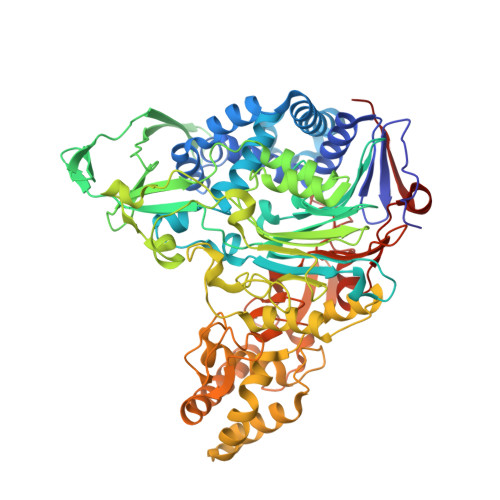
Crystal Structures of Glutaryl 7-Aminocephalosporanic Acid Acylase: Insight into Autoproteolytic Activation


Experimental Data Snapshot

  • Method: X-RAY DIFFRACTION
  • Resolution: 2.50 Å
  • R-Value Free: 
    0.200 (Depositor), 0.189 (DCC) 
  • R-Value Work: 
    0.153 (Depositor) 
  • R-Value Observed: 
    0.156 (Depositor) 

wwPDB Validation 3D Report Full Report

Validation slider image for 3S8R

This is version 1.3 of the entry. See complete history

Literature

Crystal structures of glutaryl 7-aminocephalosporanic acid acylase: insight into autoproteolytic activation.

Kim, J.K.Yang, I.S.Rhee, S.Dauter, Z.Lee, Y.S.Park, S.S.Kim, K.H.

(2003) Biochemistry 42: 4084-4093

  • DOI: https://doi.org/10.1021/bi027181x
  • Primary Citation Related Structures: 
    1OR0, 3S8R

  • PubMed Abstract: 

    Glutaryl 7-aminocephalosporanic acid acylase (GCA, EC 3.5.1.11) is a member of N-terminal nucleophile (Ntn) hydrolases. The native enzyme is an (alpha beta)(2) heterotetramer originated from an enzymatically inactive precursor of a single polypeptide. The activation of precursor GCA consists of primary and secondary autoproteolytic cleavages, generating a terminal residue with both a nucleophile and a base and releasing a nine amino acid spacer peptide. We have determined the crystal structures of the recombinant selenomethionyl native and S170A mutant precursor from Pseudomonas sp. strain GK16. Precursor activation is likely triggered by conformational constraints within the spacer peptide, probably inducing a peptide flip. Autoproteolytic site solvent molecules, which have been trapped in a hydrophobic environment by the spacer peptide, may play a role as a general base for nucleophilic attack. The activation results in building up a catalytic triad composed of Ser170/His192/Glu624. However, the triad is not linked to the usual hydroxyl but the free alpha-amino group of the N-terminal serine residue of the native GCA. Mutagenesis and structural data support the notion that the stabilization of a transient hydroxazolidine ring during autoproteolysis would be critical during the N --> O acyl shift. The autoproteolytic activation mechanism for GCA is described.


  • Organizational Affiliation
    • Graduate School of Biotechnology, Korea University, Seoul 136-701, Korea.

Macromolecule Content 

  • Total Structure Weight: 155.35 kDa 
  • Atom Count: 11,658 
  • Modeled Residue Count: 1,370 
  • Deposited Residue Count: 1,394 
  • Unique protein chains: 1

Macromolecules

Find similar proteins by:|  3D Structure
Entity ID: 1
MoleculeChains  Sequence LengthOrganismDetailsImage
Glutaryl-7-aminocephalosporanic-acid acylase
A, B
697Pseudomonas sp. SY-77-1Mutation(s): 1 
EC: 3.5.1.93
UniProt
Find proteins for P07662 (Pseudomonas sp. (strain SY-77))
Explore P07662 
Go to UniProtKB:  P07662
Entity Groups
Sequence Clusters30% Identity50% Identity70% Identity90% Identity95% Identity100% Identity
UniProt GroupP07662
Sequence Annotations
Expand
Reference Sequence

Experimental Data & Validation

Experimental Data

  • Method: X-RAY DIFFRACTION
  • Resolution: 2.50 Å
  • R-Value Free:  0.200 (Depositor), 0.189 (DCC) 
  • R-Value Work:  0.153 (Depositor) 
  • R-Value Observed: 0.156 (Depositor) 
Space Group: C 1 2 1
Unit Cell:
Length ( Å )Angle ( ˚ )
a = 225.386α = 90
b = 68.806β = 97.51
c = 112.756γ = 90
Software Package:
Software NamePurpose
DENZOdata reduction
SCALEPACKdata scaling
REFMACrefinement
PDB_EXTRACTdata extraction
HKL-2000data collection
CNSphasing

Structure Validation

View Full Validation Report


Entry History 

Deposition Data

Revision History  (Full details and data files)

  • Version 1.0: 2011-07-06
    Type: Initial release
  • Version 1.1: 2011-07-13
    Changes: Version format compliance
  • Version 1.2: 2017-11-08
    Changes: Refinement description
  • Version 1.3: 2024-03-20
    Changes: Data collection, Database references, Derived calculations