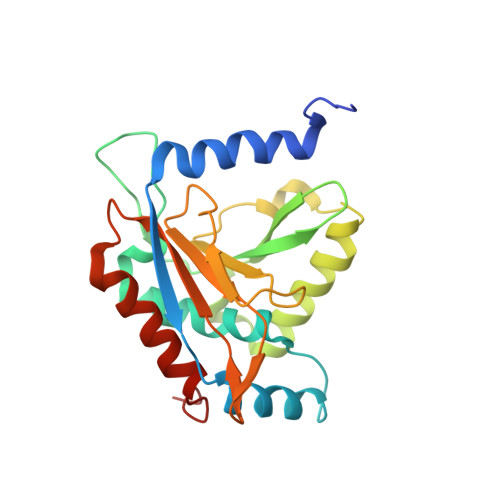
3RQC | pdb_00003rqc

Crystal structure of the catalytic core of the 2-oxoacid dehydrogenase multienzyme complex from Thermoplasma acidophilum


Experimental Data Snapshot

  • Method: X-RAY DIFFRACTION
  • Resolution: 4.01 Å
  • R-Value Free: 
    0.328 (Depositor), 0.318 (DCC) 
  • R-Value Work: 
    0.253 (Depositor), 0.246 (DCC) 
  • R-Value Observed: 
    0.257 (Depositor) 

Starting Model: experimental
View more details

wwPDB Validation 3D Report Full Report

Validation slider image for 3RQC

This is version 1.2 of the entry. See complete history

Literature

The catalytic core of an archaeal 2-oxoacid dehydrogenase multienzyme complex is a 42-mer protein assembly.

Marrott, N.L.Marshall, J.J.Svergun, D.I.Crennell, S.J.Hough, D.W.Danson, M.J.van den Elsen, J.M.

(2012) FEBS J 279: 713-723

  • DOI: https://doi.org/10.1111/j.1742-4658.2011.08461.x
  • Primary Citation Related Structures: 
    3RQC

  • PubMed Abstract: 

    The dihydrolipoyl acyl-transferase (E2) enzyme forms the structural and catalytic core of the tripartite 2-oxoacid dehydrogenase multienzyme complexes of the central metabolic pathways. Although this family of multienzyme complexes shares a common architecture, their E2 cores form homo-trimers that, depending on the source, further associate into either octahedral (24-mer) or icosahedral (60-mer) assemblies, as predicted by the principles of quasi-equivalence. In the crystal structure of the E2 core from Thermoplasma acidophilum, a thermophilic archaeon, the homo-trimers assemble into a unique 42-mer oblate spheroid. Analytical equilibrium centrifugation and small-angle X-ray scattering analyses confirm that this catalytically active 1.08 MDa assembly exists as a single species in solution, forming a hollow spheroid with a maximum diameter of 220 Å. In this paper we show that a monodisperse macromolecular assembly, built from identical subunits in non-identical environments, forms an irregular protein shell via non-equivalent interactions. This unusually irregular protein shell, combining cubic and dodecahedral geometrical elements, expands on the concept of quasi-equivalence as a basis for understanding macromolecular assemblies by showing that cubic point group symmetry is not a physical requirement in multienzyme assembly. These results extend our basic knowledge of protein assembly and greatly expand the number of possibilities to manipulate self-assembling biological complexes to be utilized in innovative nanotechnology applications.


  • Organizational Affiliation
    • Department of Biology and Biochemistry, Centre for Extremophile Research, University of Bath, UK.

Macromolecule Content 

  • Total Structure Weight: 178.43 kDa 
  • Atom Count: 12,157 
  • Modeled Residue Count: 1,522 
  • Deposited Residue Count: 1,568 
  • Unique protein chains: 1

Macromolecules

Find similar proteins by:|  3D Structure
Entity ID: 1
MoleculeChains  Sequence LengthOrganismDetailsImage
Probable lipoamide acyltransferase
A, B, C, D, E
A, B, C, D, E, F, G
224Thermoplasma acidophilum DSM 1728Mutation(s): 0 
Gene Names: Ta1436
EC: 1.2.4.4 (PDB Primary Data), 2.3.1.168 (UniProt)
UniProt
Find proteins for Q9HIA5 (Thermoplasma acidophilum (strain ATCC 25905 / DSM 1728 / JCM 9062 / NBRC 15155 / AMRC-C165))
Explore Q9HIA5 
Go to UniProtKB:  Q9HIA5
Entity Groups
Sequence Clusters30% Identity50% Identity70% Identity90% Identity95% Identity100% Identity
UniProt GroupQ9HIA5
Sequence Annotations
Expand
Reference Sequence

Experimental Data & Validation

Experimental Data

  • Method: X-RAY DIFFRACTION
  • Resolution: 4.01 Å
  • R-Value Free:  0.328 (Depositor), 0.318 (DCC) 
  • R-Value Work:  0.253 (Depositor), 0.246 (DCC) 
  • R-Value Observed: 0.257 (Depositor) 
Space Group: H 3 2
Unit Cell:
Length ( Å )Angle ( ˚ )
a = 204.84α = 90
b = 204.84β = 90
c = 441.94γ = 120
Software Package:
Software NamePurpose
ADSCdata collection
BALBESphasing
REFMACrefinement
DENZOdata reduction
SCALEPACKdata scaling

Structure Validation

View Full Validation Report


Entry History 

Deposition Data

Revision History  (Full details and data files)

  • Version 1.0: 2012-01-11
    Type: Initial release
  • Version 1.1: 2012-04-25
    Changes: Database references
  • Version 1.2: 2023-09-13
    Changes: Data collection, Database references, Refinement description