3QG5 | pdb_00003qg5

The Mre11:Rad50 complex forms an ATP dependent molecular clamp in DNA double-strand break repair


Experimental Data Snapshot

  • Method: X-RAY DIFFRACTION
  • Resolution: 3.40 Å
  • R-Value Free: 
    0.295 (Depositor), 0.299 (DCC) 
  • R-Value Work: 
    0.258 (Depositor), 0.269 (DCC) 
  • R-Value Observed: 
    0.260 (Depositor) 

wwPDB Validation 3D Report Full Report

Validation slider image for 3QG5

This is version 1.5 of the entry. See complete history

Literature

The Mre11:Rad50 Structure Shows an ATP-Dependent Molecular Clamp in DNA Double-Strand Break Repair.

Lammens, K.Bemeleit, D.J.Moeckel, C.Clausing, E.Schele, A.Hartung, S.Schiller, C.B.Lucas, M.Angermueller, C.Soeding, J.Straesser, K.Hopfner, K.P.

(2011) Cell 145: 54-66

  • DOI: https://doi.org/10.1016/j.cell.2011.02.038
  • Primary Citation Related Structures: 
    3QF7, 3QG5

  • PubMed Abstract: 

    The MR (Mre11 nuclease and Rad50 ABC ATPase) complex is an evolutionarily conserved sensor for DNA double-strand breaks, highly genotoxic lesions linked to cancer development. MR can recognize and process DNA ends even if they are blocked and misfolded. To reveal its mechanism, we determined the crystal structure of the catalytic head of Thermotoga maritima MR and analyzed ATP-dependent conformational changes. MR adopts an open form with a central Mre11 nuclease dimer and two peripheral Rad50 molecules, a form suited for sensing obstructed breaks. The Mre11 C-terminal helix-loop-helix domain binds Rad50 and attaches flexibly to the nuclease domain, enabling large conformational changes. ATP binding to the two Rad50 subunits induces a rotation of the Mre11 helix-loop-helix and Rad50 coiled-coil domains, creating a clamp conformation with increased DNA-binding activity. The results suggest that MR is an ATP-controlled transient molecular clamp at DNA double-strand breaks.


  • Organizational Affiliation
    • Center for Integrated Protein Science Munich, Ludwig-Maximilians-University Munich, Feodor-Lynen-Strasse 25, 81377 Munich, Germany.

Macromolecule Content 

  • Total Structure Weight: 171.36 kDa 
  • Atom Count: 11,601 
  • Modeled Residue Count: 1,426 
  • Deposited Residue Count: 1,488 
  • Unique protein chains: 2

Macromolecules

Find similar proteins by:|  3D Structure
Entity ID: 1
MoleculeChains  Sequence LengthOrganismDetailsImage
rad50
A, B
365Thermotoga maritimaMutation(s): 0 
Gene Names: rad50TM_1636
EC: 3.6
UniProt
Find proteins for Q9X1X1 (Thermotoga maritima (strain ATCC 43589 / DSM 3109 / JCM 10099 / NBRC 100826 / MSB8))
Explore Q9X1X1 
Go to UniProtKB:  Q9X1X1
Entity Groups
Sequence Clusters30% Identity50% Identity70% Identity90% Identity95% Identity100% Identity
UniProt GroupQ9X1X1
Sequence Annotations
Expand
Reference Sequence
Find similar proteins by:|  3D Structure
Entity ID: 2
MoleculeChains  Sequence LengthOrganismDetailsImage
Mre11
C, D
379Thermotoga maritimaMutation(s): 0 
EC: 3.1
UniProt
Find proteins for Q9X1X0 (Thermotoga maritima (strain ATCC 43589 / DSM 3109 / JCM 10099 / NBRC 100826 / MSB8))
Explore Q9X1X0 
Go to UniProtKB:  Q9X1X0
Entity Groups
Sequence Clusters30% Identity50% Identity70% Identity90% Identity95% Identity100% Identity
UniProt GroupQ9X1X0
Sequence Annotations
Expand
Reference Sequence

Small Molecules

Modified Residues  1 Unique
IDChains TypeFormula2D DiagramParent
MSE
Query on MSE
A, B
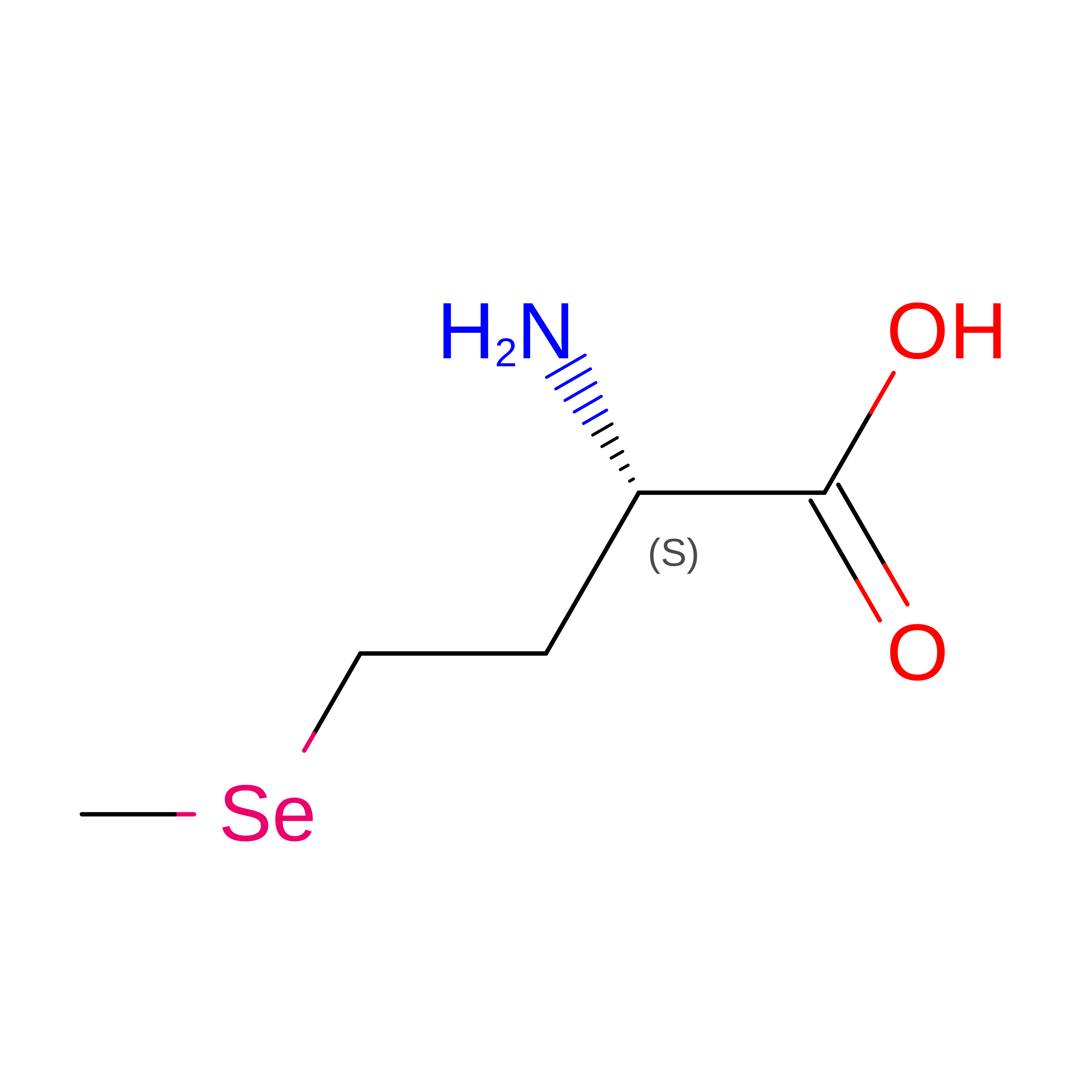
L-PEPTIDE LINKINGC5 H11 N O2 SeMET

Experimental Data & Validation

Experimental Data

  • Method: X-RAY DIFFRACTION
  • Resolution: 3.40 Å
  • R-Value Free:  0.295 (Depositor), 0.299 (DCC) 
  • R-Value Work:  0.258 (Depositor), 0.269 (DCC) 
  • R-Value Observed: 0.260 (Depositor) 
Space Group: I 2 2 2
Unit Cell:
Length ( Å )Angle ( ˚ )
a = 105.19α = 90
b = 187β = 90
c = 300.17γ = 90
Software Package:
Software NamePurpose
SHARPphasing
PHENIXrefinement
XDSdata reduction
XDSdata scaling

Structure Validation

View Full Validation Report


Entry History 

Deposition Data

  • Released Date: 2011-04-20 
  • Deposition Author(s): Lammens, K.

Revision History  (Full details and data files)

  • Version 1.0: 2011-04-20
    Type: Initial release
  • Version 1.1: 2011-07-13
    Changes: Version format compliance
  • Version 1.2: 2017-07-26
    Changes: Advisory, Data collection, Refinement description, Source and taxonomy
  • Version 1.3: 2017-11-08
    Changes: Refinement description
  • Version 1.4: 2024-03-13
    Changes: Advisory, Data collection, Database references, Derived calculations, Source and taxonomy
  • Version 1.5: 2024-11-20
    Changes: Structure summary