3QFL | pdb_00003qfl

Coiled-Coil Domain-Dependent Homodimerization of Intracellular MLA Immune Receptors Defines a Minimal Functional Module for Triggering Cell Death


Experimental Data Snapshot

  • Method: X-RAY DIFFRACTION
  • Resolution: 2.00 Å
  • R-Value Free: 
    0.258 (Depositor), 0.269 (DCC) 
  • R-Value Work: 
    0.210 (Depositor), 0.216 (DCC) 
  • R-Value Observed: 
    0.212 (Depositor) 

wwPDB Validation 3D Report Full Report

Validation slider image for 3QFL

This is version 1.2 of the entry. See complete history. 

Literature

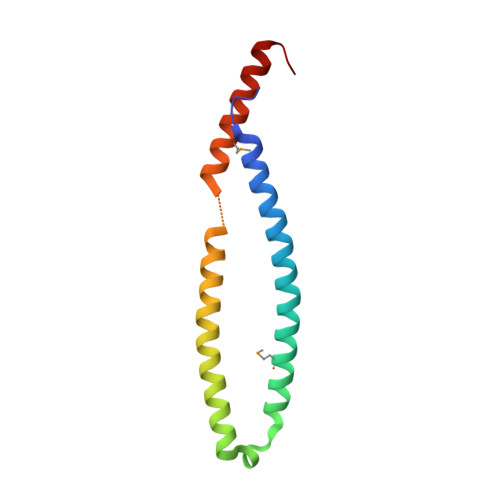
Coiled-Coil Domain-Dependent Homodimerization of Intracellular Barley Immune Receptors Defines a Minimal Functional Module for Triggering Cell Death

Maekawa, T., Cheng, W., Spiridon, L.N., Toller, A., Lukasik, E., Saijo, Y., Liu, P., Shen, Q.H., Micluta, M.A., Somssich, I.E., Takken, F.L., Petrescu, A.J., Chai, J., Schulze-Lefert, P.

(2011) Cell Host Microbe 9: 187-199

  • DOI: https://doi.org/10.1016/j.chom.2011.02.008
  • Primary Citation Related Structures: 
    3QFL

  • PubMed Abstract: 

    Plants and animals have evolved structurally related innate immune sensors, designated NLRs, to detect intracellular nonself molecules. NLRs are modular, consisting of N-terminal coiled-coil (CC) or TOLL/interleukin-1 receptor (TIR) domains, a central nucleotide-binding (NB) domain, and C-terminal leucine-rich repeats (LRRs). The polymorphic barley mildew A (MLA) locus encodes CC-containing allelic immune receptors recognizing effectors of the pathogenic powdery mildew fungus. We report the crystal structure of an MLA receptor's invariant CC domain, which reveals a rod-shaped homodimer. MLA receptors also self-associate in vivo, but self-association appears to be independent of effector-triggered receptor activation. MLA CC mutants that fail to self-interact impair in planta cell death activity triggered by the CC domain alone and by an autoactive full-length MLA receptor that mimics its ATP-bound state. Thus, CC domain-dependent dimerization of the immune sensor defines a minimal functional unit and implies a role for the dimeric CC module in downstream immune signaling.


  • Organizational Affiliation: 
    • Department of Plant-Microbe Interactions, Max-Planck Institut für Pflanzenzüchtungsforschung, Carl-von-Linne Weg 10, 50829 Cologne, Germany.

Macromolecule Content 

  • Total Structure Weight: 13.15 kDa 
  • Atom Count: 965 
  • Modeled Residue Count: 110 
  • Deposited Residue Count: 115 
  • Unique protein chains: 1

Macromolecules

Find similar proteins by:|  3D Structure
Entity ID: 1
MoleculeChains  Sequence LengthOrganismDetailsImage
MLA10115Hordeum vulgareMutation(s): 0 
Gene Names: Mla10
UniProt
Find proteins for Q8GSK4 (Hordeum vulgare)
Explore Q8GSK4 
Go to UniProtKB:  Q8GSK4
Entity Groups
Sequence Clusters30% Identity50% Identity70% Identity90% Identity95% Identity100% Identity
UniProt GroupQ8GSK4
Sequence Annotations
Expand
Reference Sequence

Small Molecules

Modified Residues  1 Unique
IDChains TypeFormula2D DiagramParent
MSE
Query on MSE
A
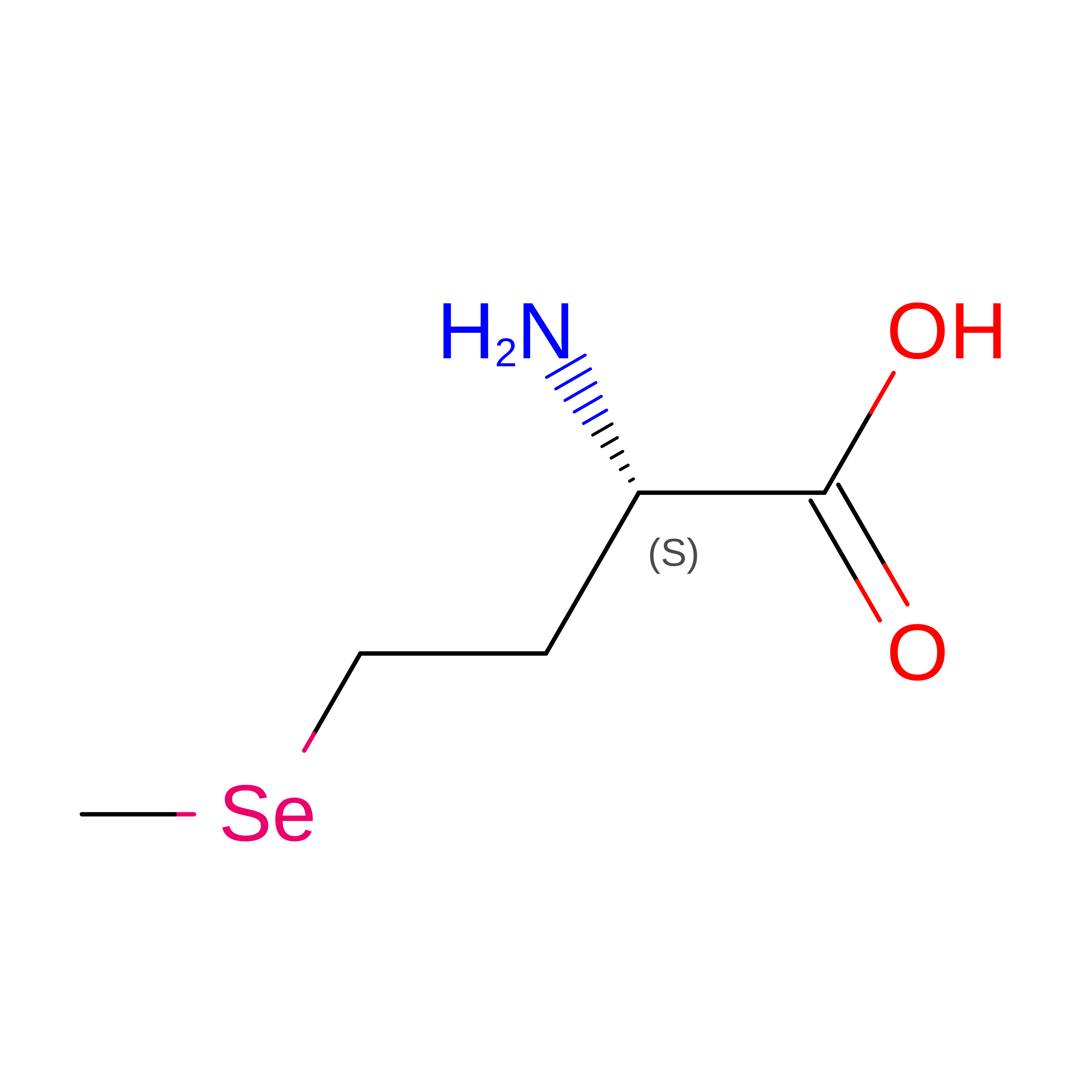
L-PEPTIDE LINKINGC5 H11 N O2 SeMET

Experimental Data & Validation

Experimental Data

  • Method: X-RAY DIFFRACTION
  • Resolution: 2.00 Å
  • R-Value Free:  0.258 (Depositor), 0.269 (DCC) 
  • R-Value Work:  0.210 (Depositor), 0.216 (DCC) 
  • R-Value Observed: 0.212 (Depositor) 
Space Group: P 21 21 2
Unit Cell:
Length ( Å )Angle ( ˚ )
a = 97.462α = 90
b = 30.268β = 90
c = 38.052γ = 90
Software Package:
Software NamePurpose
HKL-2000data collection
SOLVEphasing
PHENIXrefinement
DENZOdata reduction
SCALEPACKdata scaling

Structure Validation

View Full Validation Report


Entry History 

Deposition Data

Revision History  (Full details and data files)

  • Version 1.0: 2011-05-04
    Type: Initial release
  • Version 1.1: 2011-07-13
    Changes: Version format compliance
  • Version 1.2: 2024-10-30
    Changes: Data collection, Database references, Derived calculations, Structure summary