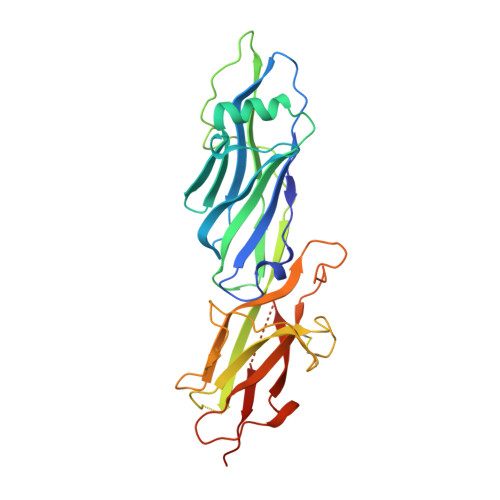
3QDH | pdb_00003qdh

Crystal structure of Actinomyces fimbrial adhesin FimA


Experimental Data Snapshot

  • Method: X-RAY DIFFRACTION
  • Resolution: 1.90 Å
  • R-Value Free: 
    0.249 (Depositor), 0.248 (DCC) 
  • R-Value Work: 
    0.209 (Depositor), 0.210 (DCC) 
  • R-Value Observed: 
    0.211 (Depositor) 

wwPDB Validation 3D Report Full Report

Validation slider image for 3QDH

This is version 1.2 of the entry. See complete history

Literature

Two autonomous structural modules in the fimbrial shaft adhesin FimA mediate Actinomyces interactions with streptococci and host cells during oral biofilm development.

Mishra, A.Devarajan, B.Reardon, M.E.Dwivedi, P.Krishnan, V.Cisar, J.O.Das, A.Narayana, S.V.Ton-That, H.

(2011) Mol Microbiol 81: 1205-1220

  • DOI: https://doi.org/10.1111/j.1365-2958.2011.07745.x
  • Primary Citation Related Structures: 
    3QDH

  • PubMed Abstract: 

    By combining X-ray crystallography and modelling, we describe here the atomic structure of distinct adhesive moieties of FimA, the shaft fimbrillin of Actinomyces type 2 fimbriae, which uniquely mediates the receptor-dependent intercellular interactions between Actinomyces and oral streptococci as well as host cells during the development of oral biofilms. The FimA adhesin is built with three IgG-like domains, each of which harbours an intramolecular isopeptide bond, previously described in several Gram-positive pilins. Genetic and biochemical studies demonstrate that although these isopeptide bonds are dispensable for fimbrial assembly, cell-cell interactions and biofilm formation, they contribute significantly to the proteolytic stability of FimA. Remarkably, FimA harbours two autonomous adhesive modules, which structurally resemble the Staphylococcus aureus Cna B domain. Each isolated module can bind the plasma glycoprotein asialofetuin as well as the polysaccharide receptors present on the surface of oral streptococci and epithelial cells. Thus, FimA should serve as an excellent paradigm for the development of therapeutic strategies and elucidating the precise molecular mechanisms underlying the interactions between cellular receptors and Gram-positive fimbriae.


  • Organizational Affiliation
    • Department of Microbiology & Molecular Genetics, University of Texas Health Science Center, Houston, TX, USA.

Macromolecule Content 

  • Total Structure Weight: 31.08 kDa 
  • Atom Count: 2,243 
  • Modeled Residue Count: 271 
  • Deposited Residue Count: 290 
  • Unique protein chains: 1

Macromolecules

Find similar proteins by:|  3D Structure
Entity ID: 1
MoleculeChains  Sequence LengthOrganismDetailsImage
Fimbrial structural subunit290Actinomyces naeslundiiMutation(s): 0 
Gene Names: fimA
UniProt
Find proteins for O68212 (Actinomyces naeslundii)
Explore O68212 
Go to UniProtKB:  O68212
Entity Groups
Sequence Clusters30% Identity50% Identity70% Identity90% Identity95% Identity100% Identity
UniProt GroupO68212
Sequence Annotations
Expand
Reference Sequence

Small Molecules

Ligands 1 Unique
IDChains Name / Formula / InChI Key2D Diagram3D Interactions
ZN

Query on ZN


Download:Ideal Coordinates CCD File
B [auth A]ZINC ION
Zn
PTFCDOFLOPIGGS-UHFFFAOYSA-N

Experimental Data & Validation

Experimental Data

  • Method: X-RAY DIFFRACTION
  • Resolution: 1.90 Å
  • R-Value Free:  0.249 (Depositor), 0.248 (DCC) 
  • R-Value Work:  0.209 (Depositor), 0.210 (DCC) 
  • R-Value Observed: 0.211 (Depositor) 
Space Group: P 1 21 1
Unit Cell:
Length ( Å )Angle ( ˚ )
a = 47.528α = 90
b = 39.799β = 98.34
c = 77.139γ = 90
Software Package:
Software NamePurpose
autoSHARPphasing
REFMACrefinement
HKL-2000data reduction
HKL-2000data scaling

Structure Validation

View Full Validation Report


Entry History 

Deposition Data

Revision History  (Full details and data files)

  • Version 1.0: 2011-08-24
    Type: Initial release
  • Version 1.1: 2011-09-14
    Changes: Database references
  • Version 1.2: 2024-10-09
    Changes: Data collection, Database references, Derived calculations, Structure summary