3Q5Y | pdb_00003q5y

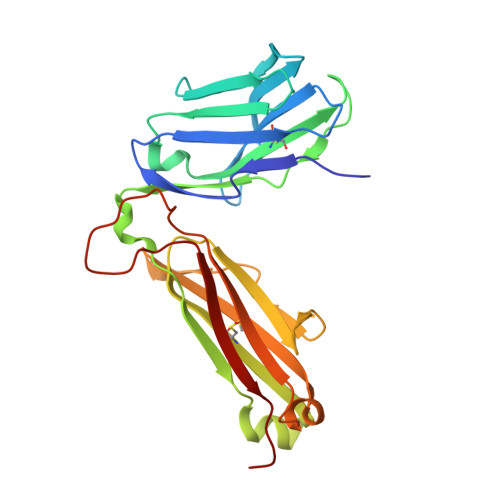
V beta/V beta homodimerization-based pre-TCR model suggested by TCR beta crystal structures


Experimental Data Snapshot

  • Method: X-RAY DIFFRACTION
  • Resolution: 1.90 Å
  • R-Value Free: 
    0.218 (Depositor), 0.230 (DCC) 
  • R-Value Work: 
    0.178 (Depositor), 0.193 (DCC) 
  • R-Value Observed: 
    0.180 (Depositor) 

wwPDB Validation 3D Report Full Report

Validation slider image for 3Q5Y

This is version 1.4 of the entry. See complete history

Literature

A conserved hydrophobic patch on Vbeta domains revealed by TCRbeta chain crystal structures: implications for pre-TCR dimerization

Zhou, B.Chen, Q.Mallis, R.J.Zhang, H.Liu, J.H.Reinherz, E.L.Wang, J.H.

(2011) Front Immunol 2: 5-5

  • DOI: https://doi.org/10.3389/fimmu.2011.00005
  • Primary Citation Related Structures: 
    3Q5T, 3Q5Y

  • PubMed Abstract: 

    The αβ T cell receptor (TCR) is a multimeric complex whose β chain plays a crucial role in thymocyte development as well as antigen recognition by mature T lymphocytes. We report here crystal structures of individual β subunits, termed N15β (Vβ5.2Dβ2Jβ2.6Cβ2) and N30β (Vβ13Dβ1Jβ1.1Cβ2), derived from two αβ TCRs specific for the immunodominant vesicular stomatitis virus octapeptide (VSV-8) bound to the murine H-2K(b) MHC class I molecule. The crystal packing of the N15β structure reveals a homodimer formed through two Vβ domains. The Vβ/Vβ module is topologically very similar to the Vα/Vβ module in the N15αβ heterodimer. By contrast, in the N30β structure, the Vβ domain's external hydrophobic CFG face is covered by the neighboring molecule's Cβ domain. In conjunction with systematic investigation of previously published TCR single-subunit structures, we identified several conserved residues forming a concave hydrophobic patch at the center of the CFG outer face of the Vβ and other V-type Ig-like domains. This hydrophobic patch is shielded from solvent exposure in the crystal packing, implying that it is unlikely to be thermodynamically stable if exposed on the thymocyte surface. Accordingly, we propose a dimeric pre-TCR model distinct from those suggested previously by others and discuss its functional and structural implications.


  • Organizational Affiliation
    • Laboratory of Immunobiology, Dana-Farber Cancer Institute, Harvard Medical School Boston, MA, USA.

Macromolecule Content 

  • Total Structure Weight: 110.94 kDa 
  • Atom Count: 8,761 
  • Modeled Residue Count: 955 
  • Deposited Residue Count: 960 
  • Unique protein chains: 1

Macromolecules

Find similar proteins by:|  3D Structure
Entity ID: 1
MoleculeChains  Sequence LengthOrganismDetailsImage
TCR N15 beta
A, B, C, D
240Mus musculusMutation(s): 0 

Small Molecules

Ligands 3 Unique
IDChains Name / Formula / InChI Key2D Diagram3D Interactions
EPE

Query on EPE


Download:Ideal Coordinates CCD File
I [auth B],
K [auth C]
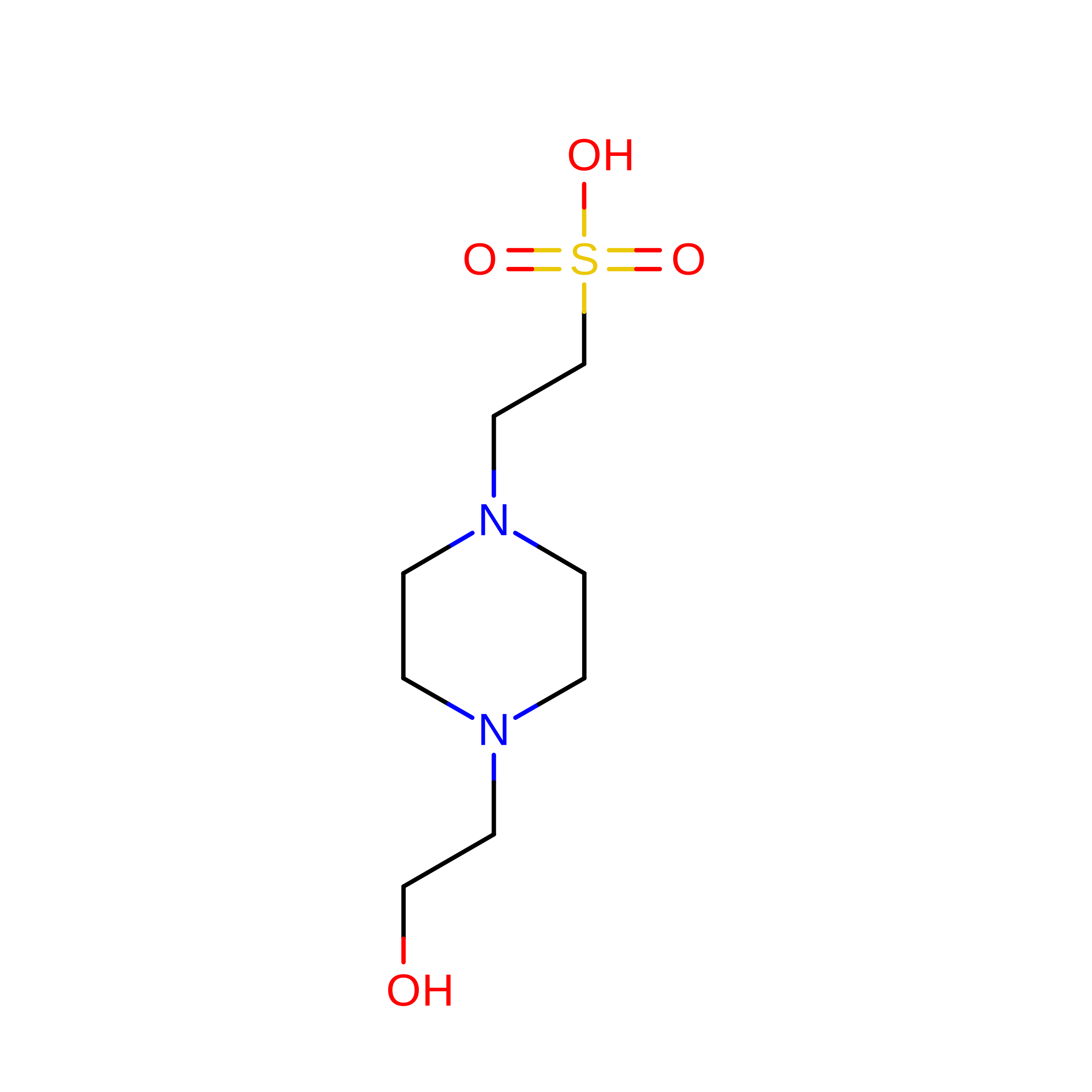
4-(2-HYDROXYETHYL)-1-PIPERAZINE ETHANESULFONIC ACID
C8 H18 N2 O4 S
JKMHFZQWWAIEOD-UHFFFAOYSA-N
PEG

Query on PEG


Download:Ideal Coordinates CCD File
F [auth A],
H [auth B]
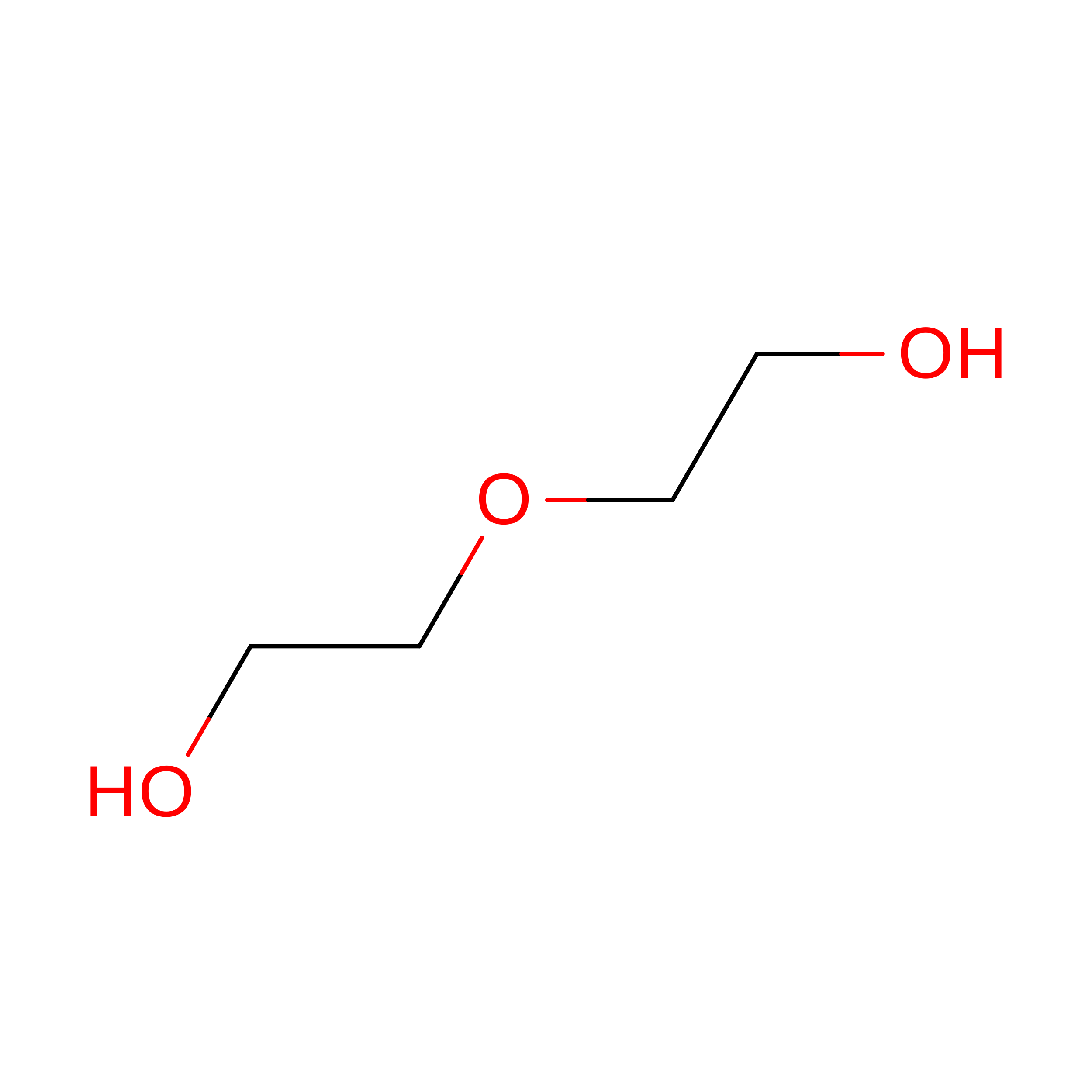
DI(HYDROXYETHYL)ETHER
C4 H10 O3
MTHSVFCYNBDYFN-UHFFFAOYSA-N
GOL

Query on GOL


Download:Ideal Coordinates CCD File
E [auth A]
G [auth B]
J [auth C]
L [auth D]
M [auth D]
E [auth A],
G [auth B],
J [auth C],
L [auth D],
M [auth D],
N [auth D]
GLYCEROL
C3 H8 O3
PEDCQBHIVMGVHV-UHFFFAOYSA-N

Experimental Data & Validation

Experimental Data

  • Method: X-RAY DIFFRACTION
  • Resolution: 1.90 Å
  • R-Value Free:  0.218 (Depositor), 0.230 (DCC) 
  • R-Value Work:  0.178 (Depositor), 0.193 (DCC) 
  • R-Value Observed: 0.180 (Depositor) 
Space Group: P 21 21 21
Unit Cell:
Length ( Å )Angle ( ˚ )
a = 78.182α = 90
b = 129.561β = 90
c = 129.702γ = 90
Software Package:
Software NamePurpose
HKL-2000data collection
PHASERphasing
REFMACrefinement
HKL-2000data reduction
HKL-2000data scaling

Structure Validation

View Full Validation Report


Entry History 

Deposition Data

Revision History  (Full details and data files)

  • Version 1.0: 2011-03-09
    Type: Initial release
  • Version 1.1: 2011-07-13
    Changes: Version format compliance
  • Version 1.2: 2013-06-19
    Changes: Database references
  • Version 1.3: 2014-10-15
    Changes: Structure summary
  • Version 1.4: 2024-11-27
    Changes: Data collection, Database references, Derived calculations, Structure summary