3P9H | pdb_00003p9h

Crystal structure of the TSG101 UEV domain in complex with FA258 peptide


Experimental Data Snapshot

  • Method: X-RAY DIFFRACTION
  • Resolution: 1.80 Å
  • R-Value Free: 
    0.253 (Depositor), 0.201 (DCC) 
  • R-Value Work: 
    0.211 (Depositor), 0.205 (DCC) 
  • R-Value Observed: 
    0.211 (Depositor) 

Starting Model: experimental
View more details

wwPDB Validation 3D Report Full Report

Validation slider image for 3P9H

This is version 1.3 of the entry. See complete history

Literature

Elucidation of New Binding Interactions with the Tumor Susceptibility Gene 101 (Tsg101) Protein Using Modified HIV-1 Gag-p6 Derived Peptide Ligands.

Kim, S.E.Liu, F.Im, Y.J.Stephen, A.G.Fivash, M.J.Waheed, A.A.Freed, E.O.Fisher, R.J.Hurley, J.H.Burke, T.R.

(2011) ACS Med Chem Lett 2: 337-341

  • DOI: https://doi.org/10.1021/ml1002579
  • Primary Citation Related Structures: 
    3P9G, 3P9H

  • PubMed Abstract: 

    Targeting protein-protein interactions is gaining greater recognition as an attractive approach to therapeutic development. An example of this may be found with the human cellular protein encoded by the tumor susceptibility gene 101 (Tsg101), where interaction with the p6 C-terminal domain of the nascent viral Gag protein is required for HIV-1 particle budding and release. This association of Gag with Tsg101 is highly dependent on a "Pro-Thr-Ala-Pro" ("PTAP") peptide sequence within the p6 protein. Although p6-derived peptides offer potential starting points for developing Tsg101-binding inhibitors, the affinities of canonical peptides are outside the useful range (K(d) values greater than 50 μM). Reported herein are crystal structures of Tsg101 in complex with two structurally-modified PTAP-derived peptides. This data define new regions of ligand interaction not previously identified with canonical peptide sequences. This information could be highly useful in the design of Tsg101-binding antagonists.


  • Organizational Affiliation
    • Chemical Biology Laboratory, Molecular, Discovery Program, CCR, NCI-Frederick, Frederick, MD 21702.

Macromolecule Content 

  • Total Structure Weight: 17.57 kDa 
  • Atom Count: 1,339 
  • Modeled Residue Count: 152 
  • Deposited Residue Count: 156 
  • Unique protein chains: 2

Macromolecules

Find similar proteins by:|  3D Structure
Entity ID: 1
MoleculeChains  Sequence LengthOrganismDetailsImage
Tumor susceptibility gene 101 protein145Homo sapiensMutation(s): 0 
Gene Names: TSG101
UniProt & NIH Common Fund Data Resources
Find proteins for Q99816 (Homo sapiens)
Explore Q99816 
Go to UniProtKB:  Q99816
PHAROS:  Q99816
GTEx:  ENSG00000074319 
Entity Groups
Sequence Clusters30% Identity50% Identity70% Identity90% Identity95% Identity100% Identity
UniProt GroupQ99816
Sequence Annotations
Expand
Reference Sequence
Find similar proteins by:  Sequence   |   3D Structure  
Entity ID: 2
MoleculeChains  Sequence LengthOrganismDetailsImage
Gag polyprotein11N/AMutation(s): 0 
UniProt
Find proteins for Q9YP46 (Human immunodeficiency virus type 1)
Explore Q9YP46 
Go to UniProtKB:  Q9YP46
Entity Groups
Sequence Clusters30% Identity50% Identity70% Identity90% Identity95% Identity100% Identity
UniProt GroupQ9YP46
Sequence Annotations
Expand
Reference Sequence

Small Molecules

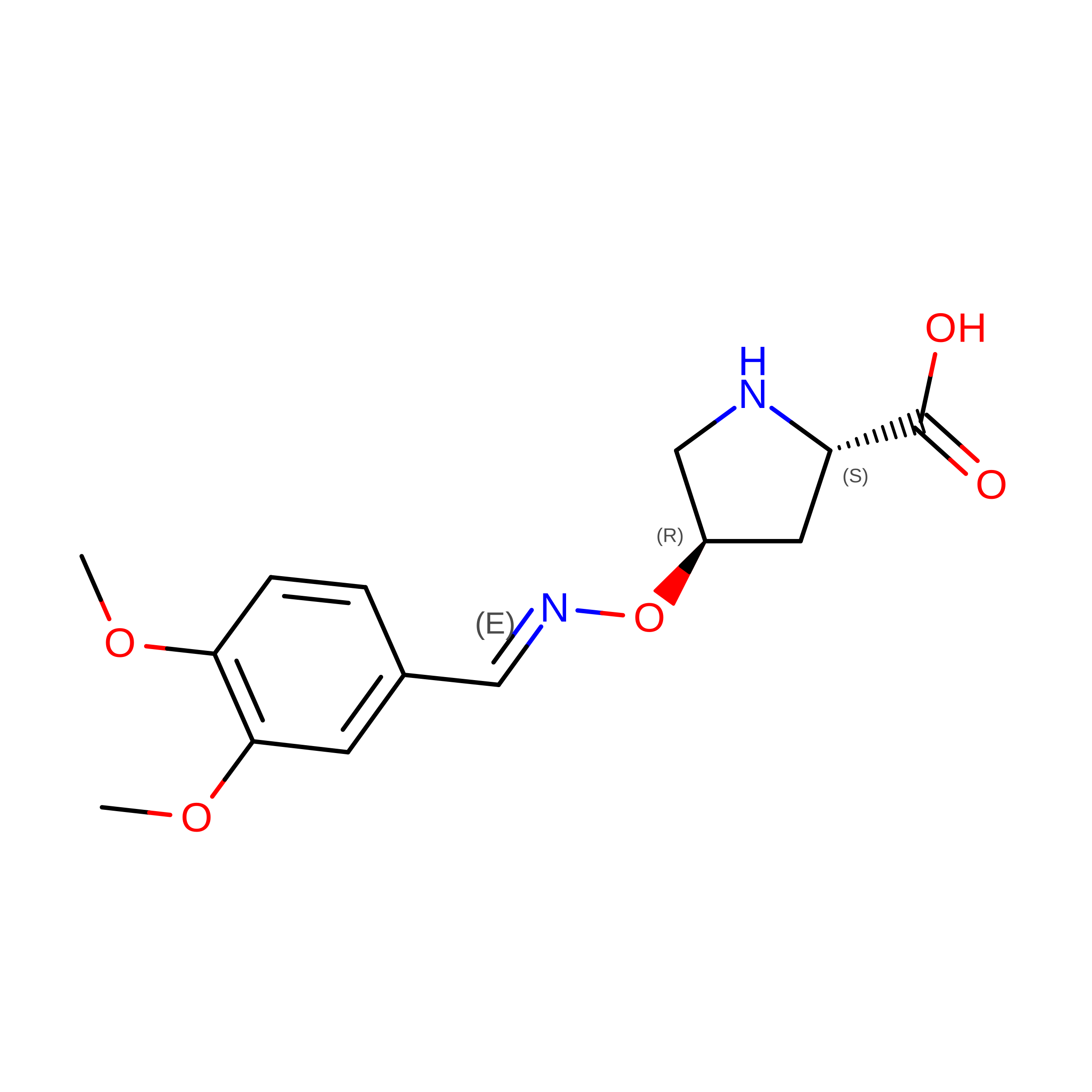
Modified Residues  1 Unique
IDChains TypeFormula2D DiagramParent
ZYJ
Query on ZYJ
B
L-PEPTIDE LINKINGC14 H18 N2 O5PRO

Experimental Data & Validation

Experimental Data

  • Method: X-RAY DIFFRACTION
  • Resolution: 1.80 Å
  • R-Value Free:  0.253 (Depositor), 0.201 (DCC) 
  • R-Value Work:  0.211 (Depositor), 0.205 (DCC) 
  • R-Value Observed: 0.211 (Depositor) 
Space Group: P 21 21 21
Unit Cell:
Length ( Å )Angle ( ˚ )
a = 33.697α = 90
b = 45.797β = 90
c = 85.387γ = 90
Software Package:
Software NamePurpose
StructureStudiodata collection
MOLREPphasing
CNSrefinement
HKL-2000data reduction
HKL-2000data scaling

Structure Validation

View Full Validation Report


Entry History 

Deposition Data

Revision History  (Full details and data files)

  • Version 1.0: 2011-06-29
    Type: Initial release
  • Version 1.1: 2011-07-13
    Changes: Version format compliance
  • Version 1.2: 2023-09-06
    Changes: Data collection, Database references, Derived calculations, Refinement description
  • Version 1.3: 2023-12-06
    Changes: Data collection