3P74 | pdb_00003p74

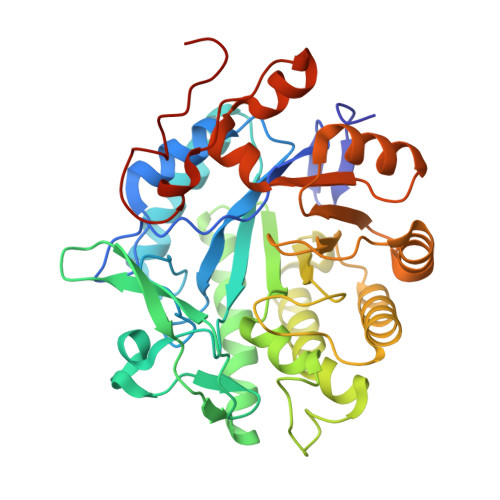
H181N mutant of pentaerythritol tetranitrate reductase containing a C-terminal His8-tag


Experimental Data Snapshot

  • Method: X-RAY DIFFRACTION
  • Resolution: 1.20 Å
  • R-Value Free: 
    0.159 (Depositor), 0.169 (DCC) 
  • R-Value Work: 
    0.136 (Depositor), 0.146 (DCC) 
  • R-Value Observed: 
    0.137 (Depositor) 

wwPDB Validation 3D Report Full Report

Validation slider image for 3P74

Ligand Structure Quality Assessment 


This is version 1.2 of the entry. See complete history

Literature

A Site-Saturated Mutagenesis Study of Pentaerythritol Tetranitrate Reductase Reveals that Residues 181 and 184 Influence Ligand Binding, Stereochemistry and Reactivity.

Toogood, H.S.Fryszkowska, A.Hulley, M.Sakuma, M.Mansell, D.Stephens, G.M.Gardiner, J.M.Scrutton, N.S.

(2011) Chembiochem 12: 738-749

  • DOI: https://doi.org/10.1002/cbic.201000662
  • Primary Citation Related Structures: 
    3P74, 3P7Y, 3P80, 3P81, 3P82

  • PubMed Abstract: 

    We have conducted a site-specific saturation mutagenesis study of H181 and H184 of flavoprotein pentaerythritol tetranitrate reductase (PETN reductase) to probe the role of these residues in substrate binding and catalysis with a variety of α,β-unsaturated alkenes. Single mutations at these residues were sufficient to dramatically increase the enantiopurity of products formed by reduction of 2-phenyl-1-nitropropene. In addition, many mutants exhibited a switch in reactivity to predominantly catalyse nitro reduction, as opposed to CC reduction. These mutants showed an enhancement in a minor side reaction and formed 2-phenylpropanal oxime from 2-phenyl-1-nitropropene. The multiple binding conformations of hydroxy substituted nitro-olefins in PETN reductase were examined by using both structural and catalytic techniques. These compounds were found to bind in both active and inhibitory complexes; this highlights the plasticity of the active site and the ability of the H181/H184 couple to coordinate with multiple functional groups. These properties demonstrate the potential to use PETN reductase as a scaffold in the development of industrially useful biocatalysts.


  • Organizational Affiliation
    • Faculty of Life Sciences, University of Manchester, 131 Princess Street, Manchester M1 7DN, UK. helen.toogood@manchester.ac.uk

Macromolecule Content 

  • Total Structure Weight: 41.07 kDa 
  • Atom Count: 3,495 
  • Modeled Residue Count: 363 
  • Deposited Residue Count: 373 
  • Unique protein chains: 1

Macromolecules

Find similar proteins by:|  3D Structure
Entity ID: 1
MoleculeChains  Sequence LengthOrganismDetailsImage
Pentaerythritol tetranitrate reductase373Enterobacter cloacaeMutation(s): 1 
Gene Names: onrPETNR
EC: 1.6.99.1
UniProt
Find proteins for P71278 (Enterobacter cloacae)
Explore P71278 
Go to UniProtKB:  P71278
Entity Groups
Sequence Clusters30% Identity50% Identity70% Identity90% Identity95% Identity100% Identity
UniProt GroupP71278
Sequence Annotations
Expand
Reference Sequence

Small Molecules

Ligands 1 Unique
IDChains Name / Formula / InChI Key2D Diagram3D Interactions
FMN

Query on FMN


Download:Ideal Coordinates CCD File
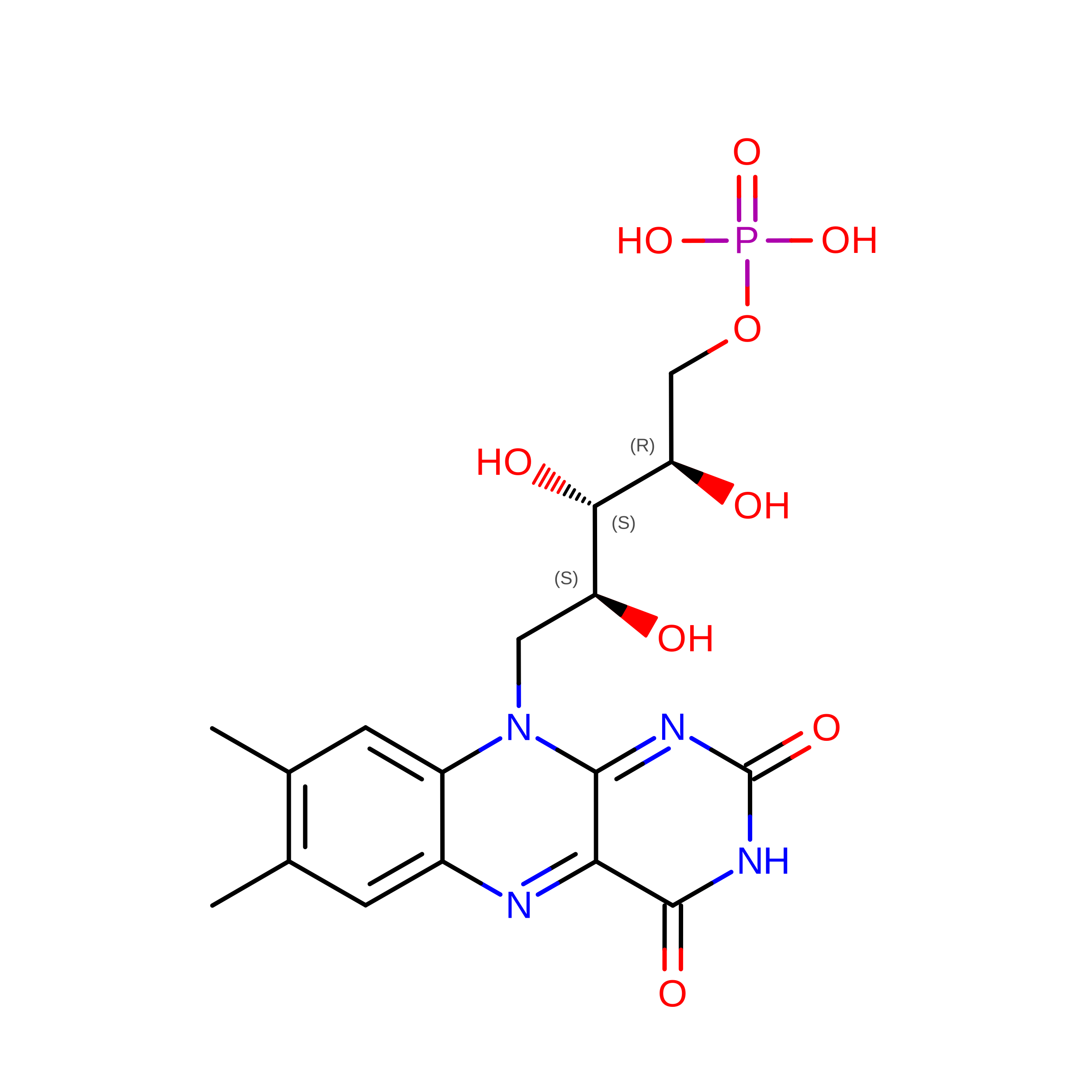
B [auth A]FLAVIN MONONUCLEOTIDE
C17 H21 N4 O9 P
FVTCRASFADXXNN-SCRDCRAPSA-N

Experimental Data & Validation

Experimental Data

  • Method: X-RAY DIFFRACTION
  • Resolution: 1.20 Å
  • R-Value Free:  0.159 (Depositor), 0.169 (DCC) 
  • R-Value Work:  0.136 (Depositor), 0.146 (DCC) 
  • R-Value Observed: 0.137 (Depositor) 
Space Group: P 21 21 21
Unit Cell:
Length ( Å )Angle ( ˚ )
a = 59.119α = 90
b = 69.086β = 90
c = 88.623γ = 90
Software Package:
Software NamePurpose
MOSFLMdata reduction
SCALAdata scaling
MOLREPphasing
REFMACrefinement
PDB_EXTRACTdata extraction
ADSCdata collection

Structure Validation

View Full Validation Report


Ligand Structure Quality Assessment 


Entry History 

Deposition Data

Revision History  (Full details and data files)

  • Version 1.0: 2011-03-23
    Type: Initial release
  • Version 1.1: 2011-07-13
    Changes: Version format compliance
  • Version 1.2: 2024-02-21
    Changes: Data collection, Database references, Derived calculations